Market Articles / 28 Sept 2026
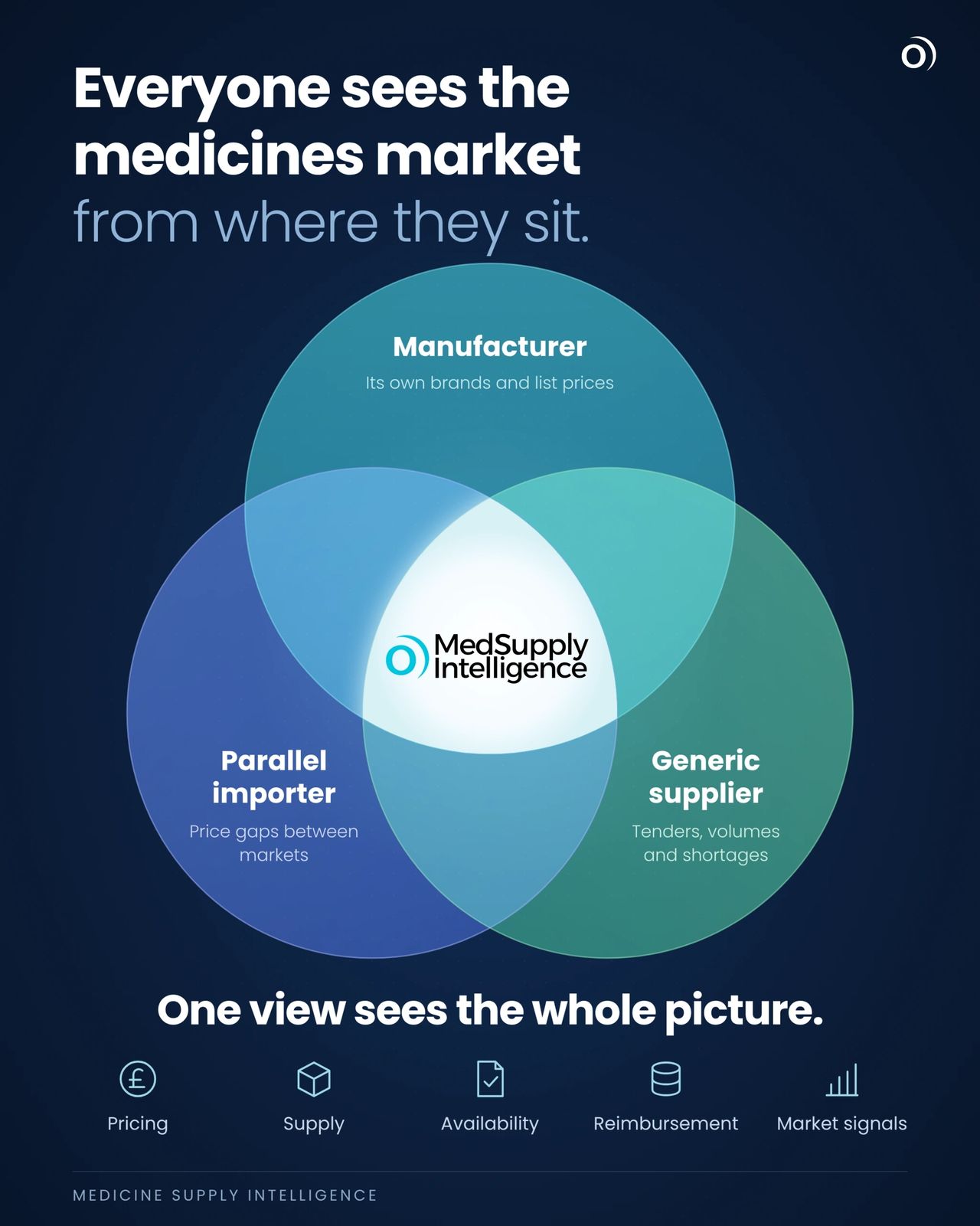
Ask a manufacturer what's happening with a medicine and you'll get one answer. Ask a parallel importer and you'll get another. Ask a generic supplier, a wholesaler or a community pharmacist, and you'll hear something different again.
Read insight→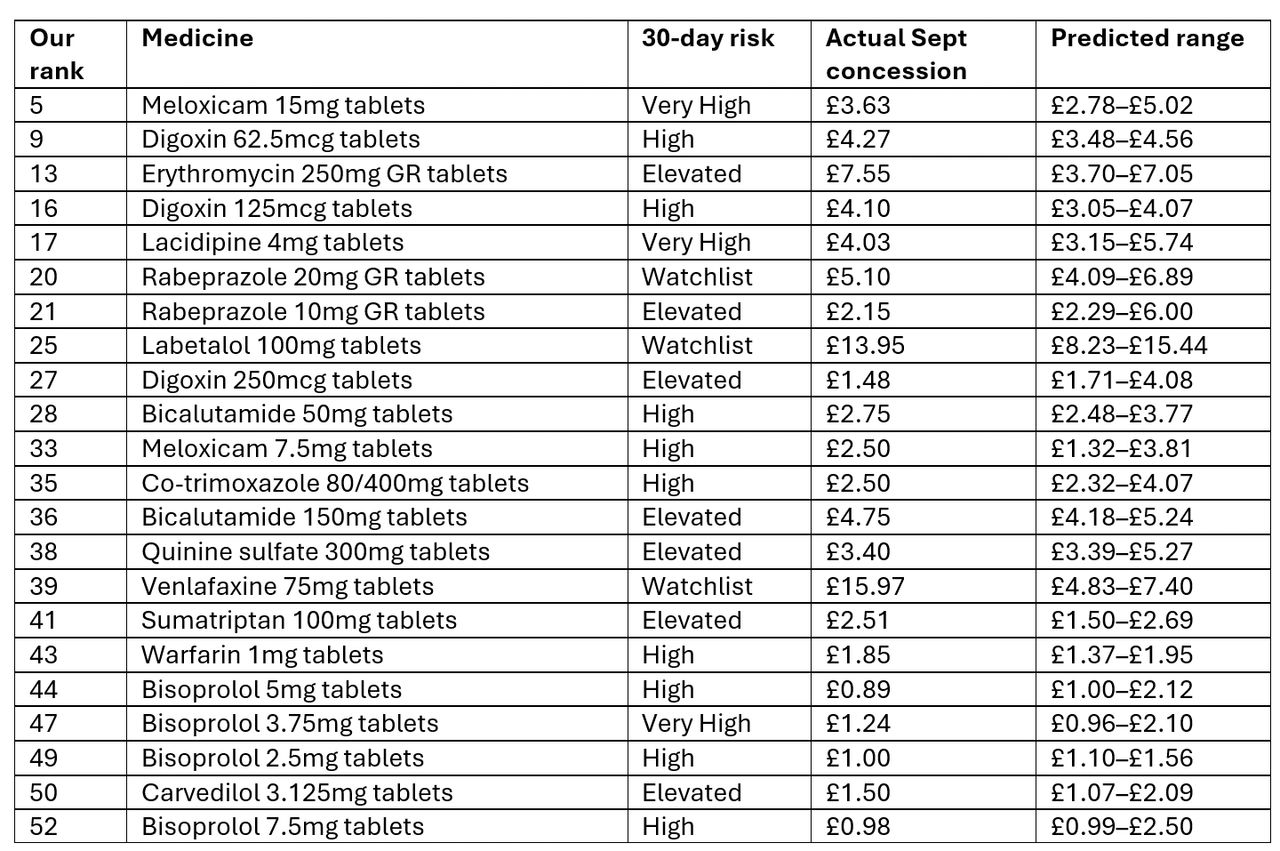
Market Articles / 16 Sept 2026
When the first set of September 2026 price concessions was announced on 16 September, we did something simple but important: we checked our own homework in public.
Read insight→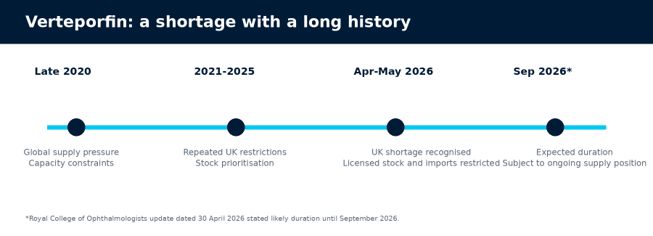
Product Insights / 14 Sept 2026
Verteporfin
When a formal shortage alert appears, it is easy to treat that moment as the beginning of the problem. Verteporfin shows why that can be misleading. The UK shortage recognised in spring 2026 was part of a much longer period of constrained global supply, with pressure around this specialist ophthalmology medicine extending back several years.
Read insight→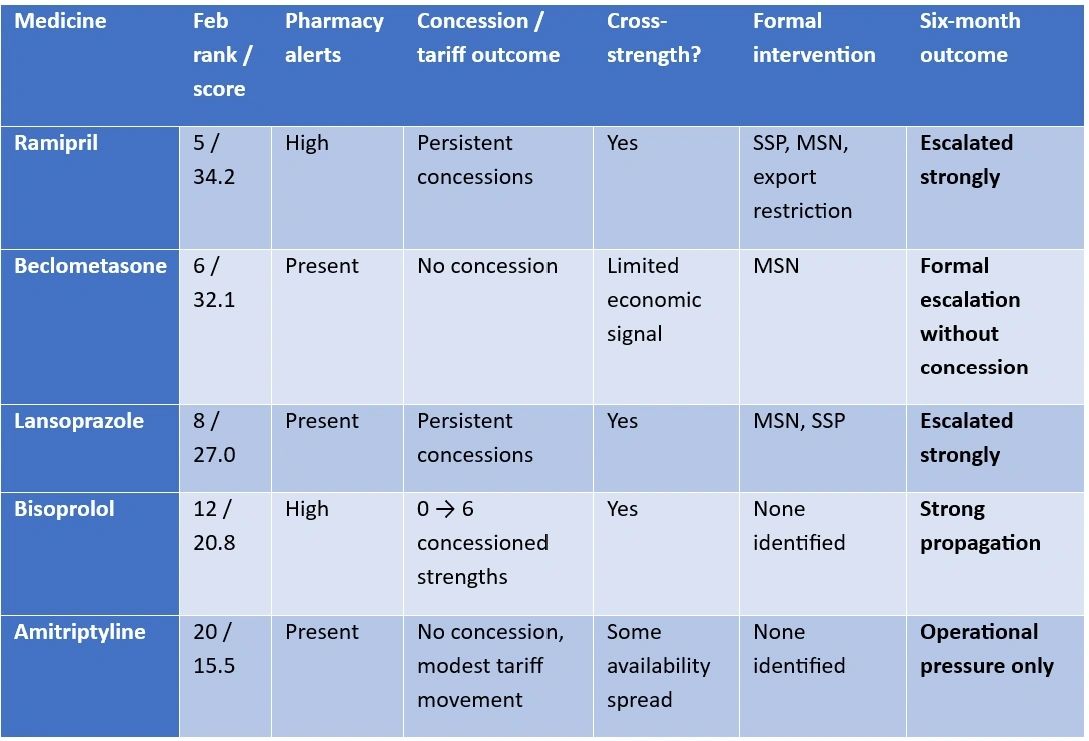
Market Articles / 10 Sept 2026
In February 2026, iethico assessed twenty of England's most prescribed medicines for supply-chain vulnerability and ranked them according to the degree of underlying strain visible at that point in time.
Read insight→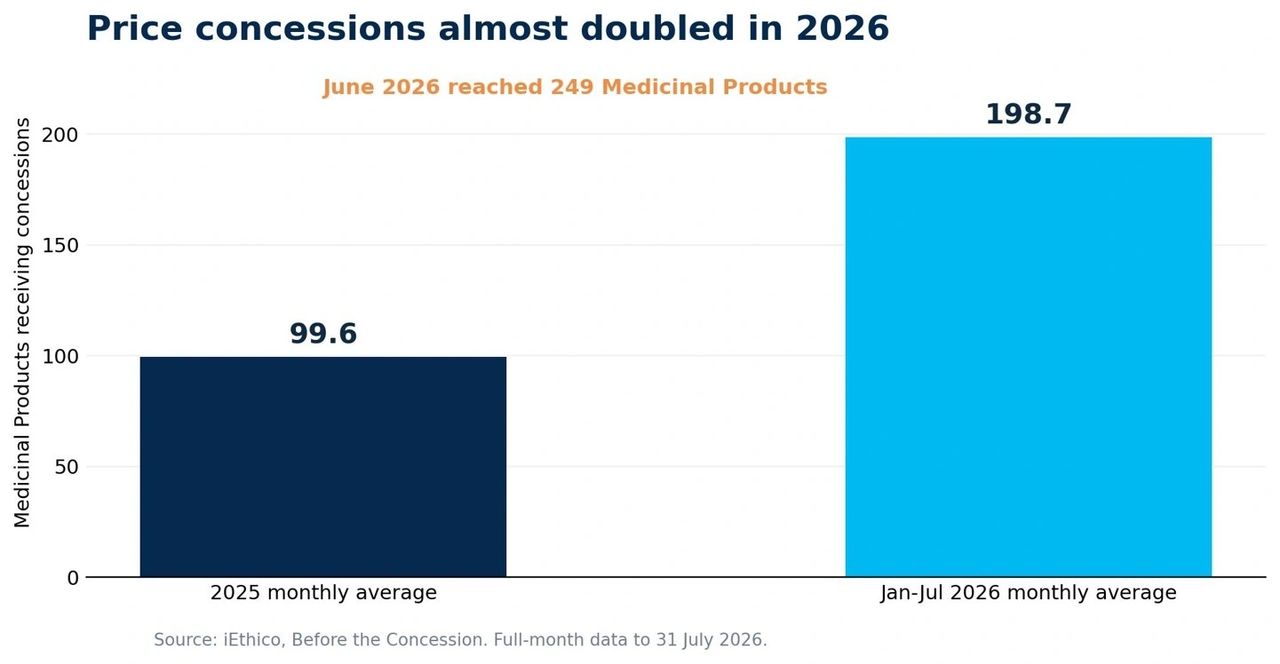
Market Articles / 8 Sept 2026
A price concession exists because, for a particular medicine in a particular month, the standard Drug Tariff reimbursement price is no longer adequately reflecting prevailing market conditions.
Read insight→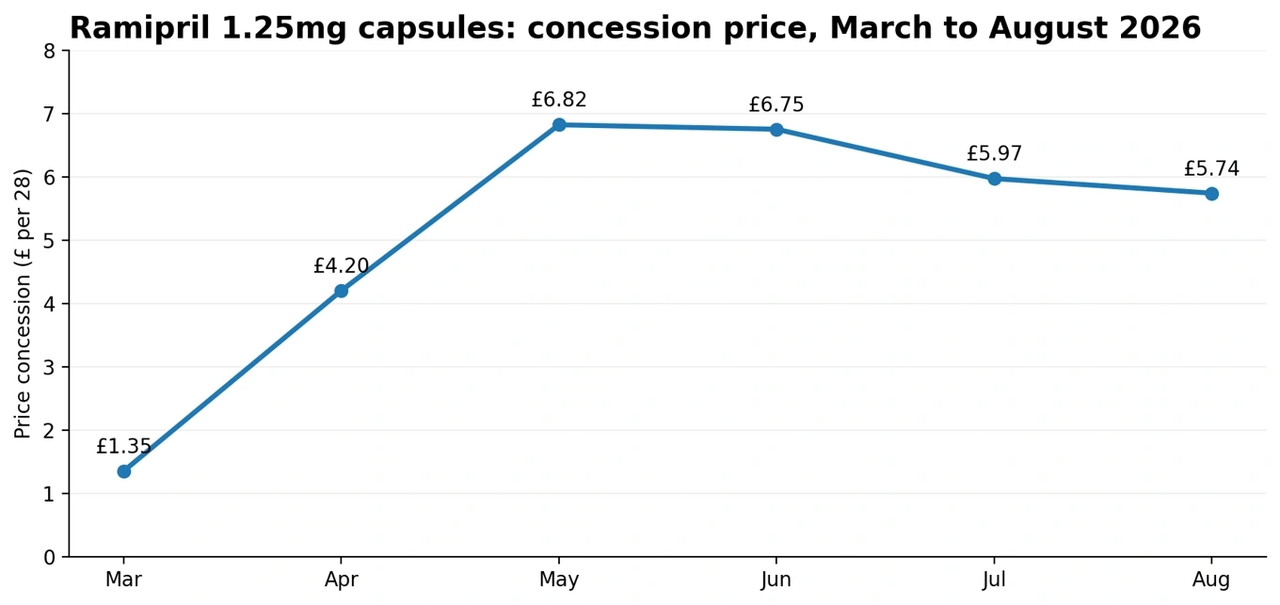
Product Insights / 7 Sept 2026
Ramipril
What Ramipril tells us about the difference between a shortage event and a developing market pattern
Read insight→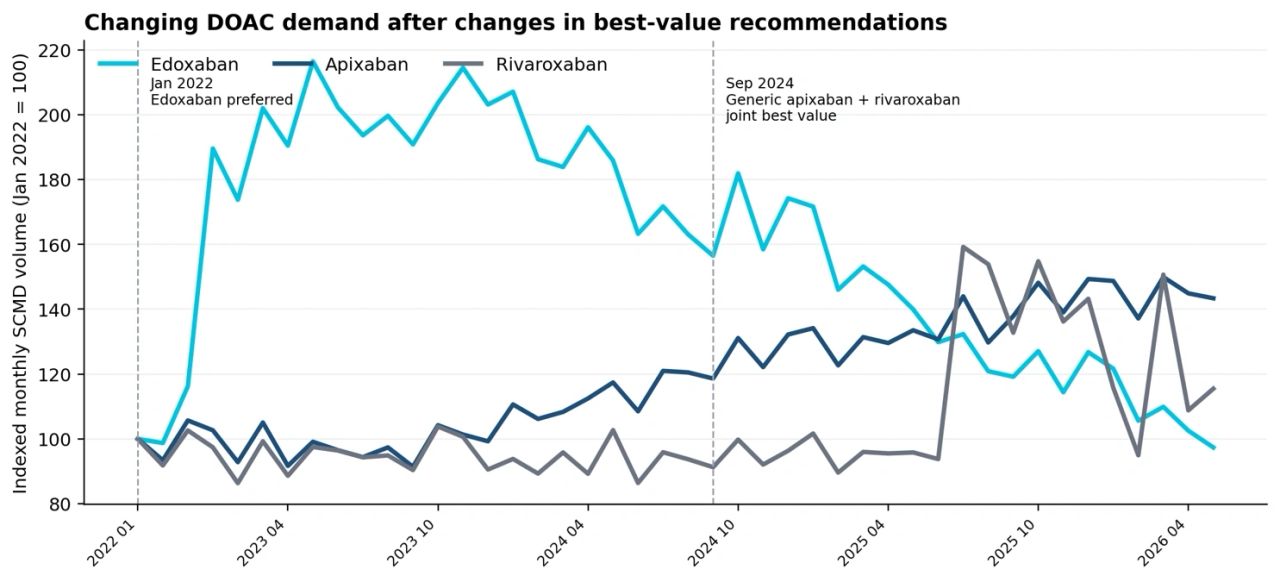
Product Insights / 1 Sept 2026
Edoxaban
14 April 2026: highlighted to iethico subscribers | 1 September 2026: DHSC Tier 2 Medicine Supply Notification
Read insight→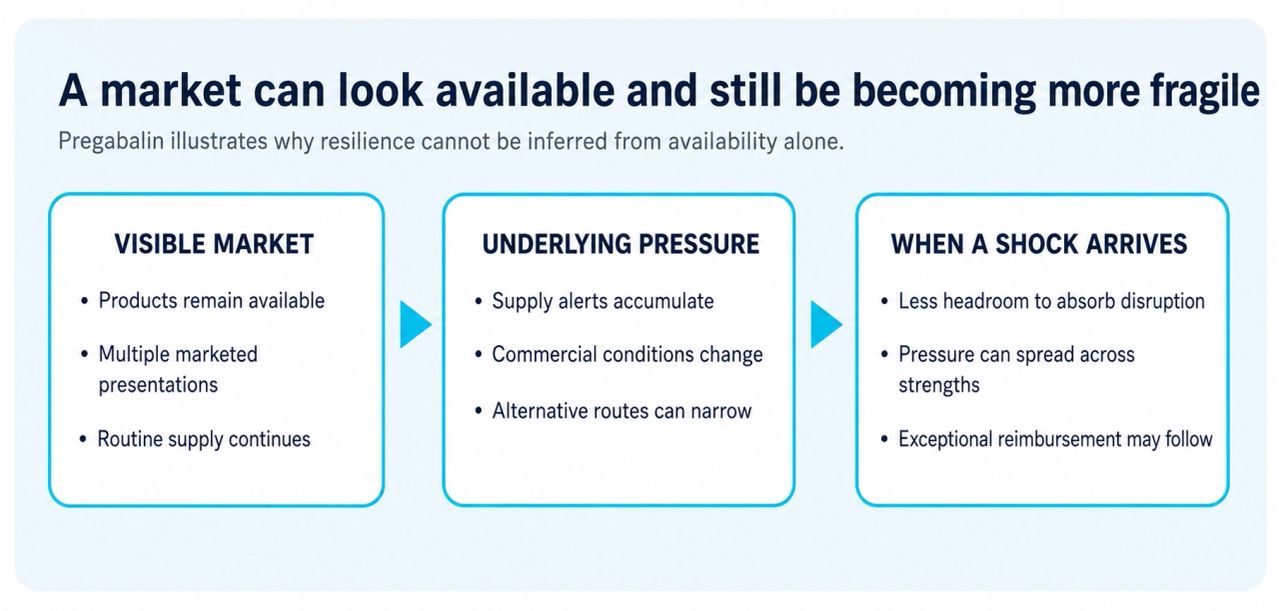
Product Insights / 28 Aug 2026
Pregabalin
Not every medicine supply risk begins with an obvious shortage. Some begin while products are still moving through the supply chain, pharmacies can still obtain stock and the market appears, at first sight, to be functioning normally. The more difficult question is whether that apparent availability is being supported by a market with enough resilience to ab
Read insight→
Product Insights / 21 Aug 2026
Sumatriptan
Medicine supply disruption can appear sudden when viewed from the point at which it becomes widely visible. A shortage notification is published, pharmacies struggle to source stock or prices move sharply, and the market appears to have changed almost overnight.
Read insight→
Product Insights / 13 Jul 2026
Duloxetine
A conceptual view of how the same supply event becomes visible at different points in the medicines supply chain.
Read insight→Perspectives / 19 Jun 2026
Debra Ainge
Medicines shortages attract attention because they are visible. Patients are affected. Pharmacists spend time sourcing alternatives. Procurement teams look for stock. Healthcare organisations implement contingency plans.
Read insight→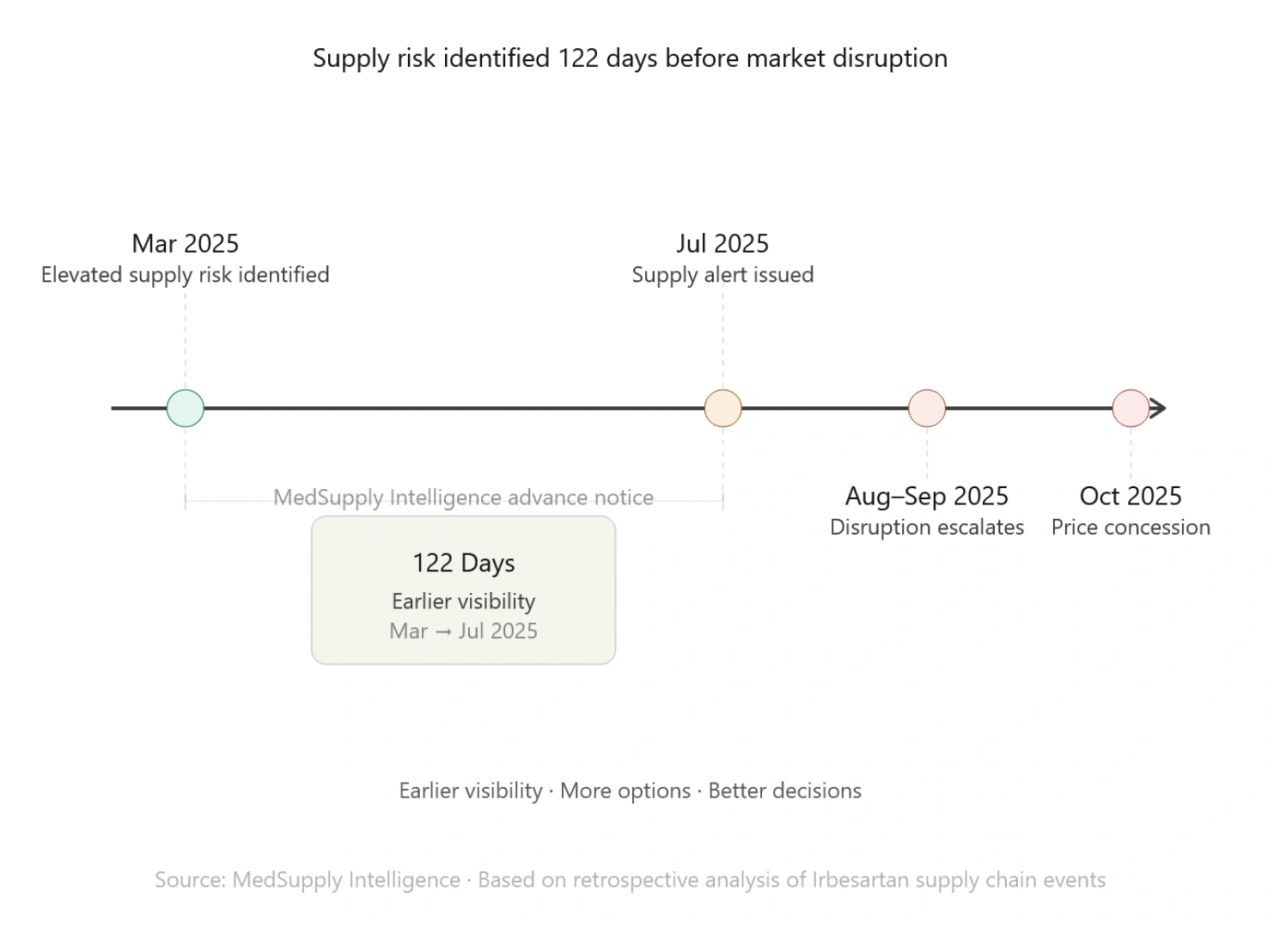
Product Insights / 13 Jun 2026
Irbesartan
Irbesartan provides an example of how supply disruption develops long before it becomes widely recognised.
Read insight→Perspectives / 13 Jun 2026
Renee Kalia
The challenge for procurement teams is not seeing that a product has become unavailable. By that stage, the market is already reacting.
Read insight→Product Insights / 10 Apr 2026
Candesartan
At the time, acquisition costs remained relatively stable at approximately £0.33 per pack and supply remained available through normal channels.
Read insight→Product Insights / 24 Mar 2026
Meglumine amidotrizoate
Meglumine amidotrizoate (Gastrografin, Urografin) - The Early Signals Behind a Global Shortage
Read insight→Product Insights / 24 Mar 2026
Pemetrexed
Pemetrexed is not currently classified as a formal shortage in the UK. On that basis, it would be reasonable to assume that supply is broadly stable.
Read insight→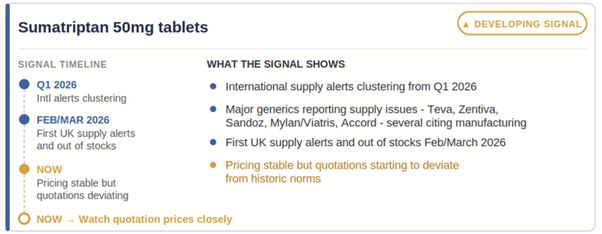
Product Insights / 23 Mar 2026
Sumatriptan
International shortage notifications and supply alerts around sumatriptan tablets have been building across multiple countries for months before significant UK market disruption has become visible.
Read insight→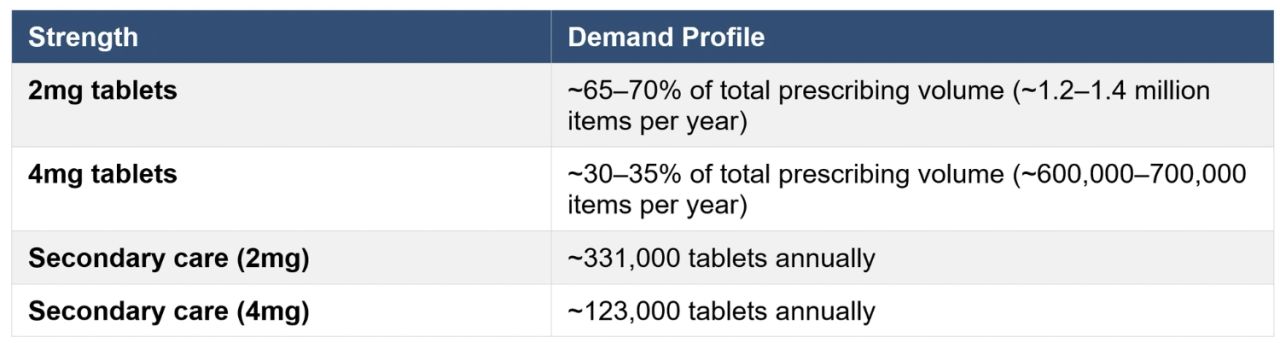
Product Insights / 9 Mar 2026
Tizanidine
Tizanidine is a mature generic molecule used in the management of spasticity, with stable, well-established prescribing across both primary and secondary care in England. For much of its history as a generic, it has been an unremarkable market. That is beginning to change. A pattern of supply signals - emerging first across European markets and now visible w
Read insight→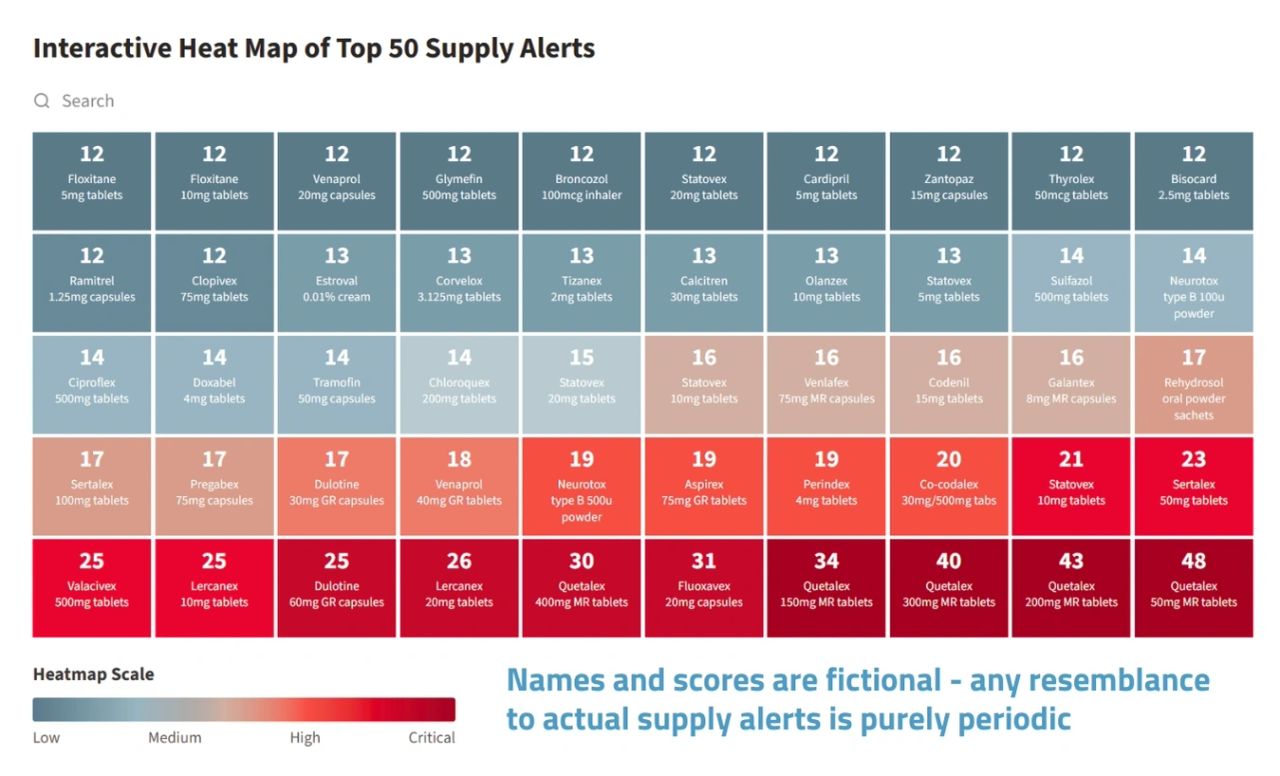
Perspectives / 9 Mar 2026
Debra Ainge
In the spirit of British Science Week, our resident chemist-turned-data-analyst discovers that the best supply chain visualisations have a suspicious amount in common with Mendeleev's finest work.
Read insight→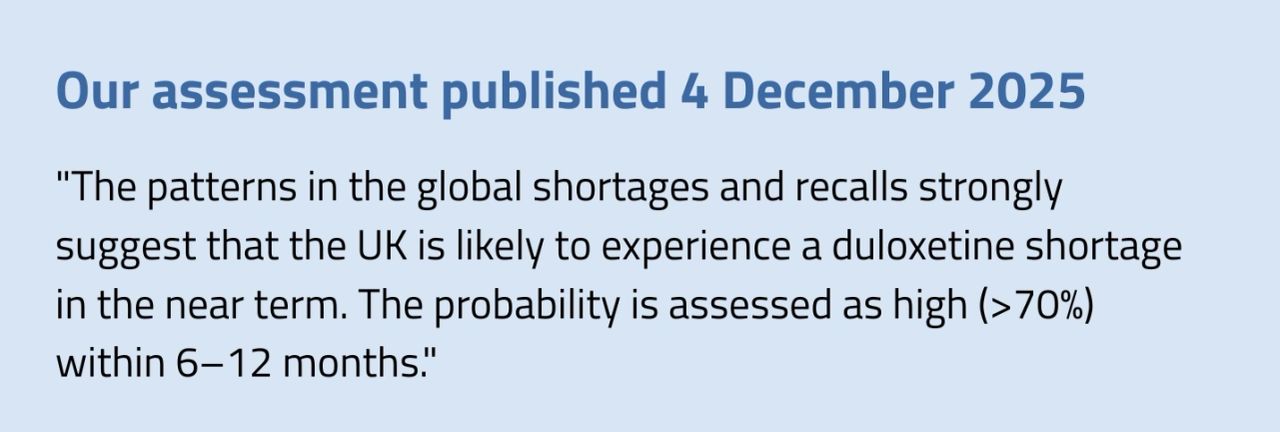
Product Insights / 6 Mar 2026
Duloxetine
Three months ago, our data signalled an emerging supply disruption. The platform data now confirms it.
Read insight→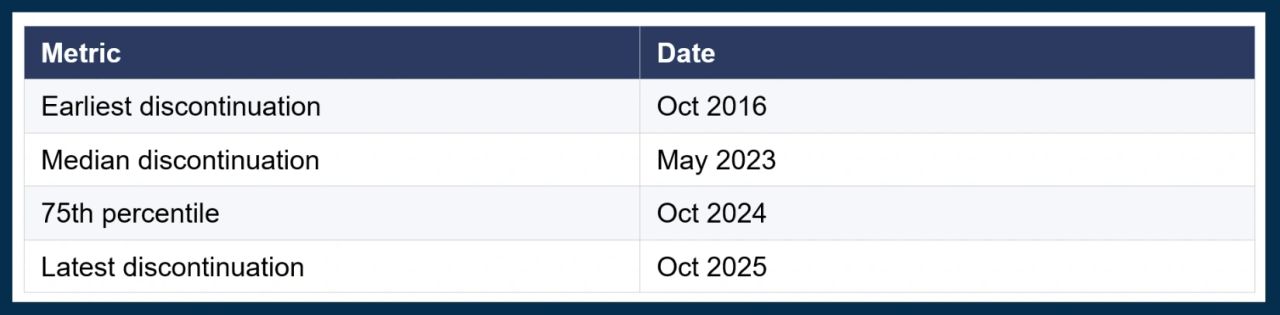
Product Insights / 6 Mar 2026
Pregabalin
In early 2025, the UK market for pregabalin capsules appeared stable. Average prices were close to £1 per pack and the molecule had a large historical supplier base. To most observers, supply looked secure.
Read insight→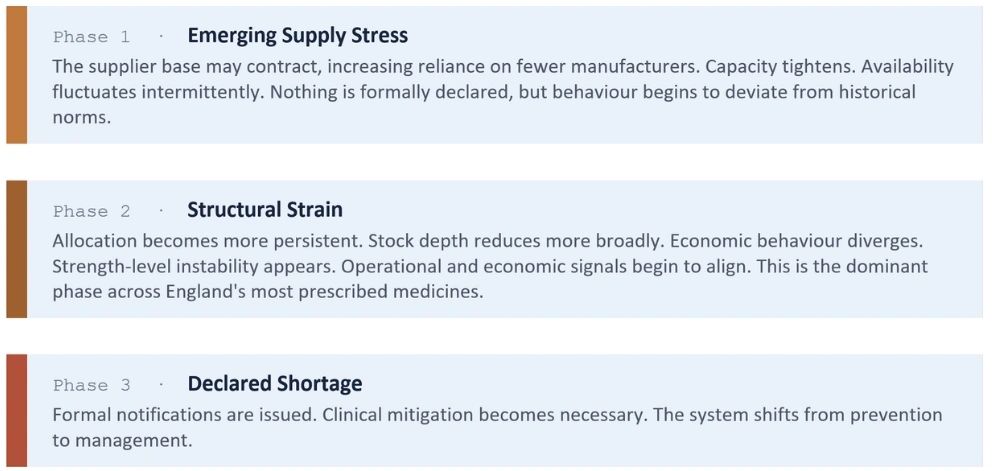
Product Insights / 4 Mar 2026
Recent parliamentary scrutiny - including the House of Lords inquiry into medicines supply resilience - has understandably focused on how we define a shortage. Clear definitions are important. They allow reporting, benchmarking and accountability. They give policymakers and system leaders a common language.
Read insight→
Product Insights / 4 Mar 2026
Atorvastatin
How international alerts, pricing drift and margin compression unfolded quietly - before most teams were watching.
Read insight→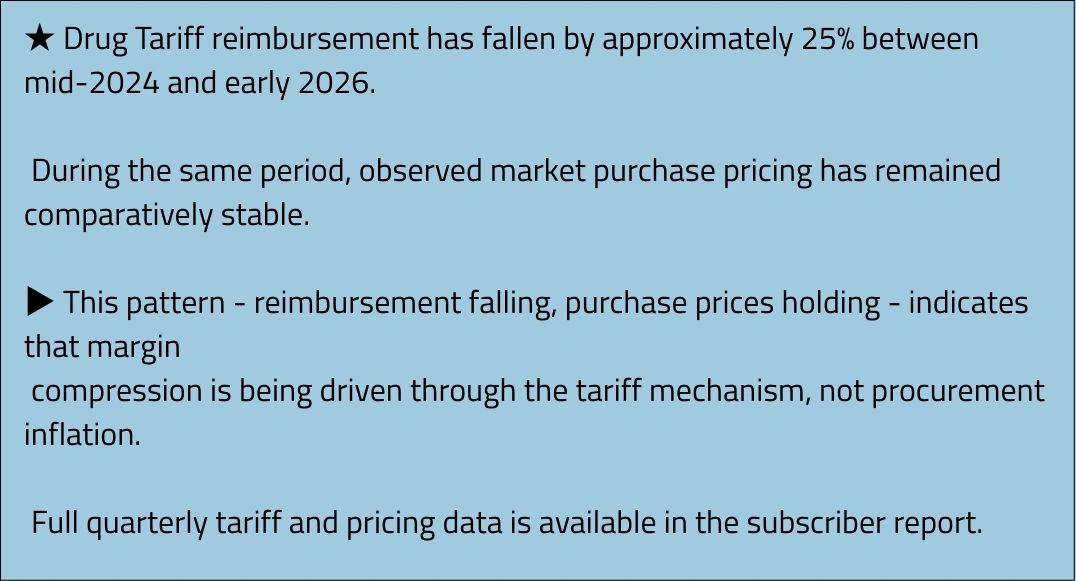
Product Insights / 3 Mar 2026
Tranexamic acid
Tranexamic acid is one of the UK's most prescribed haemostatic agents. Familiar, affordable, and deeply embedded in both primary and secondary care pathways - it rarely attracts attention.
Read insight→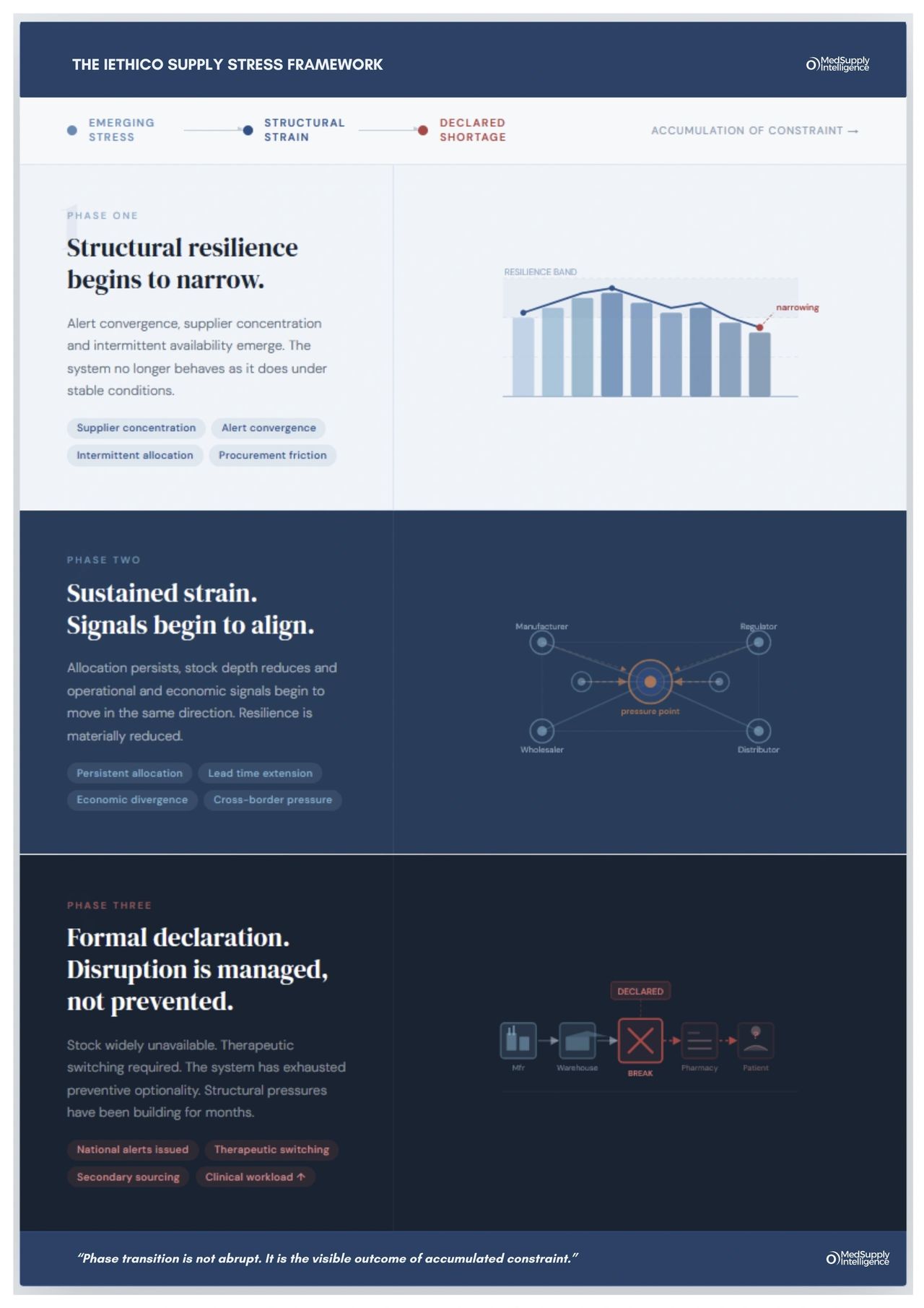
Market Articles / 27 Feb 2026
Recent parliamentary scrutiny, including the House of Lords inquiry into medicine supply resilience, has called for a more consistent definition of a "shortage."
Read insight→Product Insights / 26 Feb 2026
Oxazepam
In December, we analysed the UK oxazepam market and concluded that it was entering a high-risk phase.
Read insight→Product Insights / 25 Feb 2026
Amiodarone
Medicine shortages rarely begin at the point of formal declaration. More often, the declaration marks the moment when structural strain becomes impossible to ignore.
Read insight→Product Insights / 25 Feb 2026
Paliperidone
Paliperidone 100mg/1ml prolonged-release suspension for injection does not look unstable at first glance in the UK.
Read insight→Product Insights / 25 Feb 2026
Sertraline
Sertraline has moved beyond routine generic market volatility into a more sustained supply pressure pattern.
Read insight→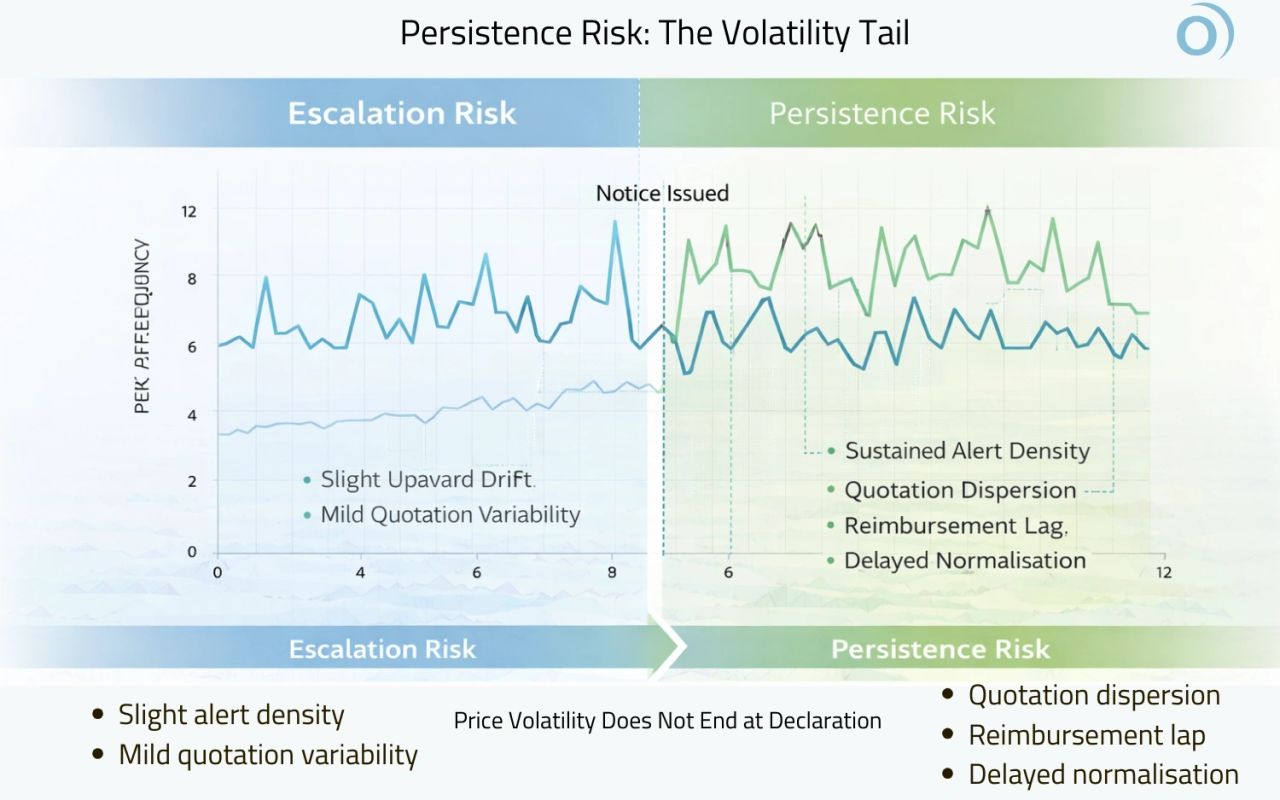
Product Insights / 24 Feb 2026
Amiodarone
To truly manage risk in medicine supply chains, it's essential to look beyond official notices and understand the entire lifecycle of disruptions—before, during, and long after they're announced.
Read insight→
Product Insights / 24 Feb 2026
Lercanidipine
Official notices are lagging indicators of medicine supply issues. By the time a formal alert is issued, the market has already been under stress for some time. The real story unfolds earlier, visible in the widening gap between reimbursement tariffs and actual wholesale costs. Lercanidipine, a widely prescribed hypertension treatment, is currently providing
Read insight→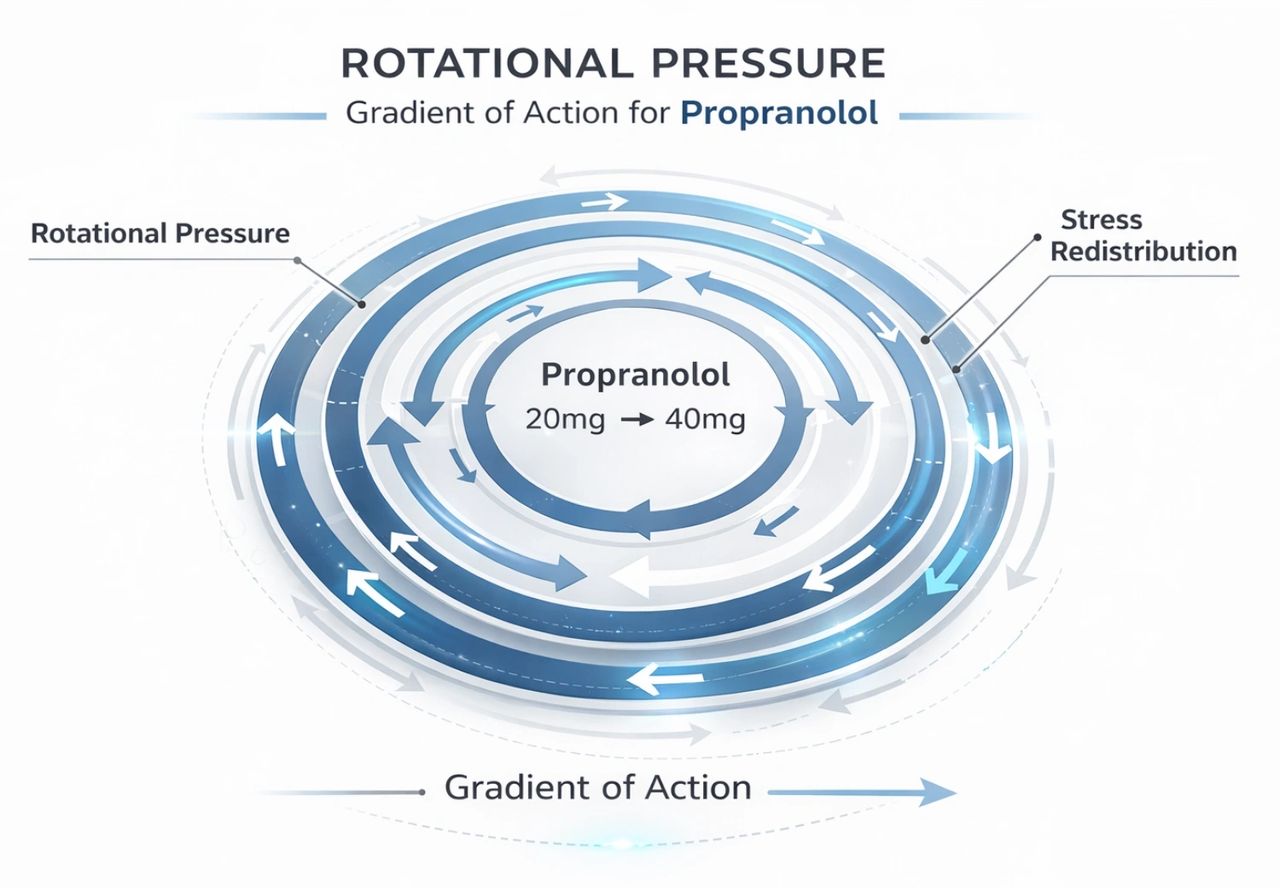
Product Insights / 21 Feb 2026
Propranolol
In November 2025, we examined the emerging instability in Propranolol modified-release (MR) products. At the time, the disruption appeared concentrated in specific MR strengths.
Read insight→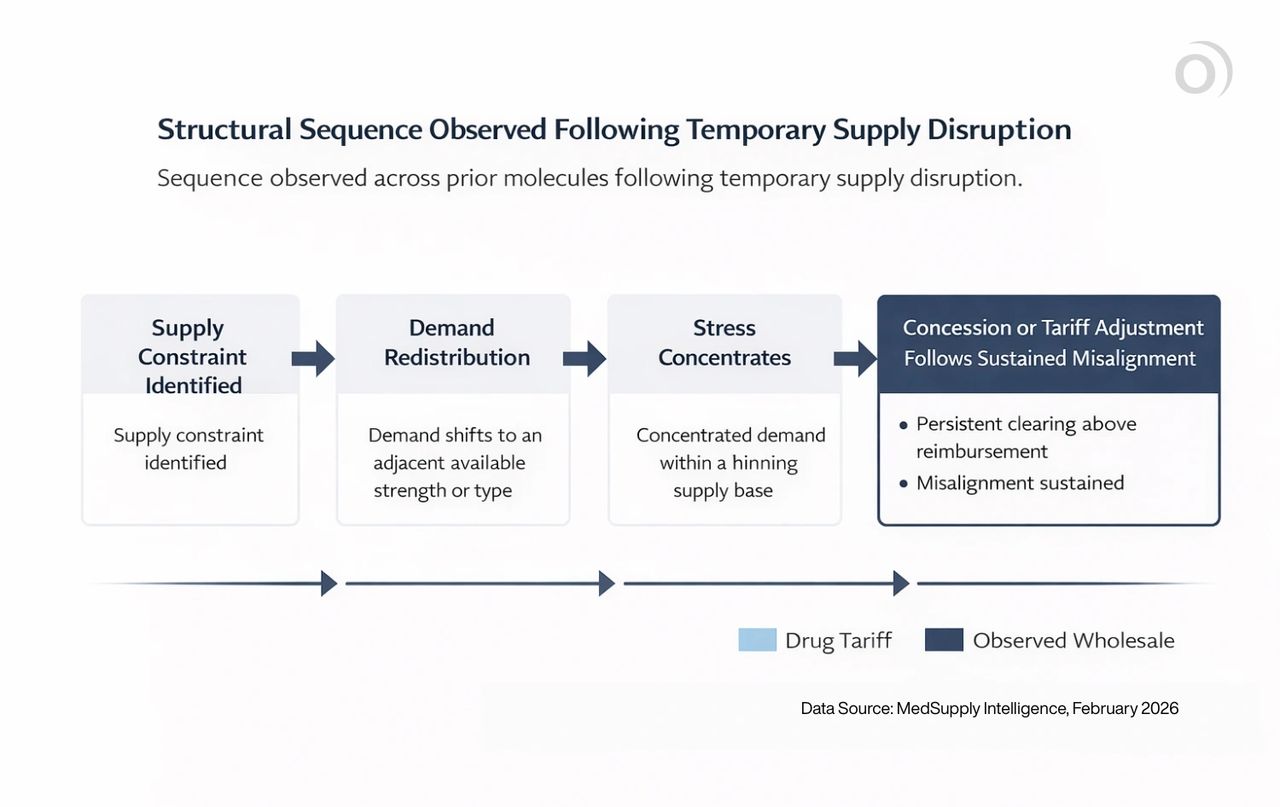
Product Insights / 21 Feb 2026
Valaciclovir
In June 2025, a temporary shortage of Valaciclovir 250mg tablets was announced in the UK, linked to production and quality issues affecting the branded product, Valtrex (GSK). By January 2026, the shortage was formally resolved.
Read insight→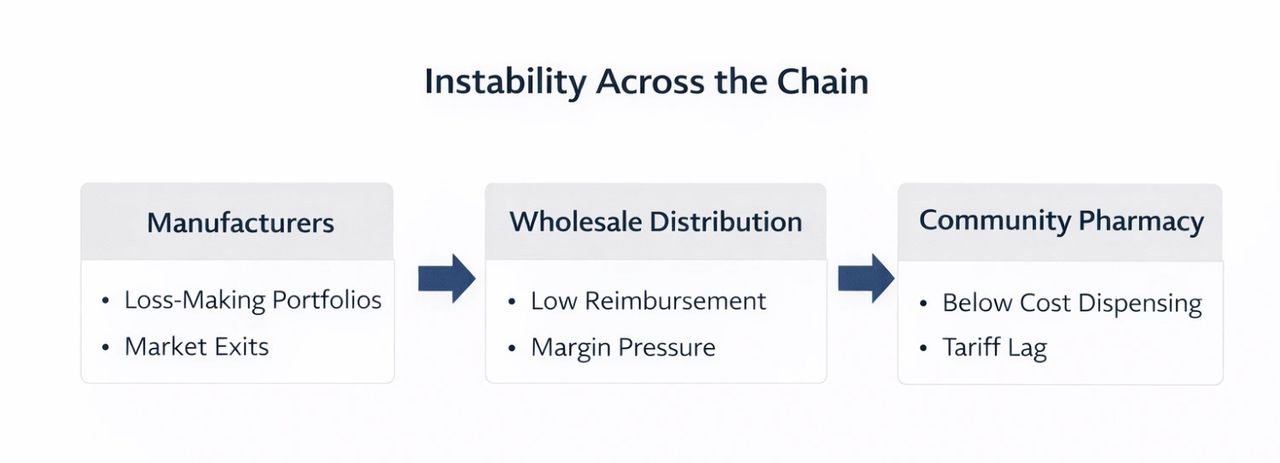
Market Articles / 20 Feb 2026
When a branded product loses patent protection, competition drives prices down rapidly, often by 80 to 90 percent. That mechanism has delivered substantial savings to healthcare systems over decades and remains one of the most powerful cost containment tools in modern medicine. The UK has benefited significantly from this model, building one of the lowest pr
Read insight→Perspectives / 19 Feb 2026
Renee Kalia
Most medicine shortages are not sudden events. They are the foreseeable outcome of sustained price compression, narrowing supplier participation, and shifting market behaviour that form long before availability is affected.
Read insight→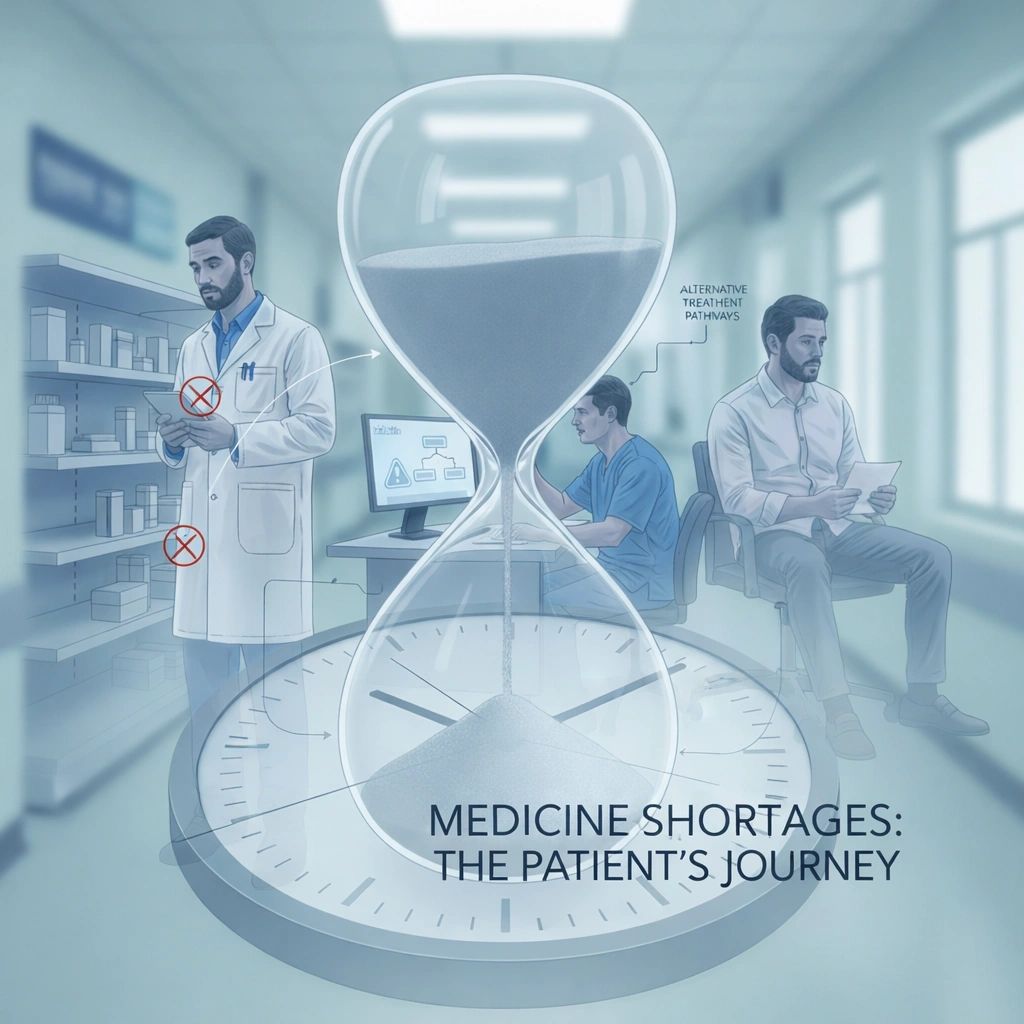
Perspectives / 19 Feb 2026
Neil G (Guest)
From the outside, a medicines shortage can look like a simple inconvenience. A prescription delayed. A trip to another pharmacy. A suggestion to “try elsewhere”.
Read insight→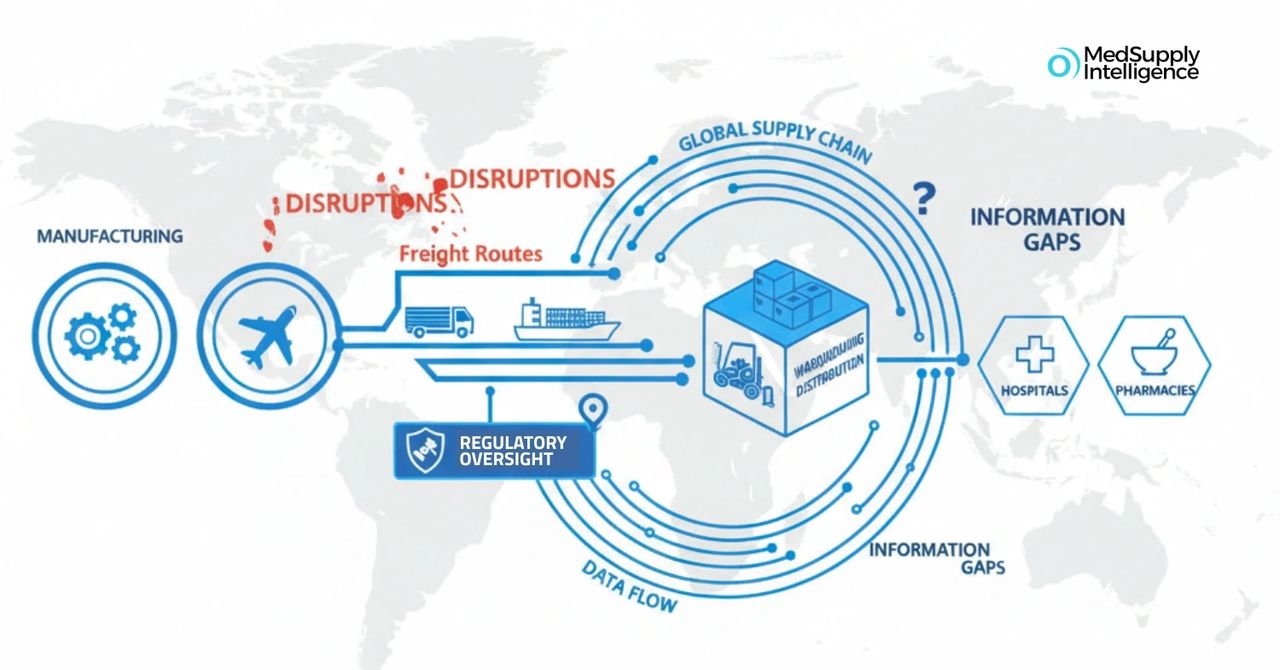
Market Articles / 17 Feb 2026
When medicines shortages are discussed publicly, the focus is usually on manufacturing disruption, API supply or global freight routes.
Read insight→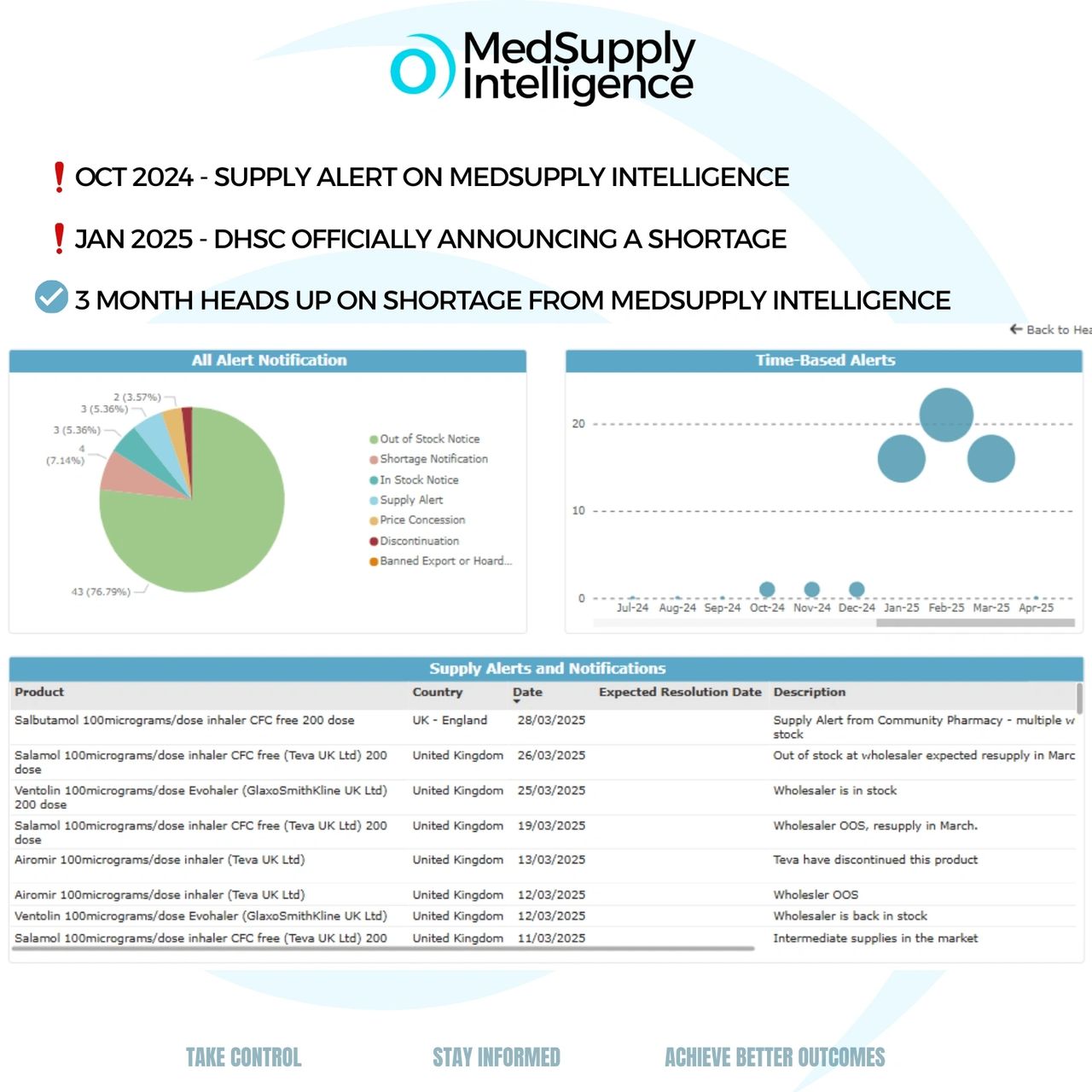
Market Articles / 16 Feb 2026
Understanding how real-time market intelligence is reshaping comparator sourcing strategy in clinical trials.
Read insight→Product Insights / 16 Feb 2026
Lercanidipine
There is currently no official shortage notice for Lercanidipine 10mg or 20mg. The market has seen no national supply alert and no formal escalation. Yet, market signals indicate an elevated near-term risk, and the supply chain is already behaving as though a concession is inevitable.
Read insight→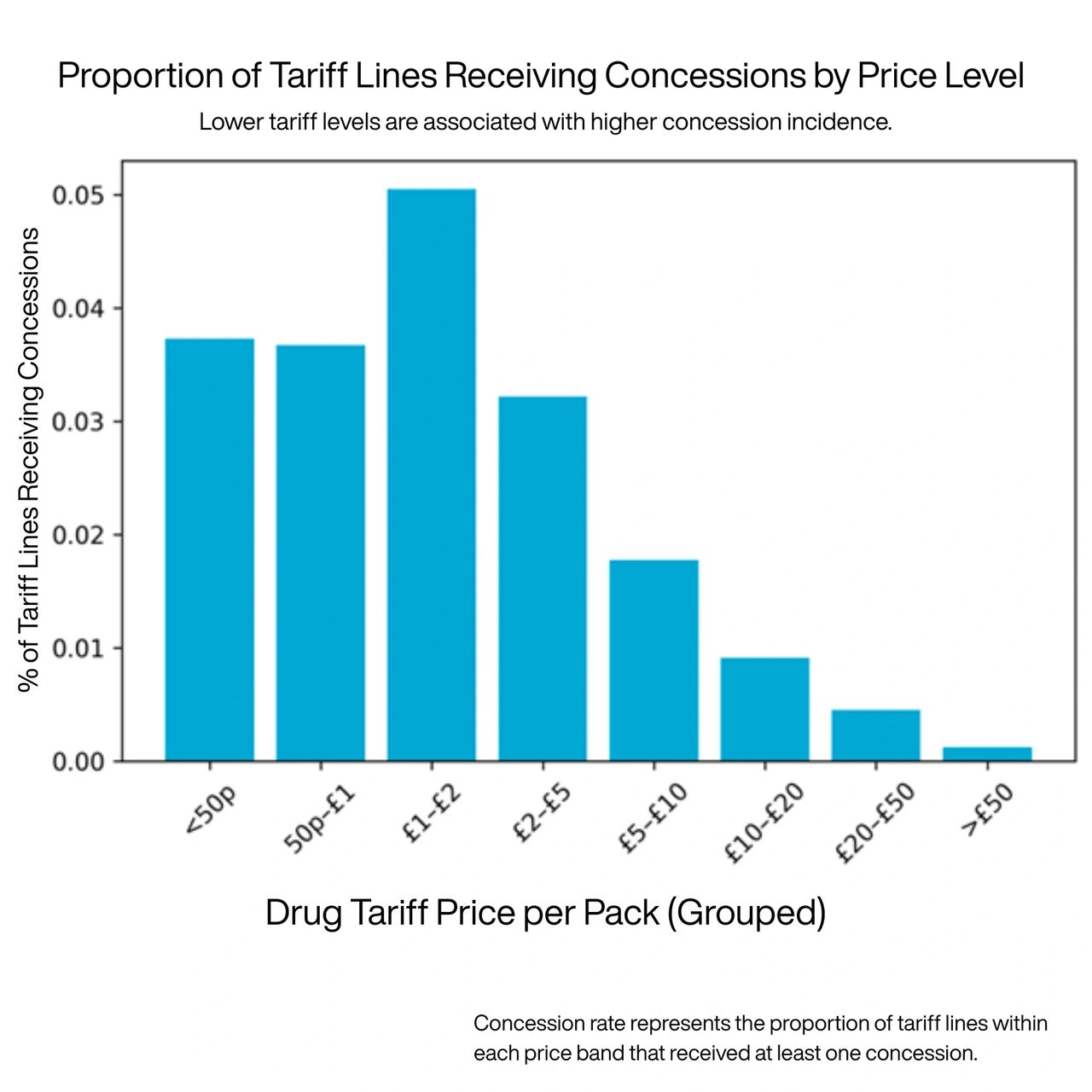
Market Articles / 13 Feb 2026
Drug Tariff concessions are presented as temporary administrative corrections, issued when medicines cannot be sourced at the published tariff price.
Read insight→Perspectives / 13 Feb 2026
Debra Ainge
When we discuss medicine shortages, the conversation inevitably turns to price. We talk about concessions, inflation, and procurement reform. When the evidence is examined across economic modelling, front-line pharmacist testimony and parliamentary scrutiny, a different conclusion becomes clear.
Read insight→Product Insights / 10 Feb 2026
Fluoxetine
Fluoxetine is one of the most established medicines in modern mental healthcare. It is widely prescribed, long off-patent, and assumed to be low risk from a supply perspective.
Read insight→Product Insights / 5 Feb 2026
Rosuvastatin
This analysis is not an attempt to “call” a shortage into existence. The events described here have already occurred. This is a post-event analysis.
Read insight→Market Articles / 5 Feb 2026
Recent proposals to revive inactive medicine licences in the UK are a welcome sign that policymakers are recognising a growing problem: medicines that should be available to patients, are quietly disappearing from the market.
Read insight→Market Articles / 3 Feb 2026
Early 2026 has continued a familiar trend in the pharmaceutical sector: voluntary recalls of imported generic medicines, with a significant proportion linked to overseas manufacturing. While none of the most recent recalls have resulted in immediate shortages, they reinforce long-standing concerns about supply chain resilience and quality oversight in a syst
Read insight→
Perspectives / 2 Feb 2026
Debra Ainge
Over the past few months, I’ve had a series of conversations with specialist wholesalers and unlicensed importers working across the UK and Europe.
Read insight→Perspectives / 2 Feb 2026
Renee Kalia
Community pharmacies often make the same observation during a shortage cycle: “As soon as a price concession is granted, the medicine suddenly becomes available.”
Read insight→Perspectives / 30 Jan 2026
Matt Johnson (Guest)
From the outside, Jersey can look insulated - a small island, separate government, different health system. In reality, when it comes to medicines supply, we are more exposed than almost anywhere else.
Read insight→Market Articles / 28 Jan 2026
At the JPMorgan Healthcare Conference, the headlines focused on drug pricing deals and cautious optimism for 2026. But beneath the surface conversations, a far bigger issue dominated executive thinking.
Read insight→
Perspectives / 27 Jan 2026
Debra Ainge
This perspective reflects themes consistently raised by senior leaders across UK wholesale distribution. It is not an argument for higher prices in isolation-but for a system that no longer mistakes fragility for efficiency.
Read insight→Perspectives / 25 Jan 2026
Adeel Sarwar (Guest)
For those of us working in primary care, medicines supply problems are no longer occasional disruptions. They are a constant operational pressure, shaping how pharmacies function, how prescribers work, and how patients experience the system.
Read insight→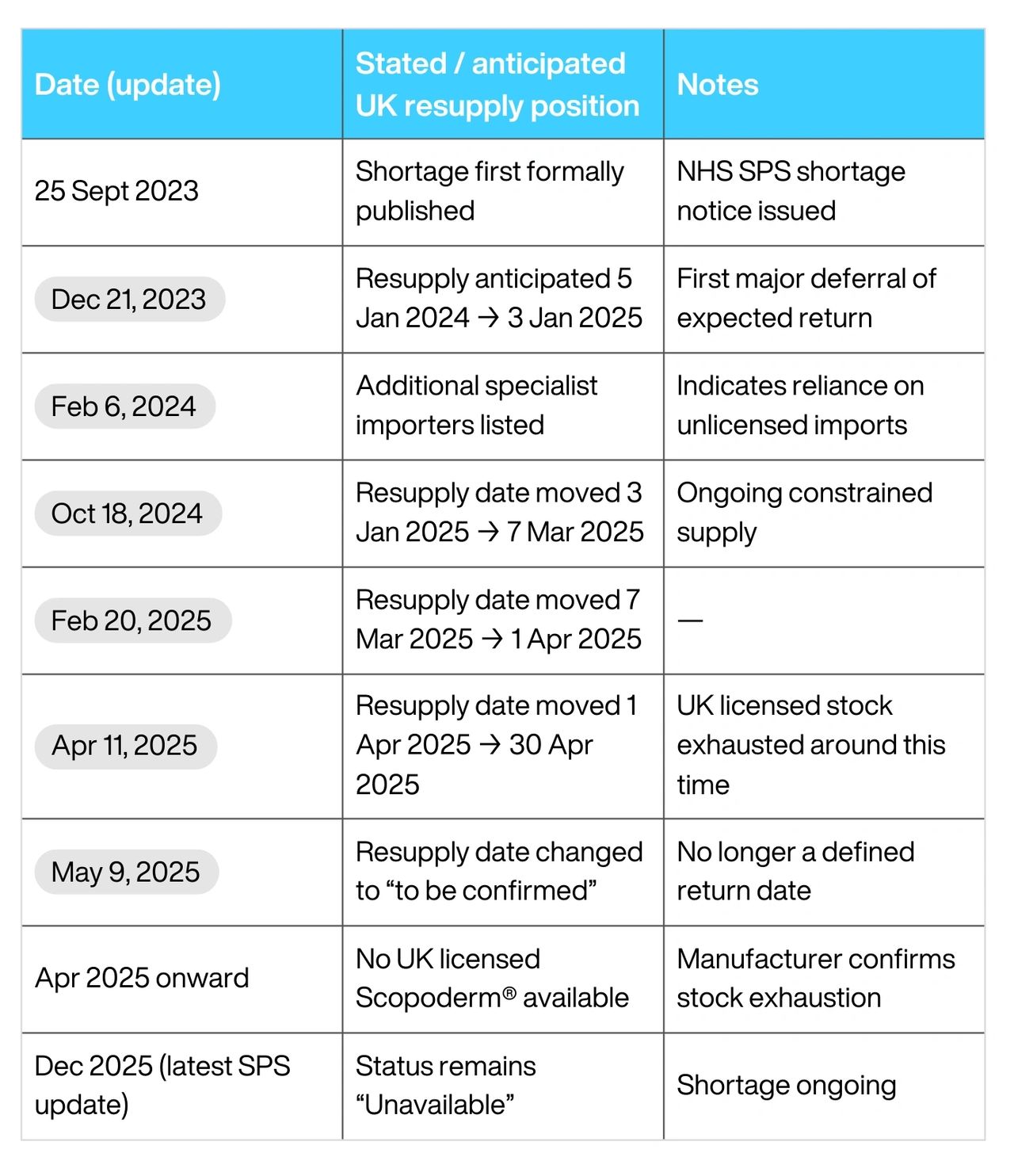
Product Insights / 23 Jan 2026
Scopoderm / Hyoscine hydrobromide
The prolonged UK shortage of Scopoderm® (hyoscine hydrobromide) transdermal patches is often framed as a discrete supply disruption. In practice, it reveals something more consequential: how sustained instability can reshape prescribing behaviour long before a medicine disappears entirely.
Read insight→Market Articles / 22 Jan 2026
Medicine supply problems are no longer rare, isolated events. For community pharmacy, they have become a constant operational reality quietly absorbing time, cash flow, workforce capacity, and patient trust.
Read insight→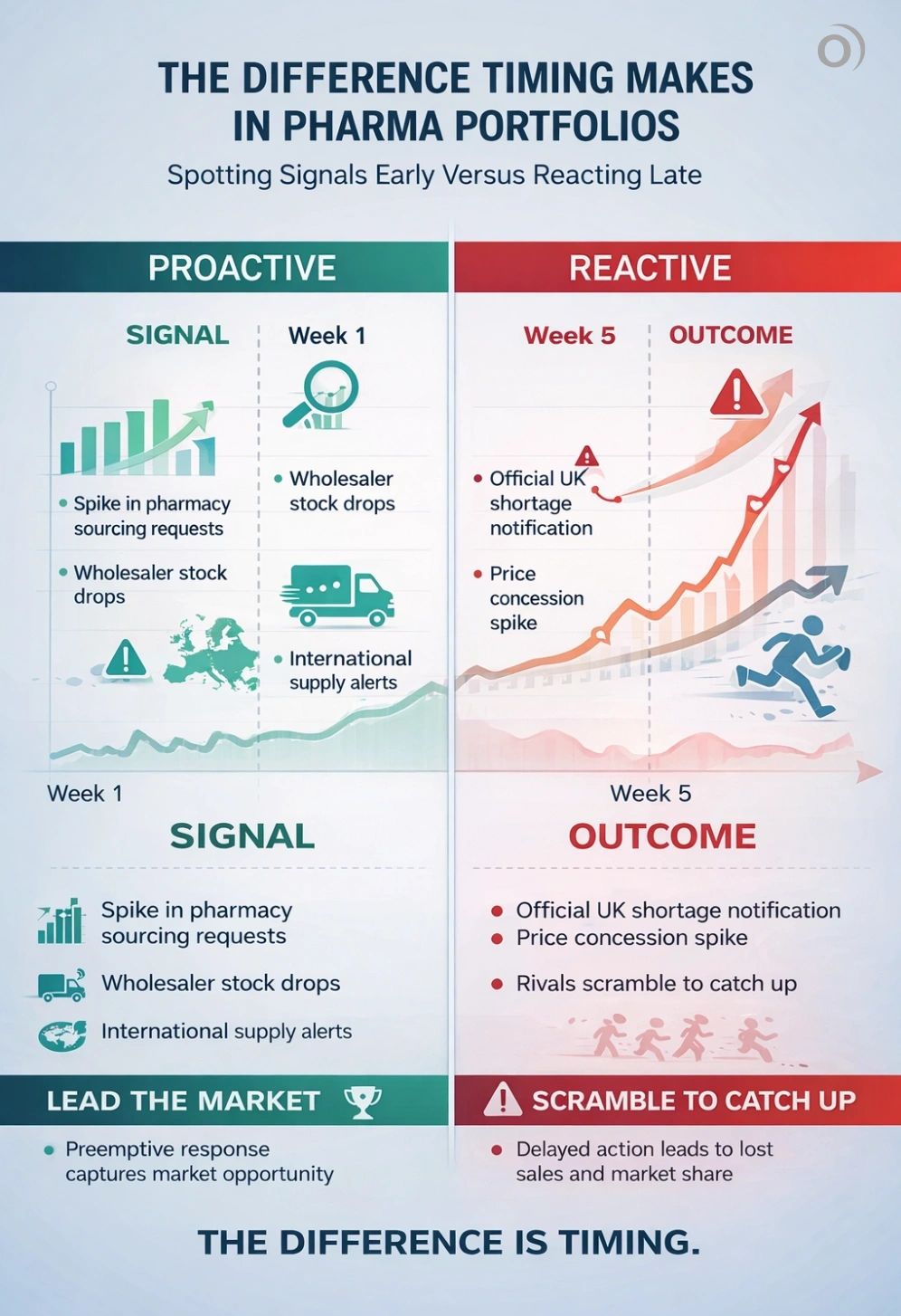
Perspectives / 21 Jan 2026
Tony Street
If there’s one thing 30 years in pharma have taught me beyond how many versions of the same spreadsheet one human can tolerate, it’s that staying ahead of supply chain disruptions is a full-contact sport.
Read insight→Product Insights / 21 Jan 2026
Co-Careldopa
Supply disruptions in the UK generics market are nothing new. What has changed is the ability to see them early, understand whether they are transient or structural, and translate that understanding into better decisions.
Read insight→Product Insights / 12 Jan 2026
Letrozole
In 2025, the UK managed to turn the supply of Letrozole, a bog-standard, off-patent cancer drug into a masterclass in market failure. Pharmacies lost money dispensing a vital medicine, patients faced uncertainty, and the NHS was exposed to needless risk. This wasn't an unavoidable catastrophe; it was a predictable outcome of ignoring data.
Read insight→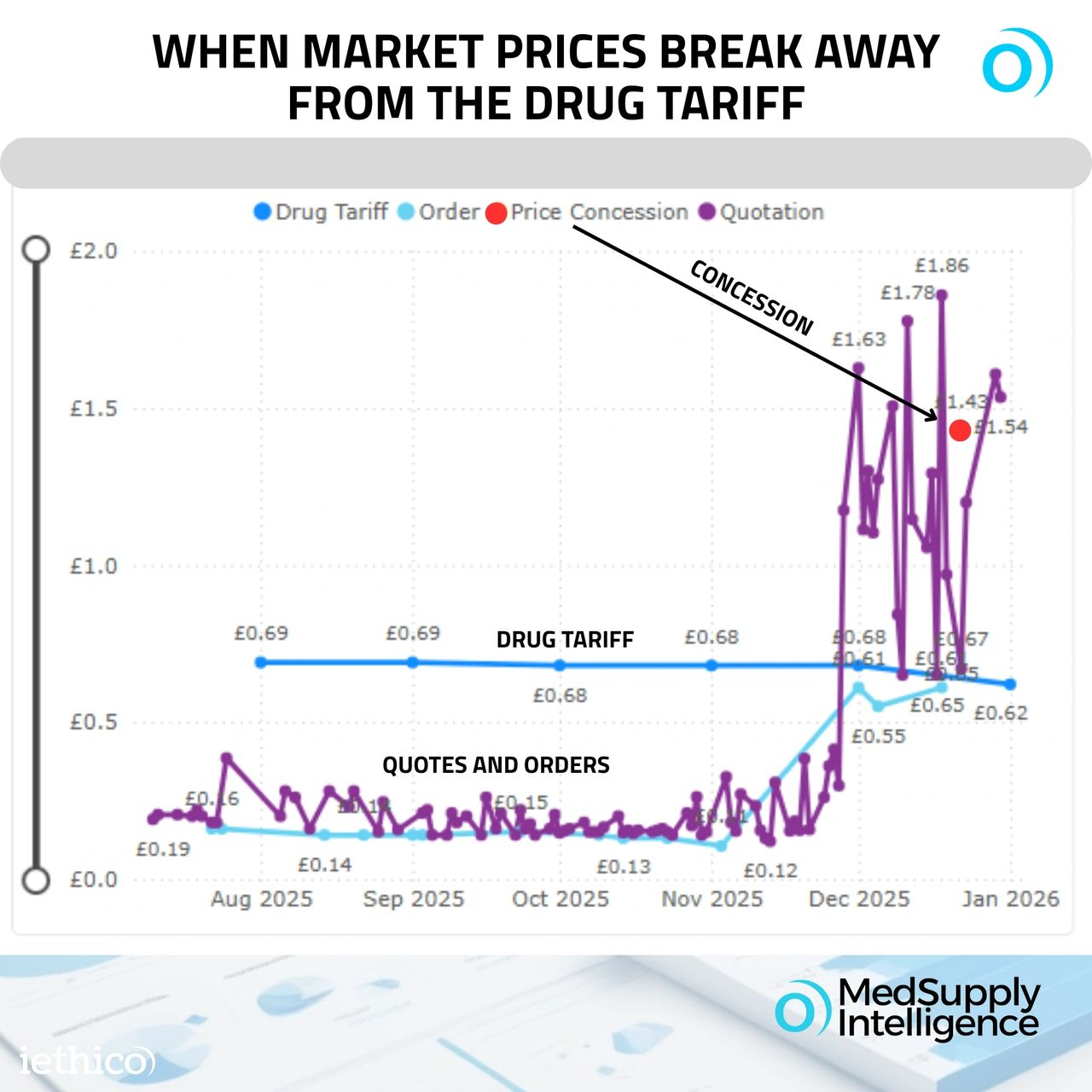
Product Insights / 9 Jan 2026
Citalopram
Remember late 2025? While everyone else was getting ready for the holidays, the UK’s medicine supply chain decided to have a small, yet spectacular, meltdown.
Read insight→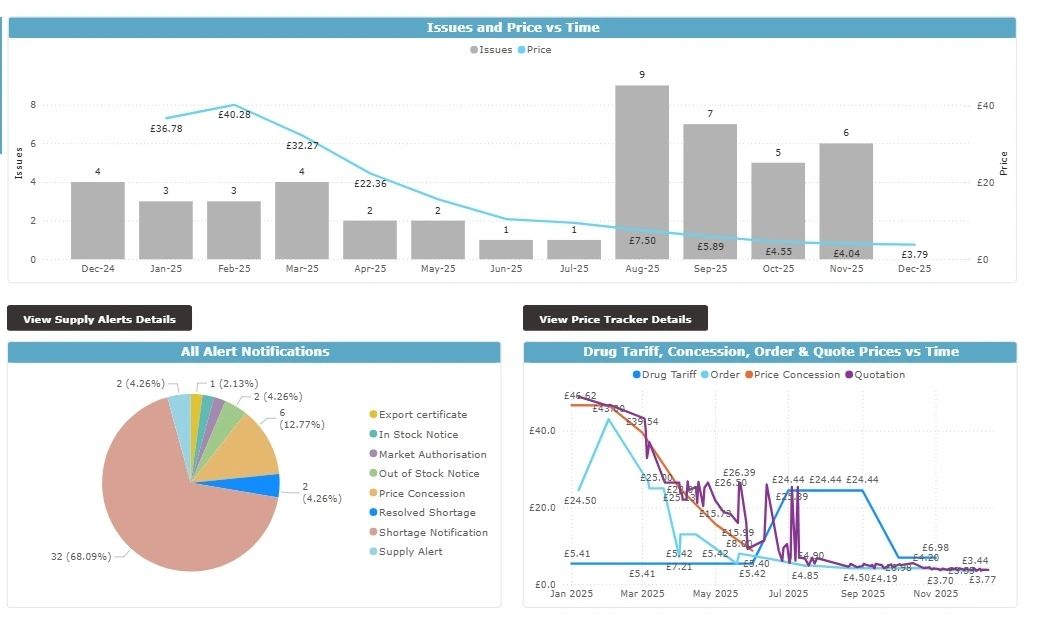
Product Insights / 17 Dec 2025
Gabapentin
Gabapentin 600mg tablets have become a live test case for the limits of generic price erosion
Read insight→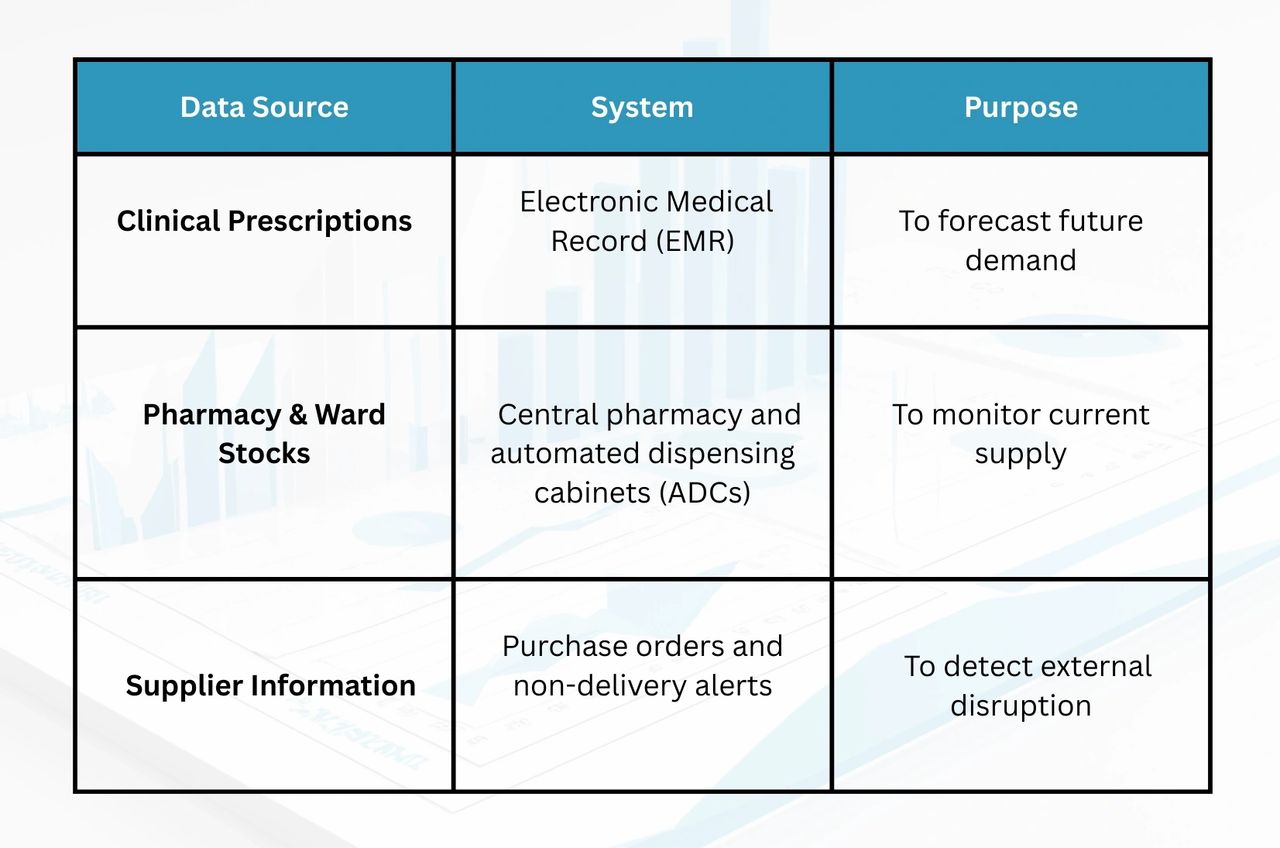
Perspectives / 16 Dec 2025
Yassine Dhif (Guest)
Medicine shortages are no longer exceptional events; they have become a constant, disruptive part of modern healthcare. During the COVID-19 pandemic, as hospitals struggled to source even the most essential medicines, the issue finally gained public attention. For those of us working in hospital pharmacy, however, the problem was already a well-known, painfu
Read insight→
Market Articles / 15 Dec 2025
In the complex world of healthcare logistics, timing is everything. A delay of weeks, or even days, in identifying a medicine shortage can mean the difference between seamless patient care and a frantic scramble for alternatives. Traditionally, the UK's approach to medicine supply issues has often been reactive, waiting for official domestic notifications be
Read insight→Product Insights / 12 Dec 2025
Oxazepam
The UK supply chain for Oxazepam 10mg is showing classic signs of impending failure. A combination of declining demand, manufacturer withdrawals, and exclusion from hospital formularies has pushed this medicine into a high-risk category for long-term supply continuity. The market is not just stressed; it is becoming commercially unviable.
Read insight→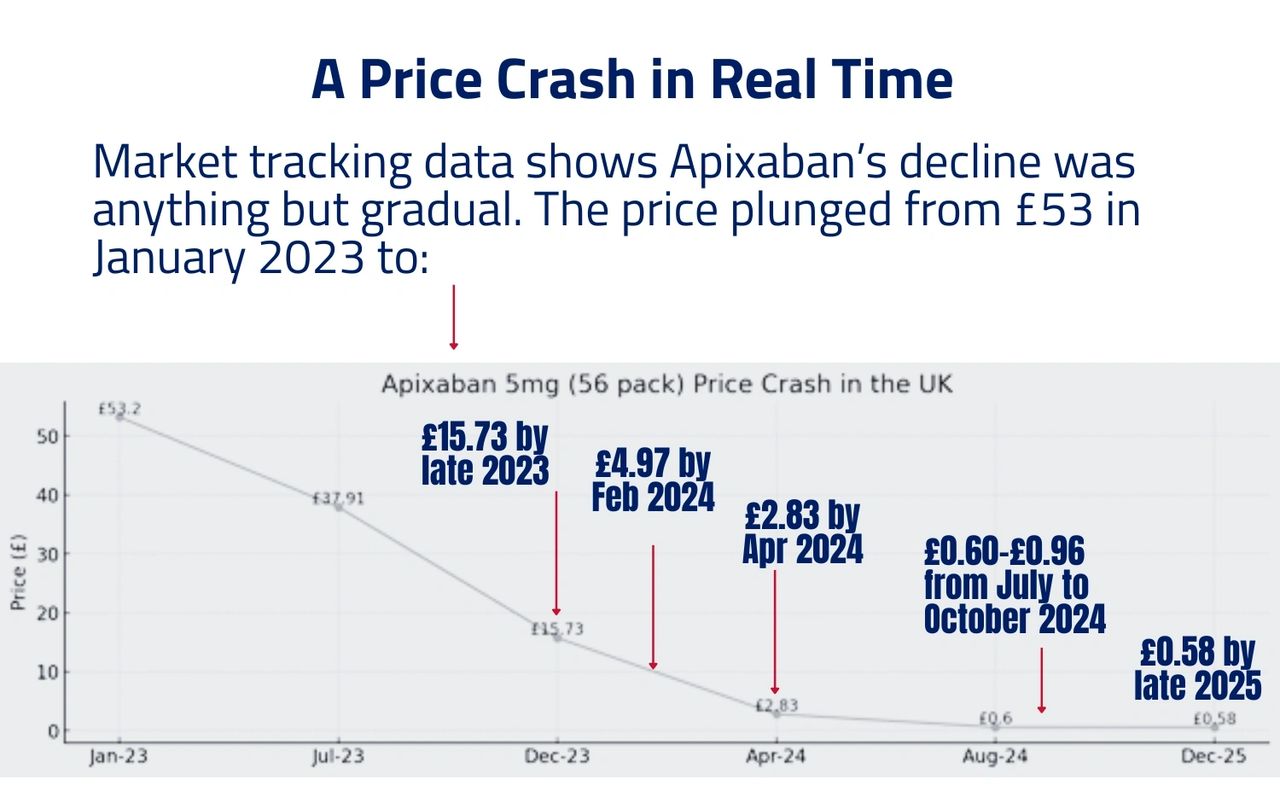
Product Insights / 10 Dec 2025
Apixaban
What does it say about our medicine system when a drug crucial to patient care plummets from premium-priced to pennies almost overnight? Apixaban’s price crash isn’t just headline grabbing, it signals a breakdown in the very logic underpinning our pharmaceutical market.
Read insight→Market Articles / 9 Dec 2025
As the year draws to a close, looking ahead becomes just as important as reflecting on the past. In a recent special episode of The PJ Pod titled "What will 2026 hold for pharmacy?", Siobhan Chan, senior features editor at The Pharmaceutical Journal, sat down with her team, Corrinne, Graham, Joanna, and Sophie, to forecast the major shifts facing the profess
Read insight→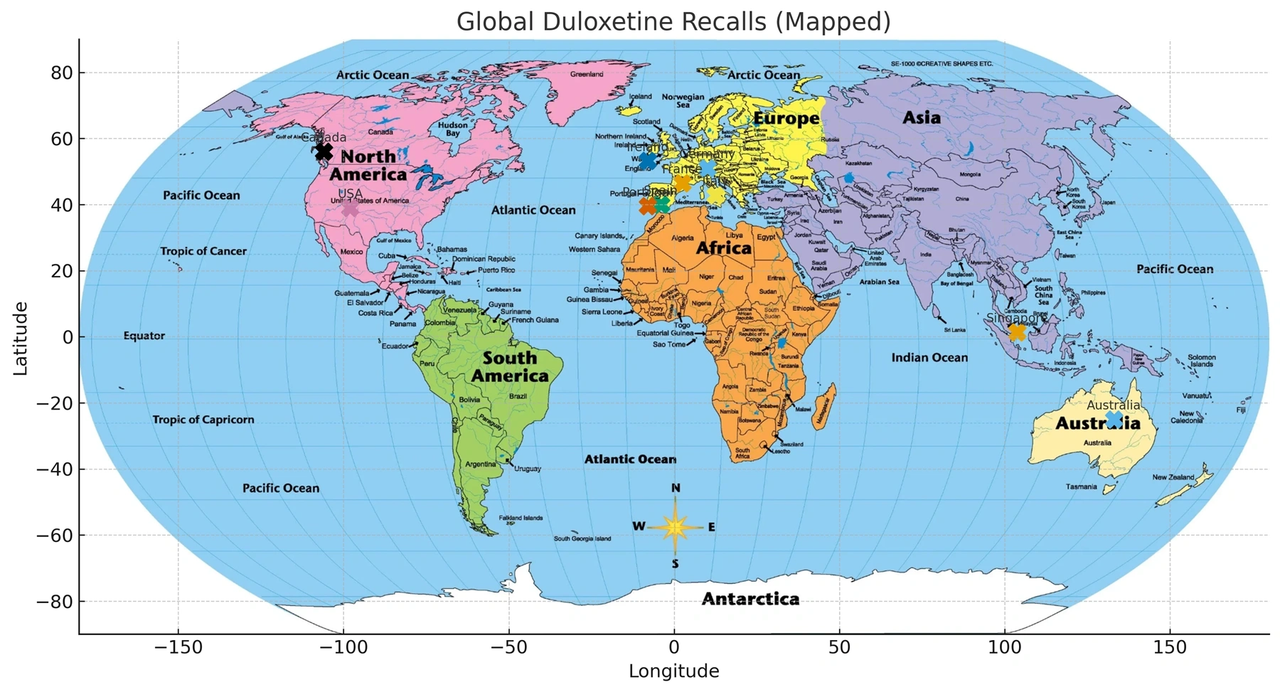
Product Insights / 4 Dec 2025
Duloxetine
For millions of patients, Duloxetine is a daily necessity for managing depression, anxiety, and neuropathic pain. However, for healthcare professionals and procurement teams, this widely prescribed medicine has become a source of escalating concern. What began as isolated recalls has mutated into a synchronized global supply failure.
Read insight→
Product Insights / 4 Dec 2025
Atenolol
Imagine walking into a pharmacy and learning that a heart medicine, something taken daily by hundreds of thousands of people, costs the pharmacy just 3 pence per pack. Not £3. Not 30p. Three pennies for a box of 28 atenolol 50mg tablets.
Read insight→
Product Insights / 28 Nov 2025
Tolterodine
The story of the Tolterodine 4mg modified-release capsule shortage is not about one product or one company. It’s a case study in systemic market failure. For those in pharmaceutical procurement, the past year has been a constant battle, trying to source a product that seemed to vanish from inventories. The official notifications, when they came, confirmed wh
Read insight→
Perspectives / 27 Nov 2025
Youcef Cheurfi
The UK's medicine supply chain is a complex network, and its stability is essential for patient care across the NHS. Systems in use by the Medicines and Healthcare products Regulatory Agency (MHRA) and dedicated NHS bodies work tirelessly to manage this flow. However, the frameworks designed to prevent shortages, including the Medicines Supply Chain Programm
Read insight→Product Insights / 26 Nov 2025
Montelukast
A patient needs their Montelukast 5mg chewable tablets. Your wholesaler is out of stock. You scramble, calling other suppliers, only to hear the same story. A UK-wide problem, it seems. But was it? The crisis that hit British pharmacies didn't start in the UK. Its origins trace back months earlier and thousands of miles away, woven from a complex web of glob
Read insight→Product Insights / 23 Nov 2025
Ibandronic acid
Ibandronic Acid Shortage: Why Only MedSupply Intelligence Makes the Global Supply Connection
Read insight→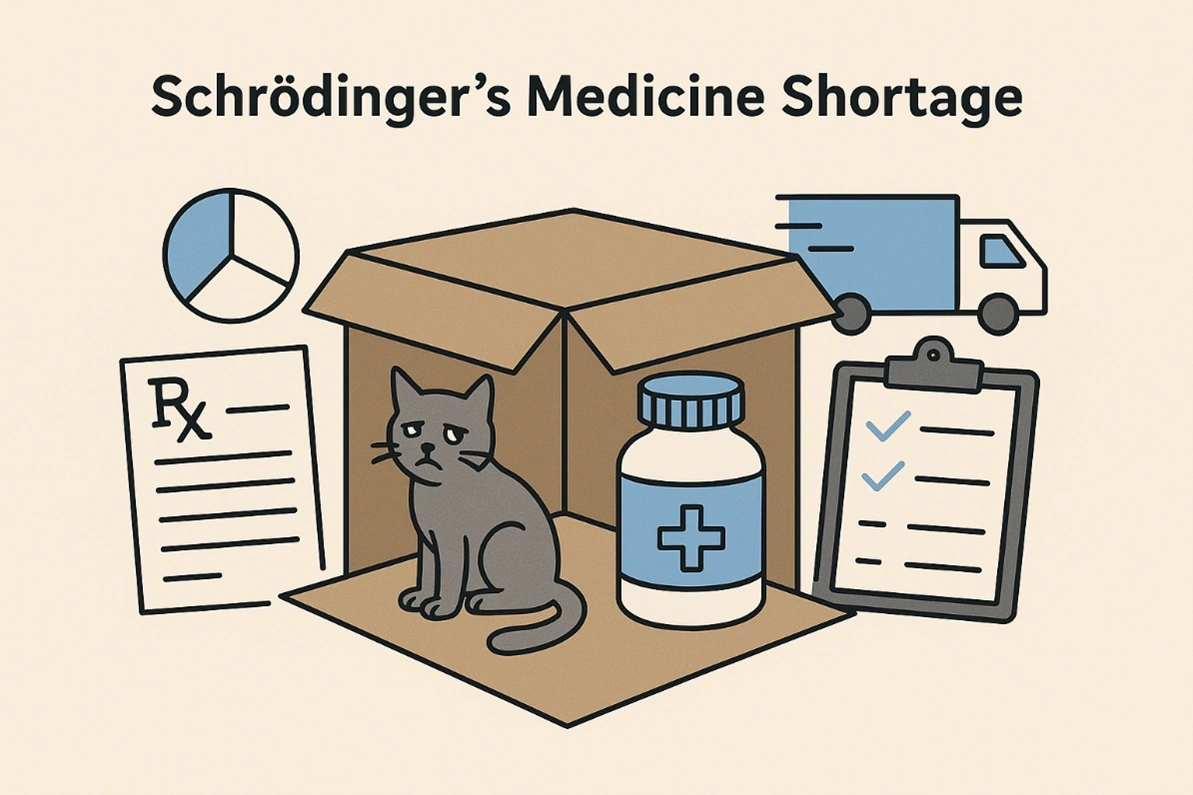
Perspectives / 21 Nov 2025
Debra Ainge
Schrödinger’s cat illustrates a situation where you don’t know the outcome until you check — the cat is both “alive and dead” in a theoretical sense because the information is unknown.
Read insight→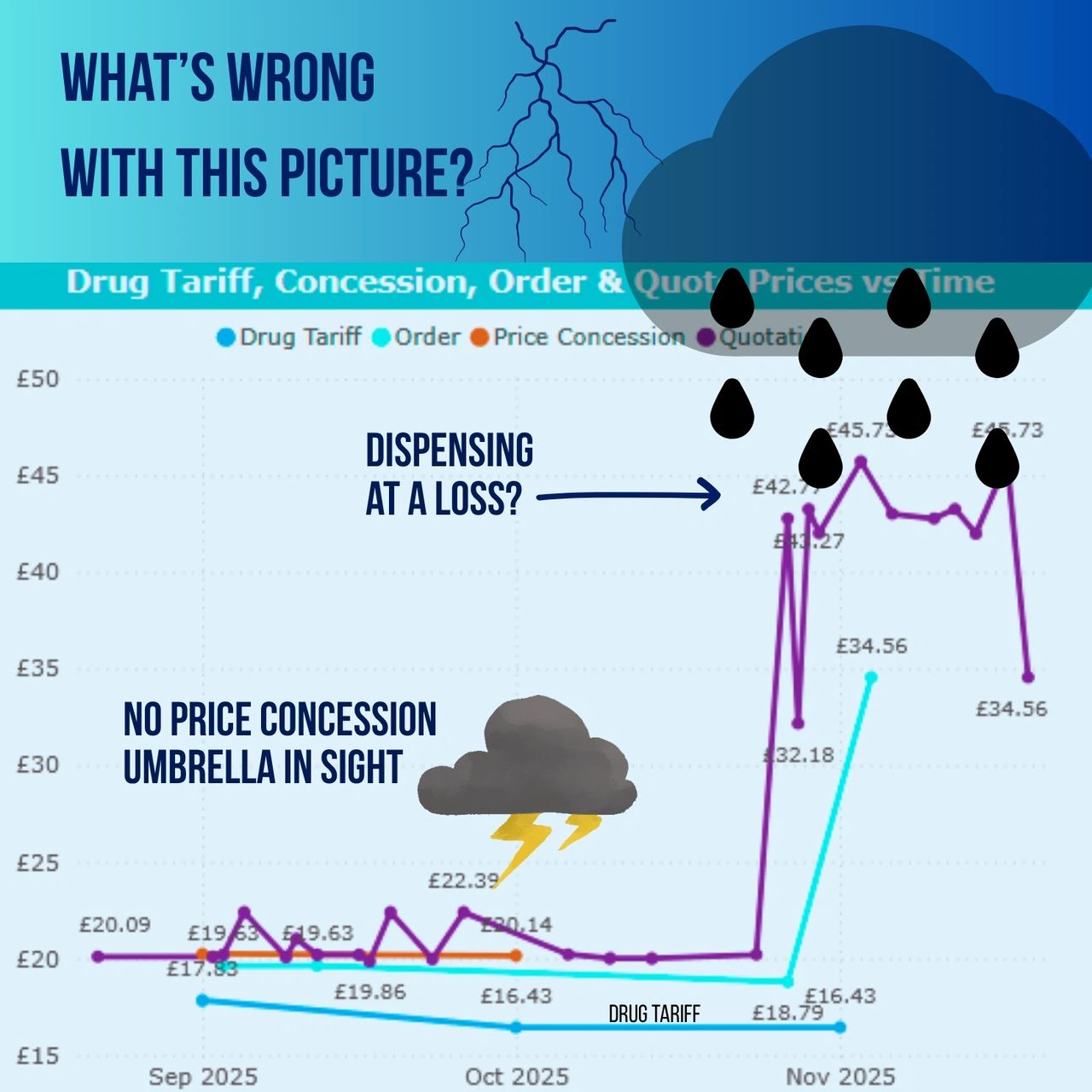
Product Insights / 20 Nov 2025
Nizatidine
In late October, pharmacy procurement teams faced a familiar challenge. After a period of relative calm, the price of Nizatidine surged, catching many by surprise. The cost climbed significantly above the drug tariff, with no price concession in sight to offer relief. This sudden market turbulence left many scrambling, forced to absorb higher costs and manag
Read insight→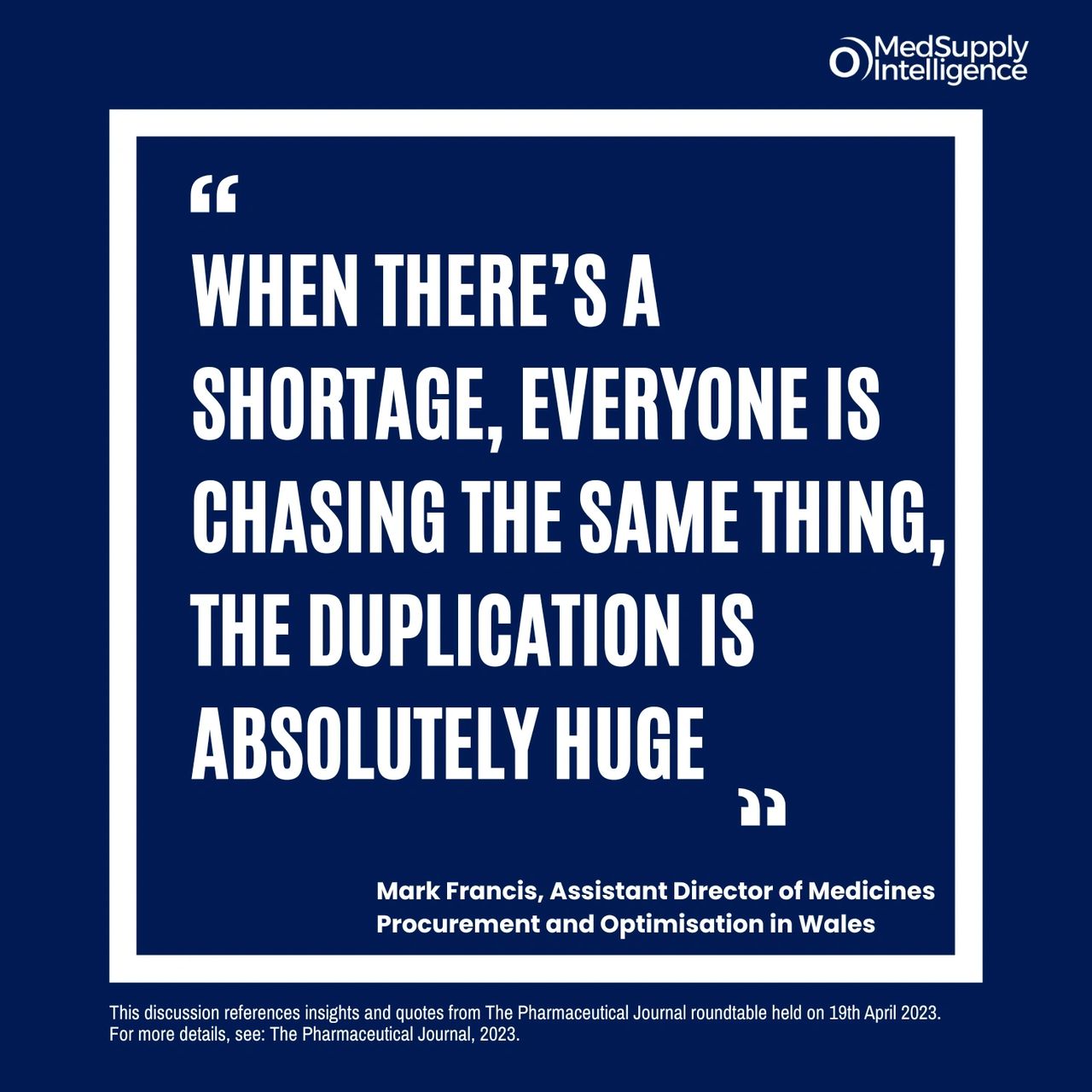
Perspectives / 19 Nov 2025
Renee Kalia
On 19th April 2023, a critical conversation took place. Pharmacists and healthcare leaders gathered for a roundtable hosted by The Pharmaceutical Journal to address one of the most pressing challenges facing the NHS: the escalating crisis of medicine shortages. The core message was unanimous. Pharmacy teams need timely, accurate, and concise information to n
Read insight→Product Insights / 19 Nov 2025
The pharmaceutical market operates around the clock. While your team is offline, global supply chains are in constant motion. New data points emerge, prices shift, and potential disruptions gather on the horizon. By the time you start your workday, you could already be behind. How do you transform this constant stream of information from a threat into a stra
Read insight→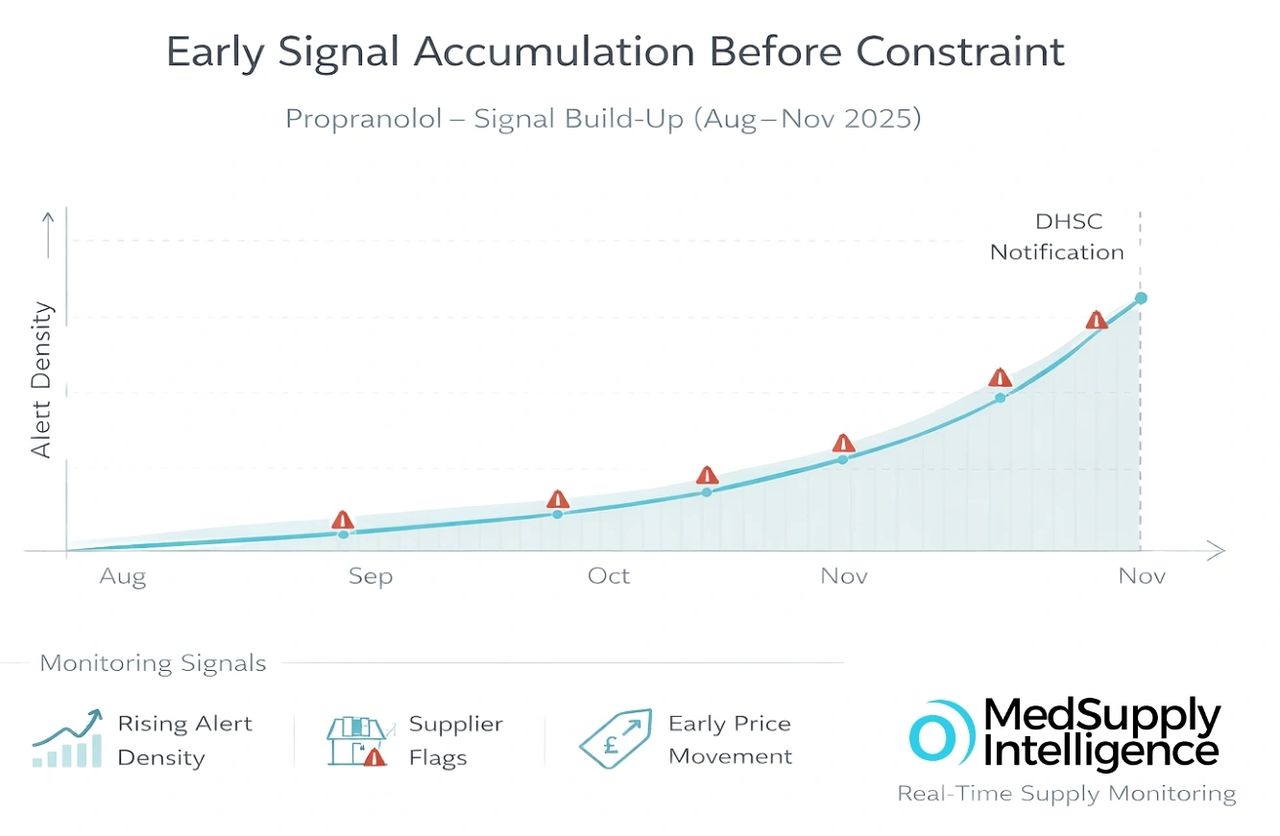
Product Insights / 14 Nov 2025
Propranolol
Update – February 2026 Since publication, instability in Propranolol has evolved into a broader rotational pressure pattern across strengths. In November, we highlighted early instability signals in Propranolol MR strengths. The subsequent quarter confirms that those signals have evolved into rotational pressure across the molecule. Read the continuation ins
Read insight→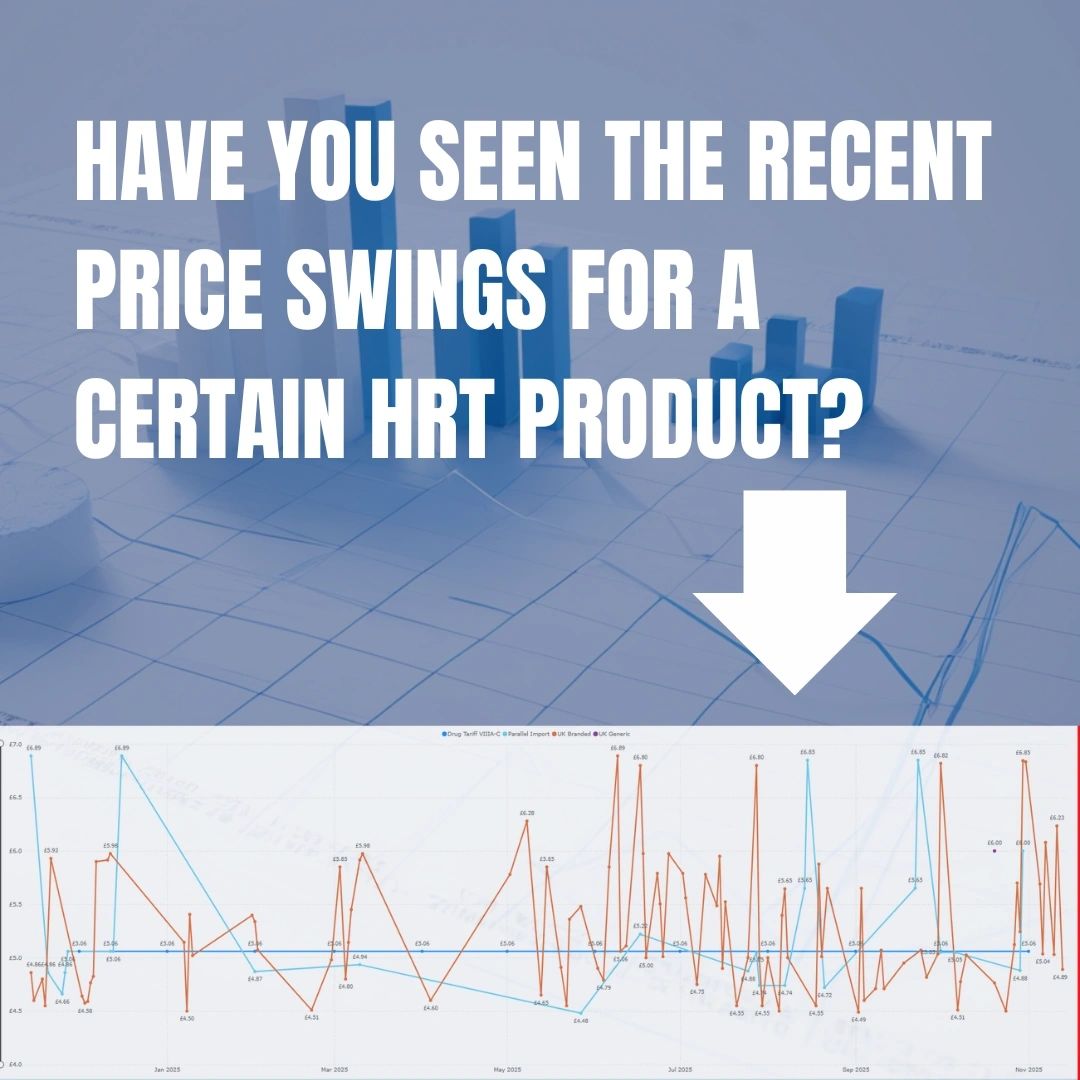
Product Insights / 11 Nov 2025
Recent price volatility in Hormone Replacement Therapy (HRT) products has left many pharmacy procurement teams scrambling. One day a product is available at a predictable price; the next, it’s a frantic search for stock at double the cost. This isn’t random chaos. It’s a predictable outcome of interconnected global supply chains.
Read insight→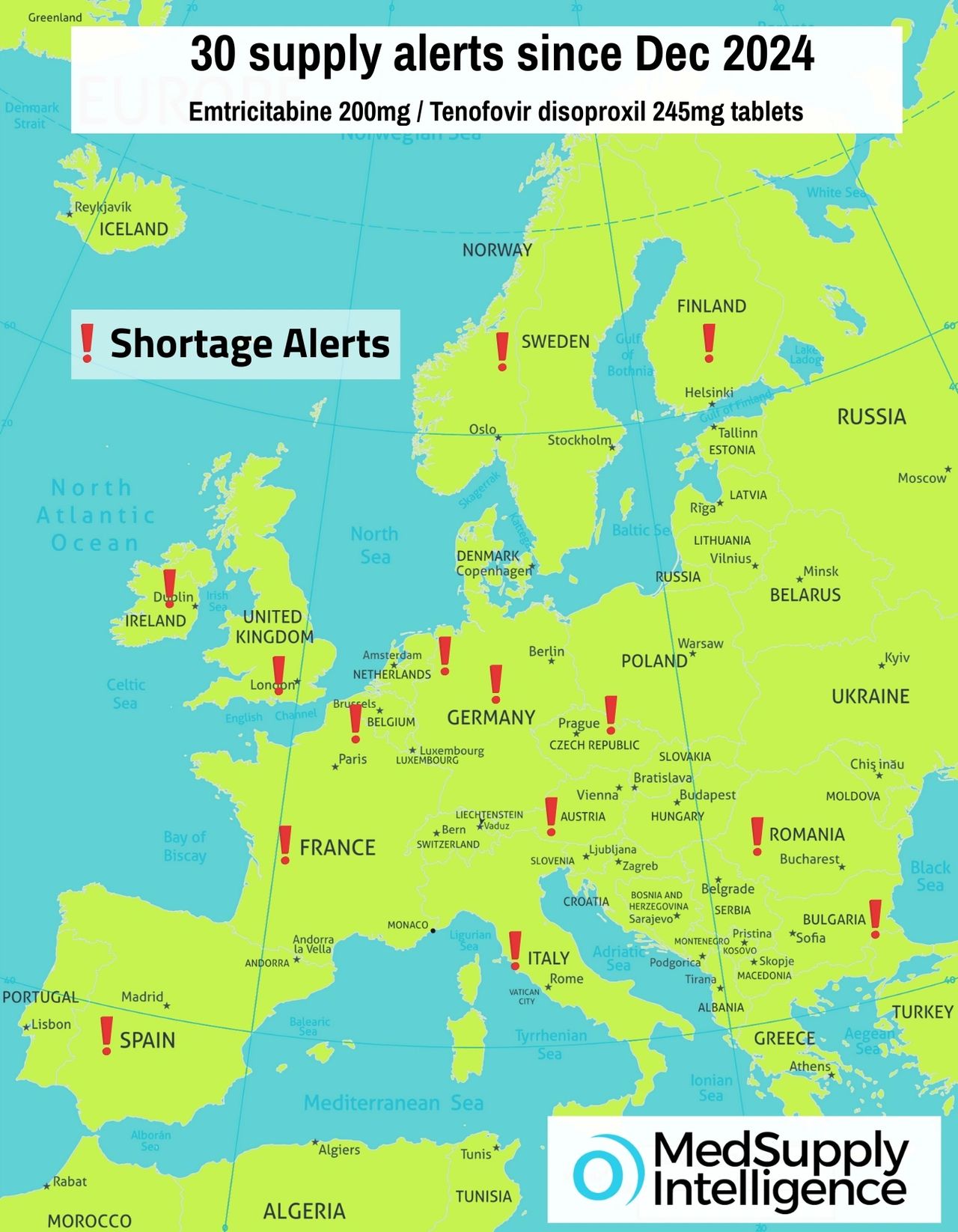
Product Insights / 10 Nov 2025
Emtricitabine / Tenofovir disoproxil
A medicine shortage doesn't begin with an official announcement. It starts with a series of small, disconnected signals that ripple across the global supply chain. For procurement and supply chain professionals in the pharmaceutical sector, waiting for a formal notice from an authority like the Department of Health and Social Care (DHSC) is a reactive strate
Read insight→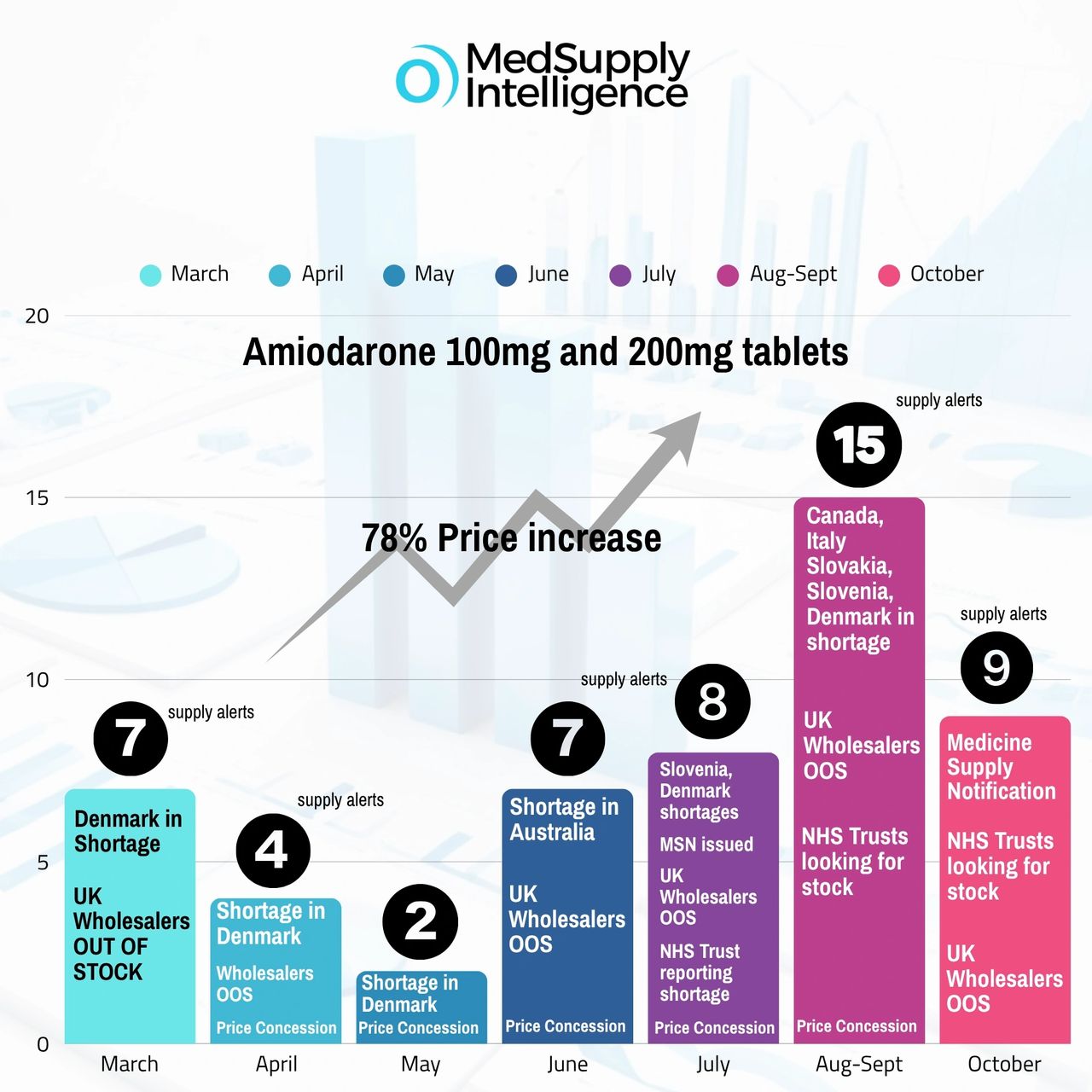
Product Insights / 8 Nov 2025
Amiodarone
Official medicine supply notifications serve a critical purpose: they confirm a crisis. But for procurement leaders, chief pharmacists, and even finance directors, confirmation often arrives too late. By the time a Medicine Supply Notification (MSN) is issued, the market has already shifted, prices may have surged, and the window for strategic action has clo
Read insight→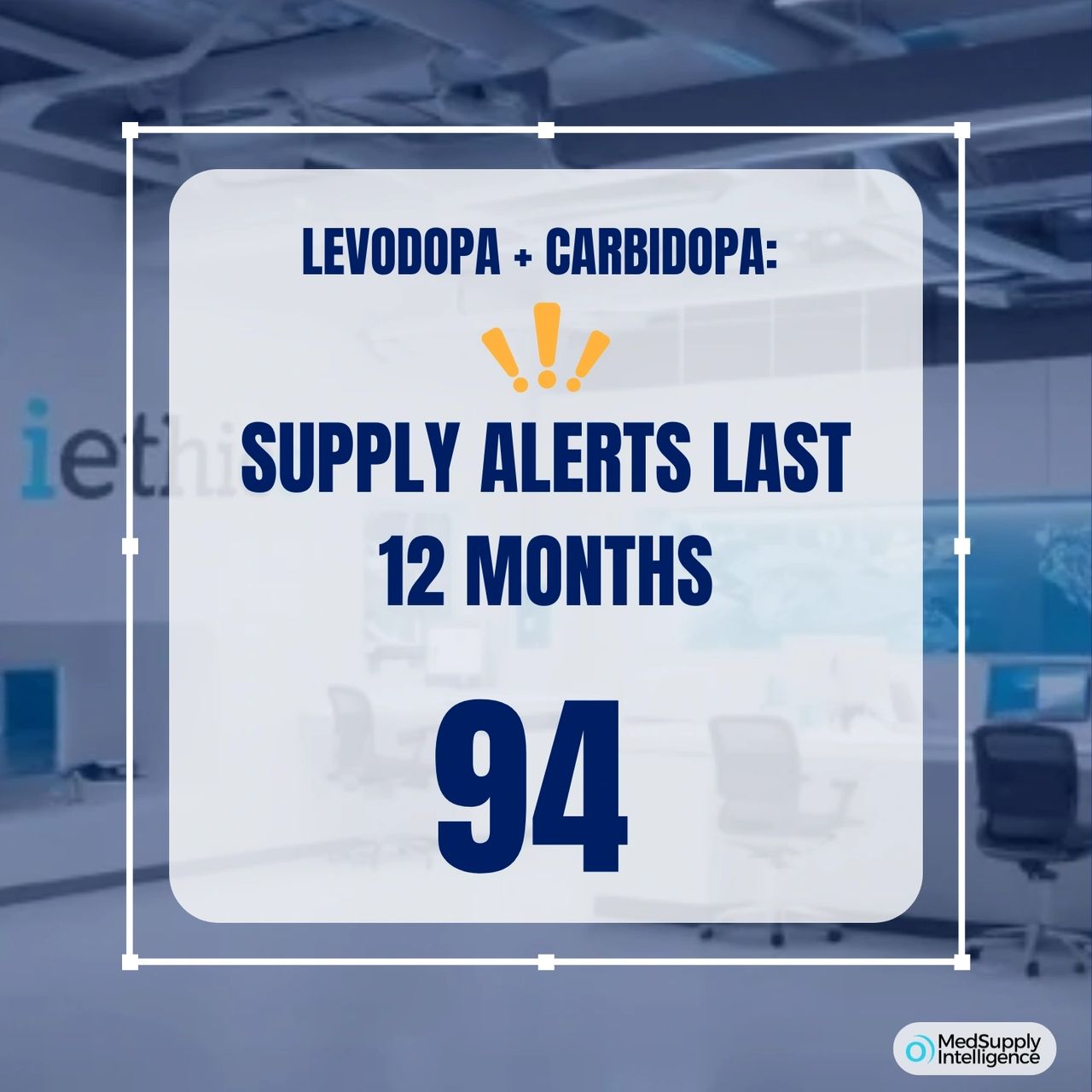
Product Insights / 7 Nov 2025
Supply Alerts vs Shortage Notifications: A Critical Distinction Official shortage lists are lagging indicators. Learn why supply alerts are crucial for managing Parkinson’s medicine volatility and securing patient care.
Read insight→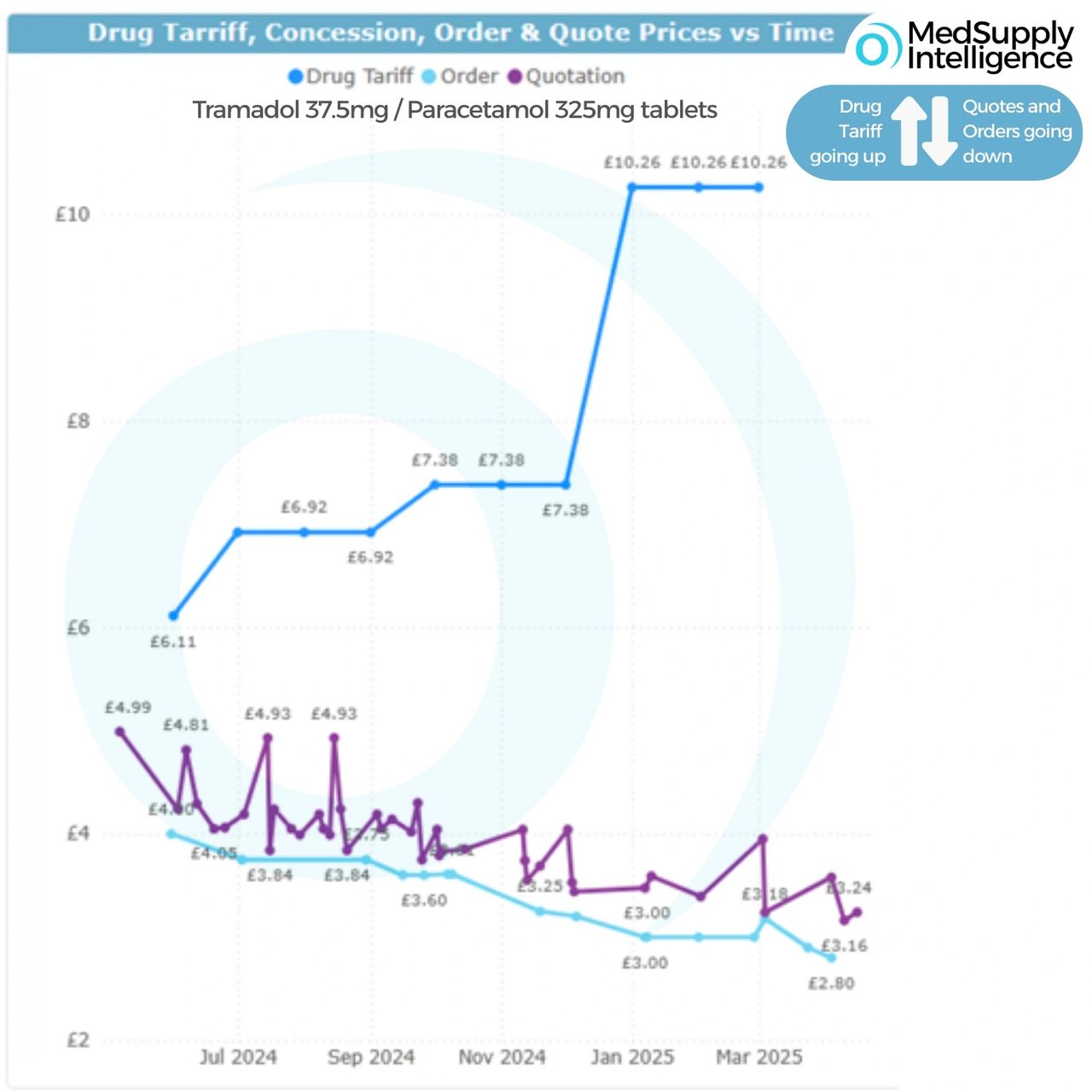
Product Insights / 12 May 2025
Salbutamol / Tramadol / Paracetamol
Want to unlock powerful insights into market pricing trends for branded and generic medicines?
Read insight→Product Insights / 12 Oct 2024
Salbutamol
The UK has been experiencing frequent medicine supply disruptions for many years, which some call a "new normal". These issues are caused by a combination of factors, including increased demand, pricing and reimbursement strategies, manufacturing and distribution problems, geopolitical factors , such as the COVID-19 pandemic, the war in Ukraine, and Brexit a
Read insight→Product Insights / 19 Aug 2024
Atomoxetine
There is no one reason why there are shortages in medicine supply. Medicine supply chains are complex and subject to global and local external and internal factors. There can be increases in demand for medication, changes in the companies who produce and supply the medication, changes to pricing and reimbursement at a national or local level and issues in ma
Read insight→
Perspectives / 10 May 2024
Debra Ainge
More flexibility around medicines substitution is essential to help community pharmacists circumnavigate shortages and better manage their workloads to deliver more clinical care, says Debra Ainge, chief executive of medicines sourcing platform iethico
Read insight→
Perspectives / 21 Nov 2023
Debra Ainge
Debra Ainge unpacks the problems leading to medicine shortages and offers some recommendations on what should be done to address the issue.
Read insight→