Extreme price erosion is structurally embedded in the generic medicines market.
When a branded product loses patent protection, competition drives prices down rapidly, often by 80 to 90 percent. That mechanism has delivered substantial savings to healthcare systems over decades and remains one of the most powerful cost containment tools in modern medicine. The UK has benefited significantly from this model, building one of the lowest priced generic markets in the developed world.
However, sustained compression does more than remove excess margin. Repeated downward adjustments apply continuous pressure, particularly on mature products that have already absorbed years of reductions. Manufacturers now report that more than 70 percent of their UK portfolio is sold into the UK market below fully allocated cost. This reflects prices achieved at manufacturer and wholesale level, rather than the retained margin generated within the community pharmacy contractual framework. At that point, the issue ceases to be one of efficiency and becomes one of structural imbalance. When most products operate below cost upstream, fragility becomes embedded within the system.
The degree of compression is not theoretical. In 2024, atenolol 25mg tablets were available for purchase at approximately 2 pence for a month’s supply, while the Drug Tariff reimbursement price stood at around 53 pence.
That difference reflects the retained margin model within community pharmacy, where profit is generated across the overall basket of medicines rather than on each individual product. However, the fact that a widely prescribed cardiovascular medicine could be traded at 2 pence illustrates how far the underlying commodity price can fall at manufacturer and wholesale level. Such levels are not simply evidence of efficiency. They signal intense competitive compression within the upstream layers of the market.
When prices fall to levels measured in pennies, efficiency and fragility begin to converge.
Instability Is Economic, Not Accidental
Market exits, supplier concentration and allocation behaviour are often framed as operational failures. In reality, they are rational responses to compressed margins and unpredictable volume.
Smaller markets tend to lose suppliers first. Complex injectables become economically unattractive. Low volume lines quietly disappear. Each withdrawal reduces optionality and increases dependency. In that context, shortages are not random shocks but downstream manifestations of prolonged economic strain.
Pressure Across the Supply Chain
The strain extends beyond manufacturing.
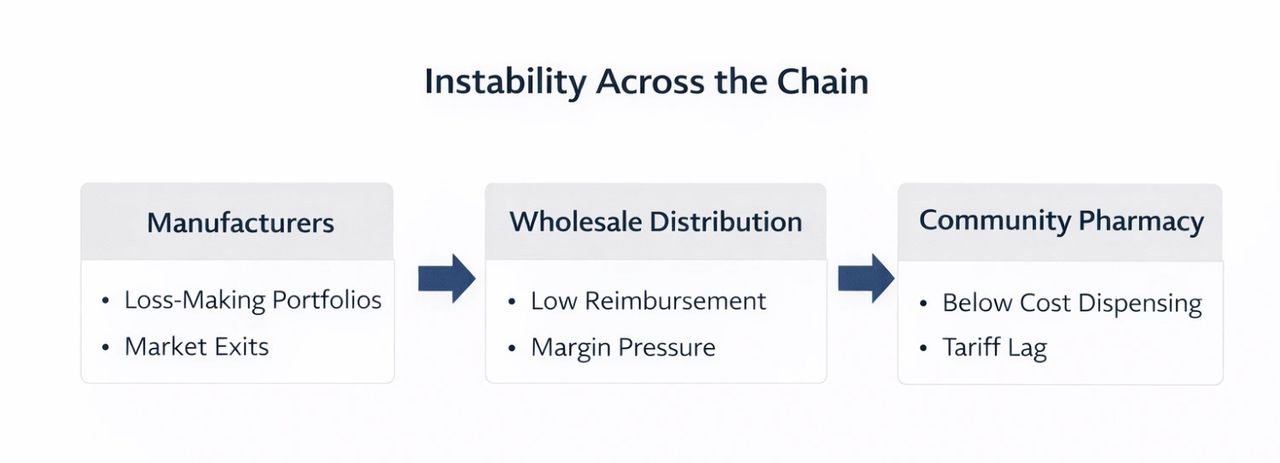
Wholesale distributors, who supply around 95 percent of NHS medicines, operate within the same economic environment. The Healthcare Distribution Association has identified historically low reimbursement prices and wider financial pressures as contributing to systemic vulnerabilities, including economic shortages
The UK reimburses over 850 million packs at £0.99 or less at Drug Tariff level. The portion ultimately received by manufacturers and wholesalers is lower once distribution margins and retained pharmacy margin are accounted for. In a global commodity market, that positioning has implications. Wholesalers are expected to finance inventory, maintain delivery networks and hold resilience stock, yet margin compression and reimbursement lag constrain their ability to build meaningful buffer capacity.
Recent restructuring within the wholesale sector reinforces this pressure. In March 2025, Alliance Healthcare announced consolidation of several UK service centres and centralisation into a new hub. Infrastructure consolidation is not inherently problematic; distribution networks evolve. However, when retrenchment occurs alongside persistent upstream margin compression, pharmacy contraction and increasing reimbursement volatility, it signals tightening economic headroom across the system.
Community pharmacies face parallel exposure. When acquisition costs rise faster than Drug Tariff adjustments, pharmacies may dispense at a loss within the retained margin framework until concession prices are issued. Manufacturers cross subsidise, wholesalers manage working capital risk and pharmacies absorb front line volatility. The pressure is distributed rather than isolated.
It is important to distinguish between Drug Tariff reimbursement prices and acquisition prices paid by pharmacies. Community pharmacy operates under a retained margin model, meaning profit is generated across the basket of medicines rather than on each individual line. However, compression at manufacturer and wholesale level ultimately determines the depth and resilience of the upstream supply base.
Secondary Care Absorbs the Hidden Cost
While financial strain is most visible in primary care, secondary care absorbs instability operationally.
Hospitals compensate when medicines become unstable. Chief pharmacists report increasing time spent sourcing alternatives, adjusting prescribing systems and managing clinical switches. Independent economic modelling has shown that shortage management consumes substantial pharmacist and technician time within NHS trusts, diverting capacity from medicines optimisation and direct patient care.
Tariff savings are measurable. Workforce diversion is less visible but structurally significant.
When Supply Constricts, the UK Must Compete
The UK participates in a globalised supply chain where supply is allocated during disruption. Allocation follows economic incentives.
The HDA has noted that manufacturers may limit supply to markets where pricing is unattractive. In stable conditions this dynamic may be muted. In constrained conditions it becomes decisive. When multiple countries compete for the same stock, markets offering stronger returns and predictability are prioritised.
The UK has optimised for low acquisition cost. During global scarcity, the question shifts from how cheaply medicines can be purchased to how reliably supply can be secured.
A System That Rewards Volatility
The reimbursement framework may unintentionally reward volatility rather than stability.
Drug Tariff reimbursement prices are adjusted reactively based on historic data. When acquisition costs rise more quickly than tariff adjustments, pharmacies may dispense at a loss until concession pricing is granted. When prices fall sharply, reimbursement may temporarily exceed acquisition cost within the retained margin envelope.
The result is oscillation between compression and correction. Rather than dampening volatility, the cycle can amplify it and shorten planning horizons across the supply chain.
Are Concessions a Symptom, Not a Shock?
Drug Tariff data reveals consistent patterns.
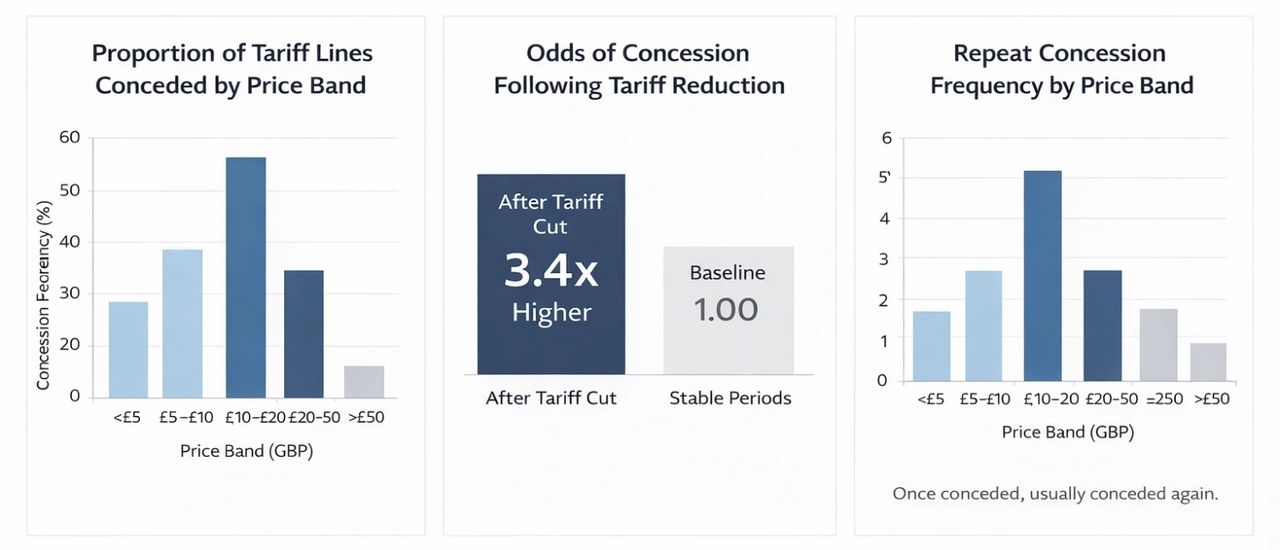
Products priced below £2 per pack at Drug Tariff reimbursement level are materially more likely to receive concessions. Once conceded, products are highly likely to be conceded again. Over time, the average number of concessions per affected product has increased, and widely used generics recur repeatedly.
Analysis also shows that when a product’s Drug Tariff reimbursement price decreases, the odds of a concession being issued in the following period are more than three times higher than during stable pricing periods. While this does not prove causation, it demonstrates a material association between compression and subsequent correction.
Concessions in high repeat products behave less like isolated shocks and more like recurring pressure cycles triggered by structural strain.
Fixing the Symptom While Avoiding the Cause
Proposals to revive inactive licences reflect recognition that medicines are disappearing from the market. However, licence inactivity is rarely administrative drift. It is usually the endpoint of an economic decision.
Manufacturers withdraw when the cost and risk of serving the UK outweigh expected returns. Reactivating a licence may restore availability temporarily, but it does not restore viability.
Across products, the pattern is consistent. Sustained compression reduces margin. Exposure is reduced. Market depth erodes. A disruption occurs. Supply collapses disproportionately. Concessions follow.
Licence inactivity is the outcome of this sequence. Without addressing the economic drivers, the pool of inactive licences will continue to expand.
A Necessary Clarification
Not all supply issues relate to generic medicines. Some are driven by manufacturing failures, regulatory constraints or geopolitical disruption that pricing reform alone cannot prevent. The globalisation of pharmaceutical production introduces vulnerabilities beyond domestic reimbursement policy.
It is also important to recognise fiscal reality. The NHS operates within finite budgets. Generic competition has delivered essential savings and remains fundamental to the health system.
The challenge is not abandoning cost discipline. It is ensuring that pricing and reimbursement structures align with long term resilience.
Government now faces pressure from multiple directions. Community pharmacy leaders highlight contractual strain. The House of Lords has raised concerns regarding medicines resilience. Distribution bodies point to economic shortages. Hospitals report growing operational workload.
These signals suggest incentives may no longer be aligned.
Ultimately, the Patient
At the end of the supply chain is the patient. Recent reporting has linked shortages of anti epileptic medication to serious harm. For individuals reliant on stable formulations, uninterrupted supply is a matter of clinical safety.
Across therapy areas, patients experience switching, altered dosing and delays driven by supply constraints rather than clinical judgement. While individual incidents may be managed, cumulative instability introduces avoidable risk.
The medicines budget may reflect savings. The lived experience may reflect uncertainty.
How Low Is Too Low?
If the objective is long term resilience rather than short term correction, several principles follow.
Pricing mechanisms should recognise early economic stress rather than respond only after supply failure. Reimbursement systems should dampen volatility rather than amplify it. Market depth should be considered a resilience objective. Cost discipline and sustainability should not be treated as opposing goals.
Sustainable pricing does not mean higher pricing across the board. It means ensuring that essential products remain economically viable before instability emerges.
Reforms to generic pricing, community pharmacy remuneration and primary care reimbursement should be considered together rather than in isolation. The current pressures are interconnected, and so must be the response.
The objective is not higher prices.
It is sustainable prices.