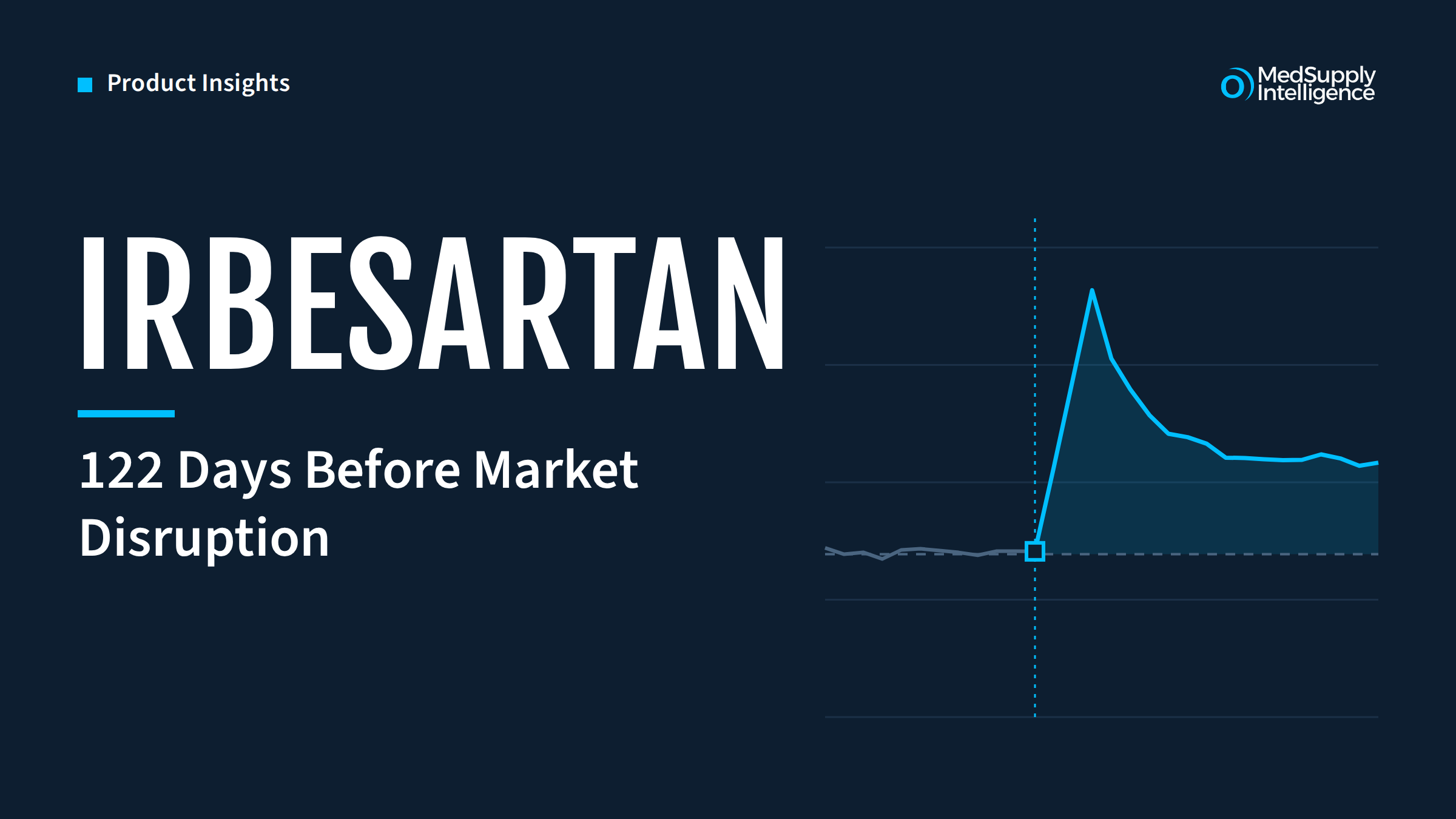
Irbesartan provides an example of how supply disruption develops long before it becomes widely recognised.
Looking back at the timeline, the progression from early supply signals to wider market disruption followed a familiar pattern: the market recognised that something was changing long before it fully understood the implications.
In March 2025, MedSupply Intelligence identified elevated supply risk for Irbesartan.
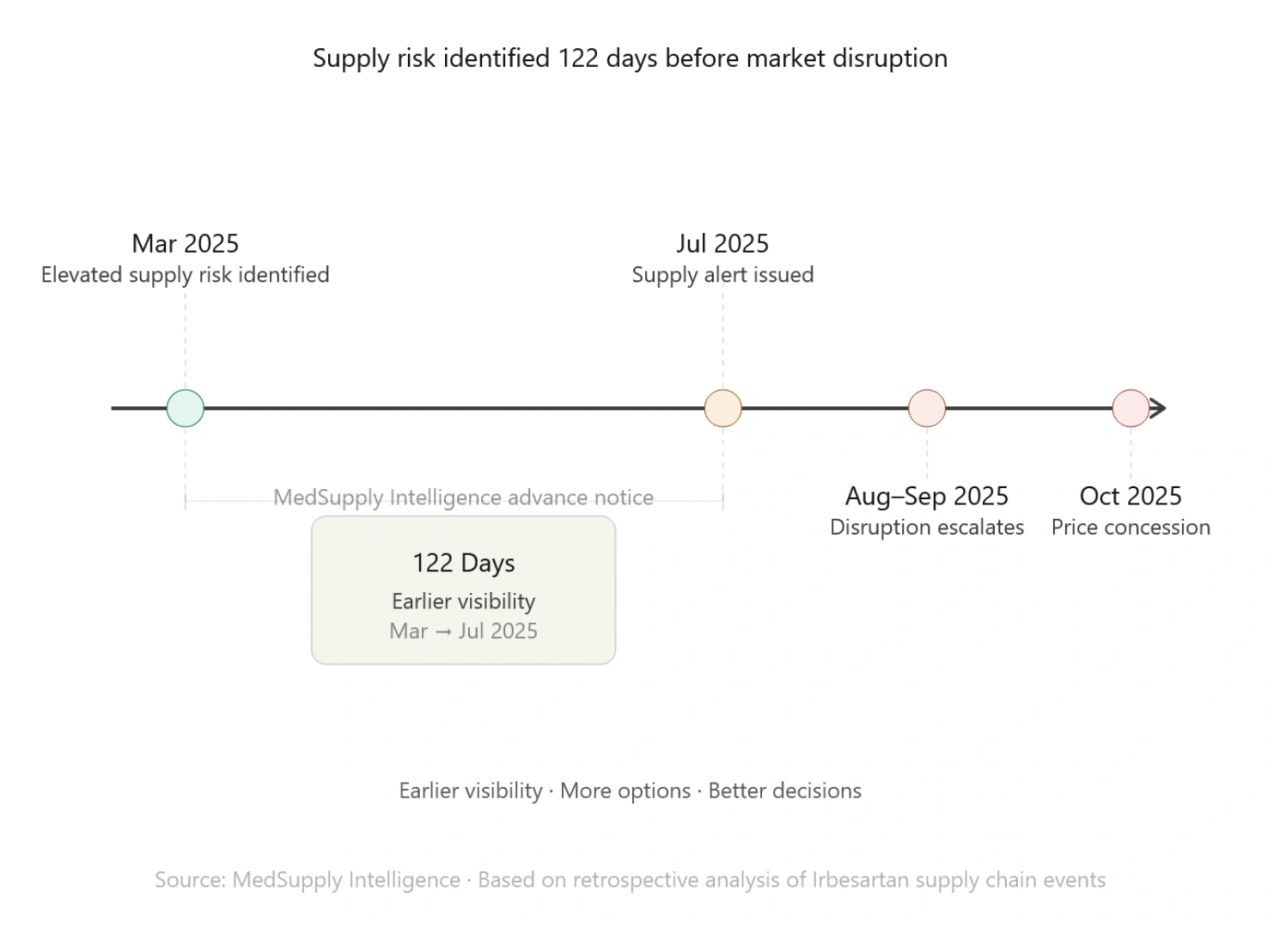
At that stage, there was no formal supply alert and no widespread discussion of a significant supply issue.
Four months later, the situation had evolved considerably.
A supply alert was issued in July 2025, followed by escalating market disruption and a subsequent price concession.
The timeline reveals a gap of 122 days between the identification of elevated supply risk and the market event that confirmed the issue.
Why does this matter?
Every procurement team eventually becomes aware of a shortage.
The challenge is not recognising disruption once it has occurred.
The challenge is understanding which changes deserve attention while there is still time to respond.
Not every supply signal develops into a market issue.
Many resolve without significant consequences.
Others continue to build until availability becomes constrained, sourcing becomes more difficult and market intervention becomes necessary.
The difficulty lies in distinguishing between routine supply chain activity and the early stages of a more significant problem.
The value of earlier visibility
Retrospective analysis always benefits from knowing the outcome.
Looking back, the sequence appears straightforward.
Supply risk increased.
A supply alert followed.
Market disruption escalated.
But those connections are rarely obvious in real time.
The value of earlier visibility is not certainty.
It is time.
Time to assess exposure.
Time to evaluate sourcing options.
Time to engage stakeholders.
Time to prepare before disruption becomes visible across the wider market.
Looking back to look forward
The Irbesartan timeline is not important because a supply issue occurred.
Medicine shortages occur across multiple therapeutic areas every year.
What makes this example noteworthy is the time between the first signs of elevated risk and the point at which the issue became visible to the wider market.
In this case, that window was 122 days.
For procurement teams operating in an increasingly complex supply environment, those additional days can provide valuable opportunities to make better-informed decisions before options become more limited.