Update – February 2026
Since publication, instability in Propranolol has evolved into a broader rotational pressure pattern across strengths. In November, we highlighted early instability signals in Propranolol MR strengths. The subsequent quarter confirms that those signals have evolved into rotational pressure across the molecule.
Read the continuation insight here.
The UK’s Department of Health and Social Care (DHSC) has issued a significant medicine supply notification affecting Propranolol, a widely used beta-blocker. While the alert confirms extended shortages for specific modified-release formulations, the reality is that this disruption did not emerge overnight.
The early warning signs were visible months ago. With the right market intelligence, organisations could already see the pressure building, long before it became an official notice.
Understanding the Propranolol Supply Alert
The recent DHSC notification outlines critical stock issues for two key Propranolol products. These shortages create immediate hurdles for dispensing and demands proactive planning of patient prescriptions.
Propranolol 80mg Modified Release (MR) Capsules
The most severe shortage impacts the Propranolol 80mg MR capsules, which are now out of stock until early March 2026. This long-term disruption means pharmacies must find sustainable alternatives for patients for an extended period. Relying on last-minute solutions is not a viable strategy given the duration of this shortage.
Propranolol 160mg Modified Release (MR) Capsules
The supply of Propranolol 160mg MR capsules is also constrained, with the product expected to be out of stock from late November 2025 until mid-to-late January 2026. While shorter in duration than the 80mg shortage, this stockout occurs during a busy period and will still require careful planning to ensure continuity of care.
What Are the Alternatives?
The DHSC has noted that some Propranolol formulations remain available. Propranolol 40mg and 80mg immediate-release tablets are still in stock and can support an increase in demand. The Propranolol oral solution also remains available but cannot accommodate a significant rise in demand, making it a less flexible option for widespread substitution. While these alternatives exist, switching patients requires clinical consultation and adds to the administrative burden on already stretched pharmacy teams.
The Early Warning Signs: A Story Told by Data
Official notifications are lagging indicators. By the time they arrive, the market has already moved. The pressures that lead to a national stockout build over time, and the data tells this story long before it becomes a headline issue. For Propranolol, the warning signs were clear.
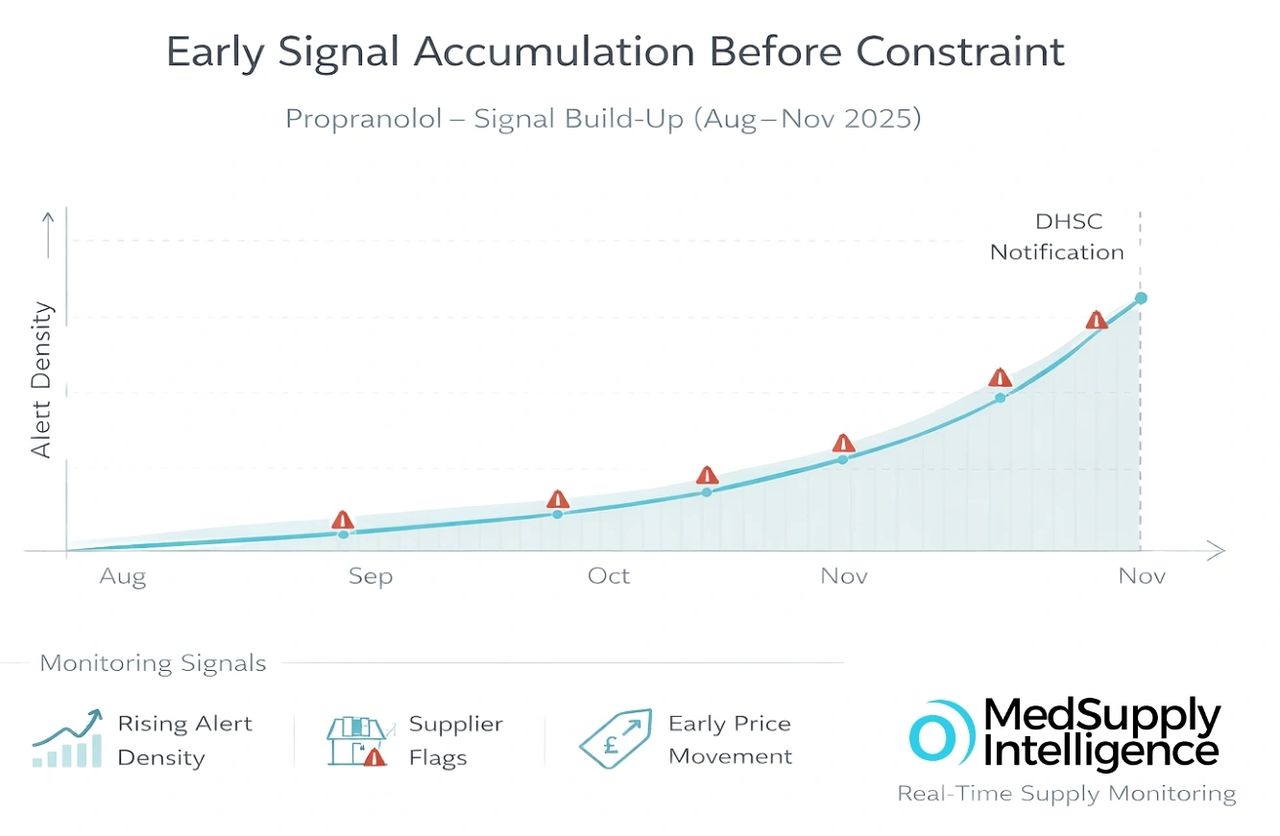
Our system tracked 108 distinct supply alerts for Propranolol products since August, more than three months before the late November stockout.
These alerts are not noise. They are early signals of instability — supplier delistings, regulatory flags, manufacturing delays. Individually, they are easy to dismiss. Together, they form a clear pattern.
For those monitoring this data in real time, the DHSC notification was not a surprise - it was confirmation.
The Financial Impact: Price Volatility Follows Scarcity
Price volatility isn’t a secondary effect of shortages, it’s the first commercial consequence of poor visibility. Supply shortages inevitably lead to price volatility, and the Propranolol market is a prime example of this economic principle in action. When supply tightens, prices often rise sharply, catching unprepared buyers off guard and eroding profit margins.
The price impact we have observed directly correlates with the supply issues:
-
The price of Propranolol 80mg has increased by 80%, a dramatic spike reflecting its severe long-term shortage.
-
The price of Propranolol 160mg is also rising, with an increase of 5% observed so far as its stockout period begins.
-
Interestingly, the price of Propranolol 10mg tablets has dropped by 6%, potentially due to shifting market dynamics and demand consolidation towards available immediate-release formats.
These price fluctuations highlight the financial risk of reactive procurement. Pharmacies that were not prepared for these changes are now forced to purchase stock at inflated prices, directly impacting their bottom line.
From Reactive to Proactive: A New Approach to Procurement
Waiting for official notifications forces procurement teams into permanent reaction mode, responding once options are limited, prices have moved, and patient pathways are already under pressure.
A proactive approach is not about working harder. It’s about seeing earlier.
-
Secure Supply Chain Sources: Identify and vet alternative suppliers, including importers, before a shortage hits your shelves. This gives you options when your primary wholesaler runs out of stock.
-
Line Up Importations: Global supply alerts provide the foresight needed to explore parallel imports as a viable solution, ensuring you have access to stock when domestic supply falters.
-
Assess Requirements Early: Understand the potential impact of a disruption on your specific patient population and adjust your ordering patterns accordingly. This prevents both over-stocking and under-stocking.
By shifting from a reactive to a proactive mindset, you can protect your patients from care disruptions and safeguard your business from the financial shocks of market volatility.
See the Data for Yourself
The Propranolol shortage is not an isolated event. It is a visible example of how supply disruption, pricing volatility, and delayed information intersect.
Organisations that rely on official notices will always be reacting to what has already happened. Those with access to real-time market intelligence can anticipate disruption, protect patient care, and make commercial decisions while there are still options on the table.
Seeing the market clearly is no longer a competitive advantage, it’s becoming a requirement.