What happens when pressure appears across a market that still looks competitive?
Updated September 2026
Not every medicine supply risk begins with an obvious shortage. Some begin while products are still moving through the supply chain, pharmacies can still obtain stock and the market appears, at first sight, to be functioning normally. The more difficult question is whether that apparent availability is being supported by a market with enough resilience to absorb the next disruption.
Pregabalin capsules are a useful case through which to examine that distinction. The point is not that Pregabalin is inevitably heading towards a national shortage. It is that the developing pattern raises a more interesting question: does the presence of multiple marketed products necessarily mean that the underlying supply market is resilient?
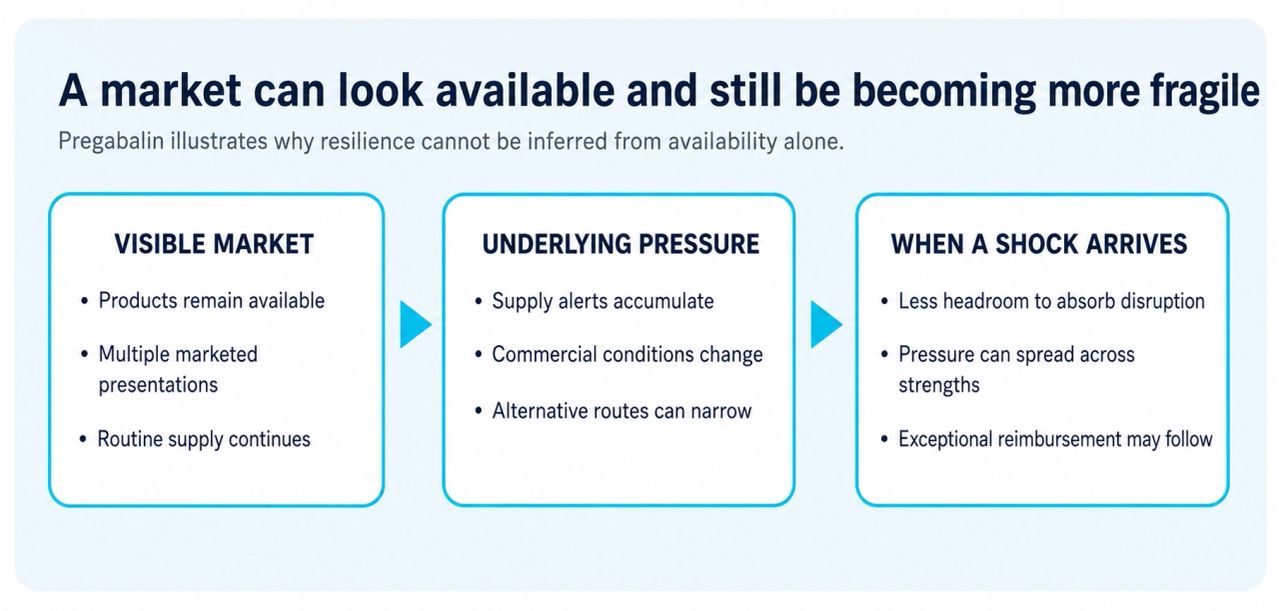
Figure 1. Availability and resilience are related, but they are not the same thing.
The challenge with structural risk
Most medicine shortages are discussed once supply has already been affected. Structural risk is different because the concern is not necessarily today’s availability. It is whether the market has enough alternative supply, commercial headroom and flexibility to withstand a future shock without the consequences escalating quickly.
That distinction matters for a medicine such as Pregabalin, which is widely prescribed across neuropathic pain, epilepsy and generalised anxiety disorder. A market can contain many marketed presentations and still be vulnerable if those products depend on common manufacturing routes, a limited number of active supply sources or similar upstream dependencies. The number of product listings is therefore not, on its own, a measure of resilience.
What has changed since our original analysis
When we first examined Pregabalin, the emphasis was on market structure. Since then, the picture has become more interesting. During 2026, price concessions have appeared across multiple Pregabalin capsule strengths, while supply evidence has continued to emerge around the product family. That does not establish a single common cause, and it does not prove that one strength is transmitting disruption to another. It does, however, mean that the resilience question is no longer purely theoretical.
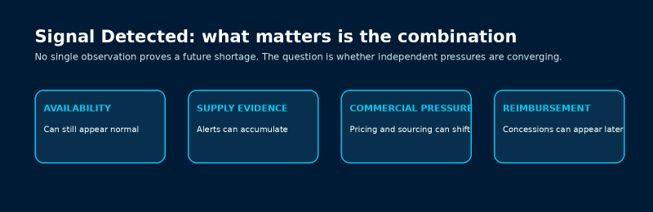
The important analytical point is the combination. A concession tells us that standard reimbursement has become insufficient for prevailing purchasing conditions for a particular presentation and month. Supply alerts tell us something different. Market structure tells us something different again. None should be treated as interchangeable, but when several forms of pressure begin to appear around the same medicine family, the pattern deserves closer attention.
Why a competitive-looking market can still be fragile
Competition is often assessed by counting suppliers or products. That is useful, but it can create a false sense of security if apparently independent products share important dependencies. Several brands may rely on the same manufacturing site, the same active pharmaceutical ingredient source, the same regulatory pathway or a small number of wholesalers and import routes.
The reverse is also true. A concentrated market is not automatically a fragile one. A small number of well-capitalised suppliers with robust capacity and contingency arrangements may be more resilient than a larger market in which every participant is operating with very little spare capacity or economic headroom.
This is why resilience is difficult to observe directly. During normal trading conditions, both markets may look similar. The difference becomes visible when something goes wrong.
The signal is not a prediction
There is an important distinction between identifying pressure and predicting a shortage. Early supply intelligence should not turn every unusual movement into a warning that disruption is inevitable. Many signals resolve. Manufacturing capacity returns, demand normalises, alternative sources become available or commercial conditions adjust.
The value lies in recognising when the evidence surrounding a medicine is changing. That allows organisations to investigate exposure and options while the market is still functioning, rather than waiting until a formal shortage or severe sourcing problem removes much of that flexibility.
What Pregabalin highlights
Pregabalin highlights a broader problem in medicine supply analysis. We are very good at recognising disruption once it has become visible. It is harder to assess whether the conditions that allow a market to absorb disruption are strengthening or weakening beforehand.
The absence of a shortage does not mean the absence of risk. Equally, the presence of a concession does not by itself prove a national supply shortage. The useful question sits between those two extremes: is the market becoming more sensitive to disruption, and are independent indicators beginning to support the same interpretation?
For procurement teams, manufacturers and pharmacies, that is a more useful question than asking whether a product is simply in stock today. Availability describes the present. Resilience helps determine how the market may respond when conditions change.
Signal lesson
The most important signal around Pregabalin may not be any single alert, price movement or reimbursement decision. It is the possibility that a market which still looks competitive on the surface can nevertheless be losing some of its ability to absorb shocks.
That is why market intelligence needs to look beyond the visible shortage. The opportunity is to understand changes in resilience while there is still time to investigate what they mean.
Editorial note
This Insight discusses observed market signals and public reimbursement developments. It does not disclose iethico’s underlying source architecture, signal weighting, thresholds or detection logic. The observations describe market pressure and temporal association, not proof of causation or certainty of a future shortage.