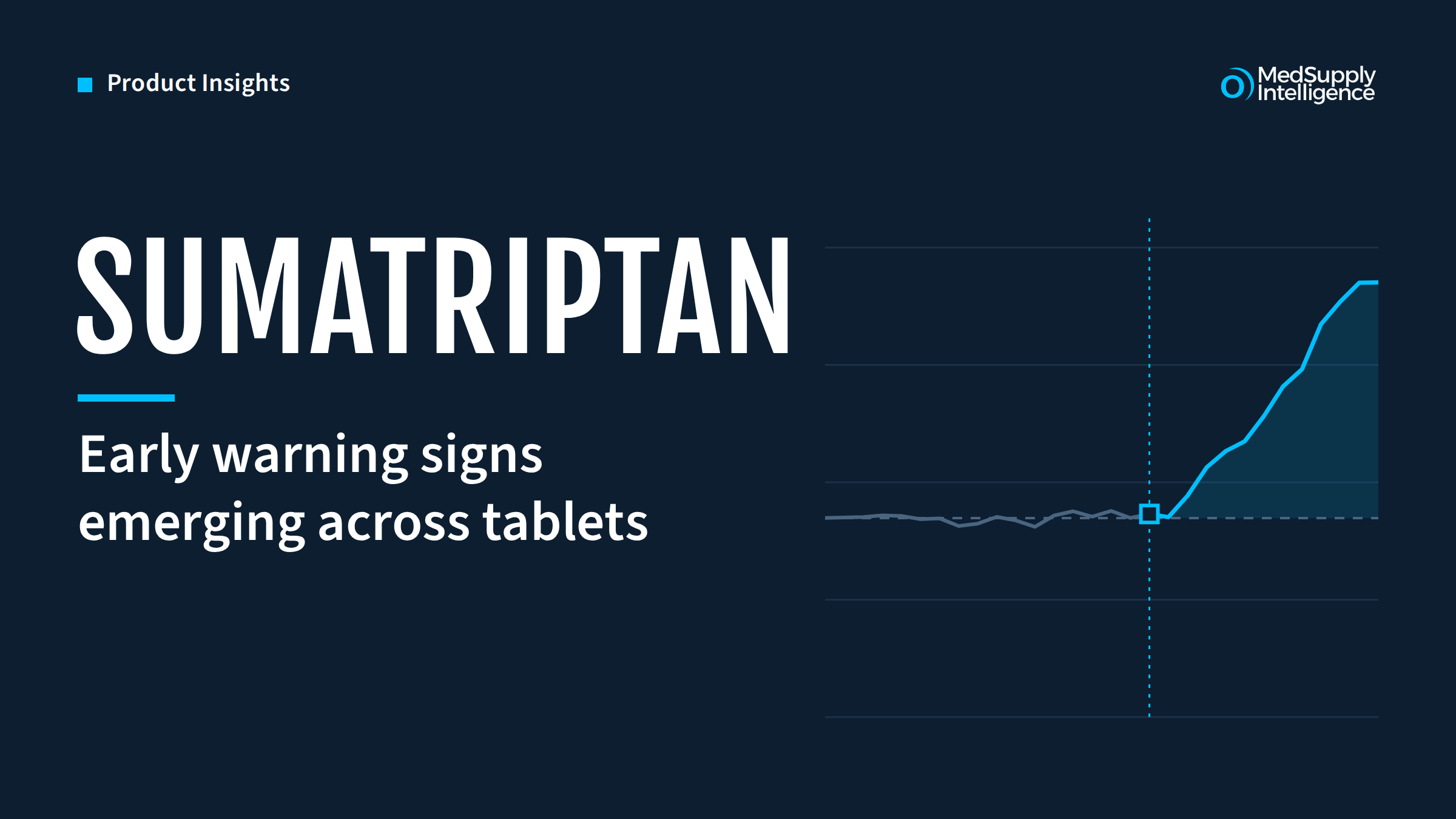
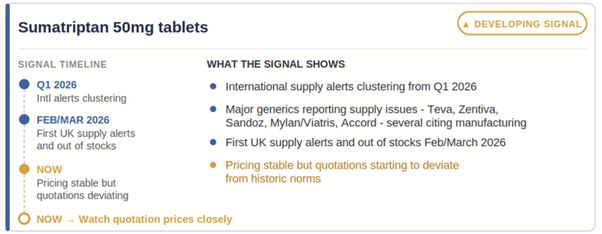
International shortage notifications and supply alerts around sumatriptan tablets have been building across multiple countries for months before significant UK market disruption has become visible.
Since late 2025, a growing number of international supply notifications, shortage alerts and wholesaler out-of-stock reports have begun appearing across both 50mg and 100mg tablet presentations.
What initially appeared to be isolated supply issues is now starting to resemble a broader international supply-pressure pattern.
Between August 2025 and March 2026, alert activity has expanded across Canada, Sweden, Finland, Ireland, Italy, Estonia, Austria, Belgium, Germany, Australia and the UK itself. Multiple major generic manufacturers have appeared repeatedly across the data, including Teva, Viatris, Accord, Sandoz, Zentiva, Mylan and others.
Importantly, the causes being reported are not uniform.
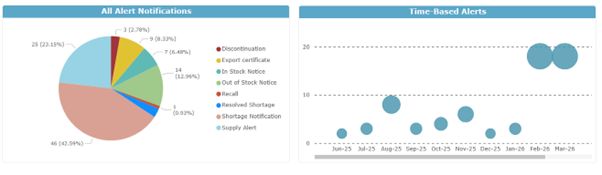
Across the available international and wholesaler data, the emerging disruption pattern includes:
-
manufacturing issues,
-
manufacturing delays,
-
export restrictions,
-
wholesaler out-of-stock notifications,
-
logistics and distribution disruption,
-
increased demand,
-
and product discontinuations.
That matters because multi-factor disruption signals often indicate broader deterioration in supply resilience rather than a single isolated supply event.
By February and March 2026, the frequency of notifications has accelerated materially.
At the same time, UK wholesaler alerts and out-of-stock notifications have started appearing more regularly.
However, broader UK market pricing still appears relatively stable.
That is the important point.
While official pricing conditions have not yet materially reacted, quotation behaviour is beginning to deviate from historic norms, particularly across sumatriptan 50mg tablet sourcing.
This is often where procurement risk first becomes visible:
not through formal price movement, but through widening quotation variance, supplier fragmentation and early sourcing instability.
That is the signal iethico highlighted to subscribers in the February MedSupply Intelligence newsletter, before issuing further warnings again during March as international alert clustering continues to intensify.
At this stage, the developing pattern suggests increasing supply-chain pressure beneath the surface of what still appears to be a relatively stable UK procurement environment.
The risk profile is particularly important because oral tablet demand for sumatriptan remains structurally high across the NHS.
Although some migraine patients use non-tablet formulations, the majority of triptan prescribing volume remains concentrated in oral tablets, with sumatriptan 50mg tablets continuing to represent a common first-line acute migraine treatment pathway.
That concentration creates vulnerability when disruption begins affecting multiple suppliers simultaneously.
The developing signal therefore is not simply about isolated shortages.
It is about the convergence of:
-
international alert clustering,
-
repeated manufacturer involvement,
-
expanding wholesaler disruption,
-
and early quotation instability appearing before wider market repricing.
This is not yet a full pricing event.
But by March 2026, the underlying supply environment is already showing signs of material deterioration.
That is the value of early signal detection.
Not reacting after the market breaks - but identifying pressure while there is still time to assess exposure, monitor quotation behaviour closely and prepare mitigation strategies before disruption fully escalates.