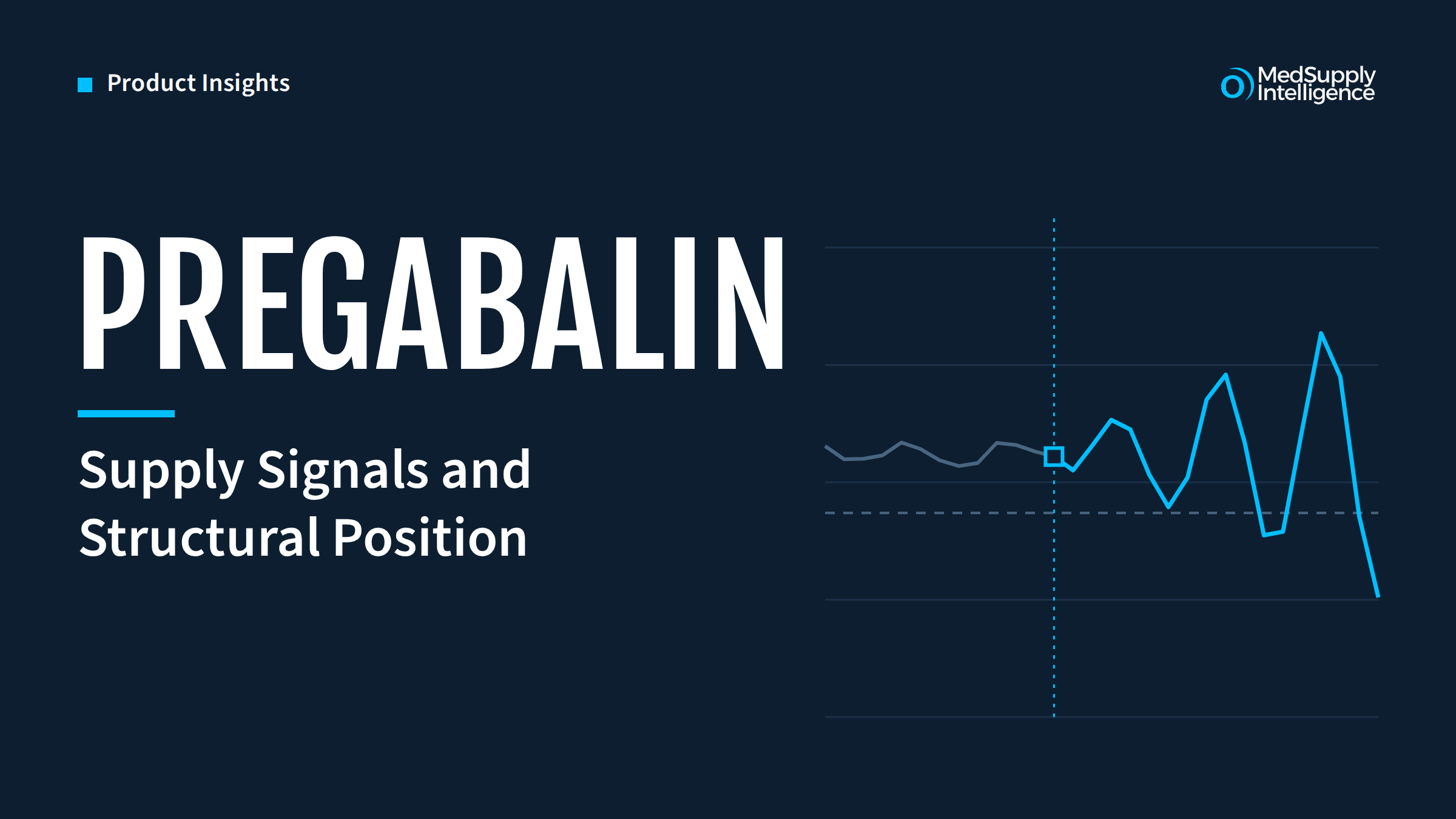
In early 2025, the UK market for pregabalin capsules appeared stable. Average prices were close to £1 per pack and the molecule had a large historical supplier base. To most observers, supply looked secure.
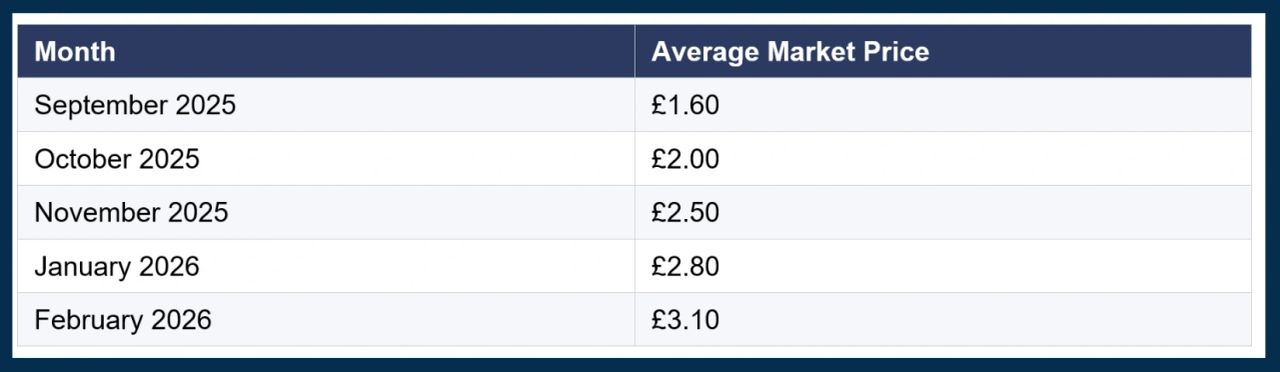
Within months, that picture changed materially. By February 2026, average market prices had reached £3.10. Wholesale availability became uneven, and quote volatility widened across multiple strengths.
The story of pregabalin is not an isolated fluctuation. It illustrates how supply stress develops through a sequence of upstream signals that become visible well before pricing and availability change in the domestic market - and why the time to act is before those changes arrive.
The Illusion of Market Stability
Demand: large, stable, and unforgiving
Pregabalin sits on a substantial prescribing base in England. Primary care dispensing averages approximately 1.4 to 1.5 million items per month, concentrated in the standard titration strengths of 50mg, 75mg, 100mg and 150mg. Secondary care adds further volume: NHS hospitals purchased approximately 14.6 million capsules in 2025.
Neither dataset suggests a demand shock. The prescribing base is large and stable. That stability is itself a vulnerability: when supply-side elasticity reduces, a rigid and high-volume demand base means disruption propagates quickly through the system with limited scope for absorption.
Supply: historical depth versus active redundancy
The supplier dataset for pregabalin capsules contains 254 capsule pack records across all strengths. On the surface, this suggests considerable depth. The reality is more constrained.
Approximately 42% of pregabalin capsule packs have been discontinued.
The timing of these exits reinforces the concern:
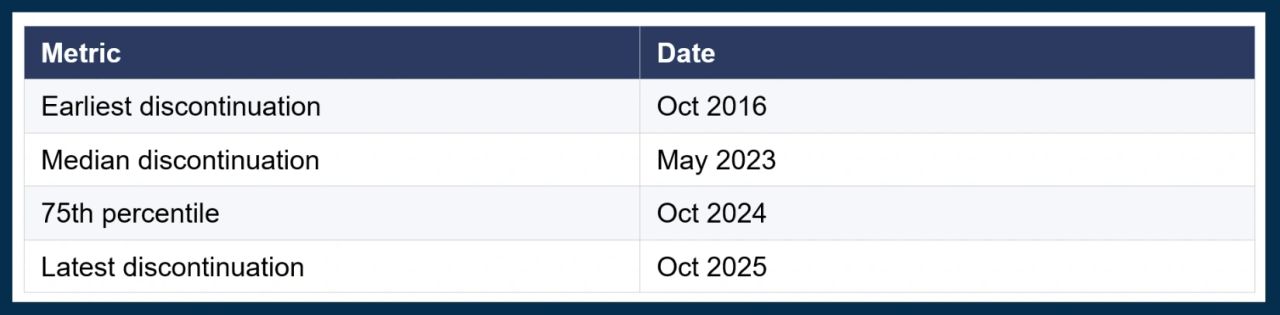
In addition, 37 capsule packs have been discontinued since March 2024. Supplier attrition has continued in recent years, not just in the early period following loss of exclusivity. The number of suppliers actively contributing to the market today is materially smaller than the headline licence count implies.
The gap between apparent supplier depth and effective market redundancy is the core structural vulnerability. A large historical licence pool does not mean a resilient active supply base.
How Supply Stress Develops: A Structured Framework
Medicine supply instability rarely appears suddenly. It tends to evolve through recognisable phases as resilience narrows and constraints accumulate. Understanding these phases is what separates anticipation from reaction.
Phase 1 - Emerging Supply Stress
The earliest visible signals that structural resilience is narrowing. Supplier concentration may increase. Manufacturing capacity may tighten. Alert activity begins to converge across jurisdictions. Availability fluctuates intermittently and procurement friction increases — but nothing is formally declared. The system simply no longer behaves as it does under stable conditions.
Phase 2 - Structural Strain
Supply continues, but with materially reduced elasticity. Allocation becomes more persistent. Stock depth reduces more broadly. Lead times extend. Economic behaviour begins to diverge from historical norms — prices drift upward, quote volatility widens, and reimbursement tension may emerge. Operational and economic signals begin to align. The market is functioning, but its capacity to absorb further shocks has narrowed significantly.
Phase 3 - Declared Shortage
The final visible stage. Stock becomes widely unavailable across distribution channels. National alerts or formal shortage notifications are issued. Therapeutic switching becomes necessary. Secondary sourcing becomes active. Clinical and procurement workload increases significantly. By Phase 3, the system is managing disruption rather than preventing it. The structural pressures that led to this point have typically been building for months.
Phase transition is not abrupt. It is the visible outcome of accumulated constraint. A medicine does not become unstable at the moment it is formally declared a shortage - by that stage, the window to act has already closed.
Tracking Pregabalin Through the Phases
Phase 1: Early signals present, domestic market stable (April - June 2025)
International supply alerts began appearing during spring 2025, but the UK domestic market remained stable. Average prices held between £1.05 and £1.15 per pack. The stress was visible upstream in international data but had not yet translated into domestic commercial behaviour.

The transition: alert volume surges (July - August 2025)
A clear structural shift occurred in July 2025. Supply alerts rose from 33 in June to 80 in July - an increase of more than 140% in a single month. Alerts began clustering across multiple suppliers simultaneously. This type of clustering typically indicates upstream manufacturing pressure rather than an isolated incident at a single site.
Prices began to drift upward but remained relatively contained through August.
Phase 2: Market response begins (September 2025 onwards)
From September 2025, persistent alerts began to influence commercial behaviour. Average market prices increased progressively across the following months:
Real-time order and quotation data reinforced this picture. Across multiple strengths, baseline prices typically sat between £0.80 and £2.00. Quotes periodically rose to £4 to £7. Quote volatility appeared before order prices moved - reflecting perceived supply risk within the wholesale market ahead of it manifesting in final transaction prices.
When similar quote behaviour appears simultaneously across several strengths, it typically indicates broader upstream pressure rather than a single pack issue.
The wide price separation between low-cost generics and branded Lyrica, priced at around £64 to £96, illustrates how far the market can move if generic supply tightens further.
Pricing is a lagging indicator. Quote volatility and international alert clustering are the earlier signals. By the time domestic order prices move materially, the low-cost procurement window has already narrowed.
Wholesaler Availability: Patchy and Narrowing
Although pregabalin capsules have a historically large licence pool, only a smaller subset of suppliers appears consistently active at any given time. Some lines remain available while others appear intermittently or not at all.
This patchy availability is typical of markets where supply continues but redundancy has narrowed. The system absorbs shocks less smoothly than the headline licence count suggests - and the data on recent discontinuations confirms that this redundancy has been reducing, not stabilising.
Where Pregabalin Sits Now
Based on the combined evidence, pregabalin capsules are positioned in Phase 2 - Structural Strain. Supply is continuing, but with reduced elasticity. The market has not yet reached the stage of stock being widely unavailable or formal national shortage notifications being issued. However, the conditions that typically precede that stage are clearly visible and progressing.
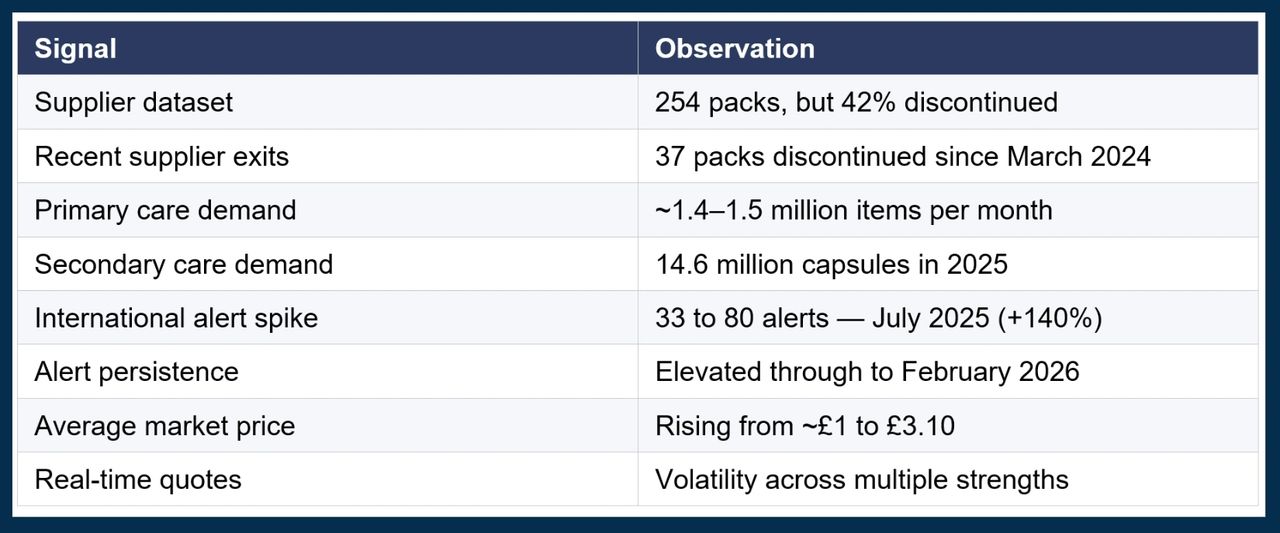
A concession price should be anticipated within one to two months. When it arrives, it will be the formal acknowledgement that supply cannot meet demand at current tariff prices - and it will mark the end of the pre-shortage window.
What This Means for Different Stakeholders
For pharmacy buyers and procurement teams
The time to review supply arrangements is now - before a formal shortage is declared and before pricing moves further. The pre-shortage window remains open, but the signals indicate it may not do so for long. Suppliers with robust, independent supply chains that are not exposed to the upstream concentration risk visible in this data are in a position to offer meaningful continuity of supply.
For wholesalers
Monitor real-time quote volatility across multiple strengths as a leading indicator. Quote widening ahead of order price movement has already been observed in this market. Inventory positioning decisions made now, ahead of further price movement, carry significantly more optionality than those made under pressure.
For medicines management and clinical teams
When a high-volume medicine like pregabalin enters the structural strain phase, the appropriate response is to begin modelling substitution pathways and clinical adaptations before urgency escalates. The window in which to plan - rather than react - is the period before a Phase 3 declared shortage. That window is still open for pregabalin, but narrowing.
Conclusion
Pregabalin capsules illustrate how medicine supply stability cannot be assessed by licence counts alone. Although the molecule retains a historically large supplier base, 42% of capsule packs have been discontinued - including 37 packs withdrawn since early 2024. Clustered international supply alerts emerged during spring and summer 2025, with market pricing responding several months later.
Demand remains large and stable, meaning even modest reductions in supply elasticity propagate quickly through the system.
The combined signals place pregabalin capsules firmly in Phase 2 - Structural Strain. Supply continues, but with reduced structural resilience. A concession price should be anticipated shortly.
Shortages are rarely sudden events. They are the final, visible stage of accumulated pressure within a tightly interconnected supply architecture. Understanding how they form is what determines whether they can be anticipated - or only managed after the fact.