 Gabapentin 600mg tablets have become a live test case for the limits of generic price erosion
Gabapentin 600mg tablets have become a live test case for the limits of generic price erosion. Over the course of 2025, prices collapsed, reimbursement lurched, and supply instability intensified, all while prescribing demand remained widespread and largely unchanged.
The data now raises an uncomfortable but necessary question: have we already reached rock bottom on gabapentin pricing, and is the market operating below a level that can support reliable supply?
A Market That Repriced Itself - Quickly
At the start of 2025, market-facing prices for gabapentin 600mg, orders and quotations, were routinely in the £40 - £50 per pack range. Within months, those prices collapsed.
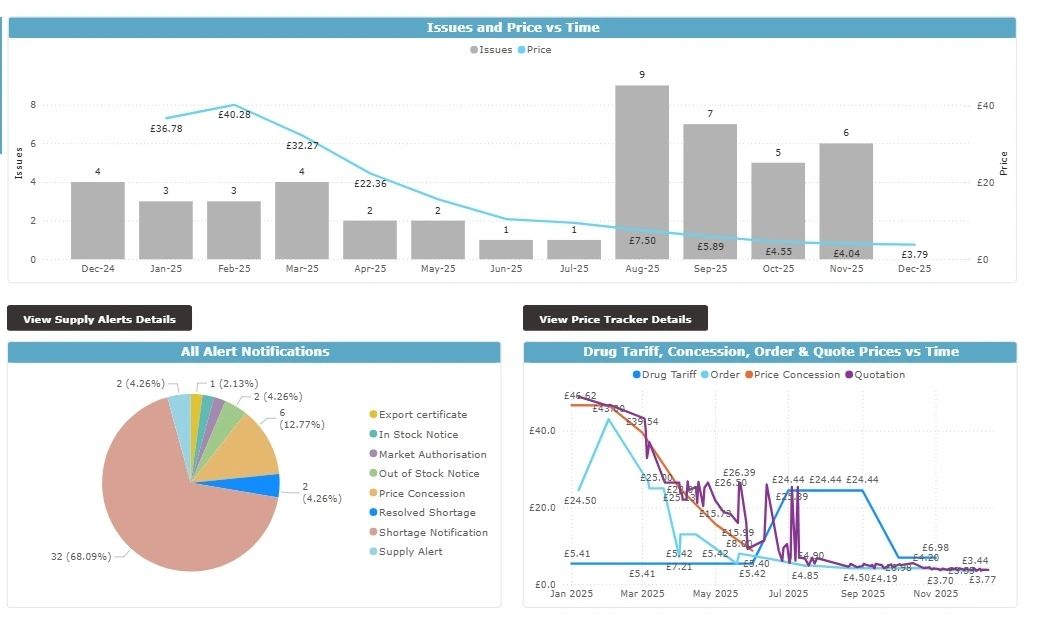
Order pricing shows the clearest signal of where the market settled:
Volatile through Q1 2025, ranging from the mid-£20s to high-£40s,
A sharp correction in April into single digits,
Followed by stabilisation through the rest of the year around £3.40 - £5.00 per 100 tablets.
This was not a slow adjustment driven by reimbursement policy. It was a rapid commercial reset driven by supplier behaviour. By early summer, the market had already found its price floor.
Quotations: Stress, Volatility, Then Capitulation
Quotation data captures the stress phase in real time.
Early 2025 quotations mirror order prices at around £45 - £50. As the market destabilised in spring, quotation prices became highly volatile, swinging between the mid-teens and mid-£20s as suppliers tested what the market would bear.
By June and July 2025, that volatility disappeared, not because stability returned, but because quotes converged downward, clustering tightly around £3.50-£5.50. Once suppliers accepted the new floor, there was no rebound.
Quotations didn’t signal a recovery. They signalled resignation.
Price Concessions: Recording the Collapse, Not Preventing It
Price concessions followed a near-linear downward trajectory:
~£46.60 in January and February 2025,
~£39.54 in March,
~£25.13 in April,
~£15.73 in May,
falling to ~£8.78 by June.
This matters because it shows concessions were reactive, not protective. They did not hold prices up or stabilise supply. They simply documented how fast prices were falling once the market had already turned.
By the time concessions reached single digits, the damage was already done.
Drug Tariff: Late, Blunt, and Temporary
The Drug Tariff followed a completely different timeline.
From January to June 2025, the tariff sat flat at around £5.41-£5.42.
In July, it jumped sharply to around £24.44, where it remained through the summer.
By October and November, it fell back again to around £6.98.
This was not a smooth corrective mechanism. It was a delayed intervention, applied after market prices had already collapsed and withdrawn again within months.
Crucially, when the tariff rose sharply in the summer, market prices did not follow. Orders and quotations remained anchored in low single digits. The tariff uplift failed to pull prices back up, highlighting how disconnected reimbursement had become from commercial reality.
Supply Signals Replace Price Signals
As pricing fell and reimbursement lagged, supply instability increased.
Supply alert data shows gabapentin 600mg tablets among the most frequently flagged products, with shortage notifications dominating alert types. This pattern is not isolated to one formulation; multiple strengths and presentations of gabapentin show recurrent disruption.
When prices stop signalling scarcity, alerts take their place. In the gabapentin market, supply alerts have become the primary indicator that the system is under strain.
Prescribing Demand Has Not Disappeared
This is not a demand story.
Prescribing data shows gabapentin 600mg remains widely and consistently used across England, with broad geographic distribution and no evidence of structural decline. It remains embedded in long-term treatment pathways for neuropathic pain and epilepsy.
Stable, inelastic demand combined with falling prices creates the most fragile market conditions of all. Suppliers cannot rely on demand growth to offset margin erosion, and exit decisions translate directly into shortages.
Market Authorisation Does Not Equal Market Resilience
While multiple Market Authorisation Holders exist for gabapentin 600mg, authorisation alone does not guarantee active supply.
At very low price points, suppliers can:
remain authorised but supply intermittently,
reduce batch frequency,
or deprioritise the UK market entirely.
What looks like a competitive market on paper often functions as dependence on a very small number of commercially viable suppliers. As prices fall, that active base narrows further.
What Pharmacies See on the Ground
Wholesaler availability reflects this fragility.
Tariff-aligned generic lines appear inconsistently available, while higher-priced branded or semi-branded alternatives remain visible, often at prices far above expected reimbursement. The result is a two-tier market:
low-price generics that are unreliable,
higher-price options that are commercially unusable for routine dispensing.
For pharmacies, this means margin risk, time lost sourcing stock, and repeated workarounds. For patients, it means delays and uncertainty.
International Shortages: An Early Warning, Not a Distraction
It is notable that a significant proportion of recent gabapentin 600mg supply alerts originate outside the UK, including in Sweden, Germany, Spain, Australia, and other European markets.
This does not weaken the case that pricing has reached rock bottom. It strengthens it.
International markets often experience supply disruption before the UK, particularly when global manufacturing issues, regulatory changes, or API constraints arise. Manufacturers prioritise markets with higher or more stable realised prices, meaning disruption can surface elsewhere before it becomes visible in the UK.
In this context, international shortages function as early-warning indicators. They show that the global gabapentin supply chain is already under strain, even while UK prices remain anchored at the bottom of the curve.
The UK’s ultra-low pricing delays the visible impact, but it does not prevent it. Once supply tightens upstream, there is little commercial buffer left to protect UK availability.
Have We Hit Rock Bottom?
Prices may not have much further to fall numerically. Orders, quotes, and concessions have already converged at low single-digit levels, and they have stayed there even when reimbursement briefly rose.
By one definition, that looks like rock bottom.
But rock bottom is not defined by how cheap a product becomes. It is defined by what breaks first.
In the case of gabapentin 600mg, what is breaking is:
supply reliability,
supplier participation,
and the alignment between price, reimbursement, and availability.
International alerts suggest this fragility is not local or temporary, it is systemic.
The Bigger Question
If this is rock bottom, the real question is what comes next.
If prices remain this low, supply fragility is likely to persist. If reimbursement rises again, there is no guarantee market prices will follow. And if global disruption continues to build while UK pricing remains inert, shortages risk becoming routine rather than exceptional.
Gabapentin 600mg shows that there is a point at which lower prices stop delivering value and start eroding access.
The evidence increasingly suggests we are already there.
The question now is whether the system recognises that, or whether it will keep digging.