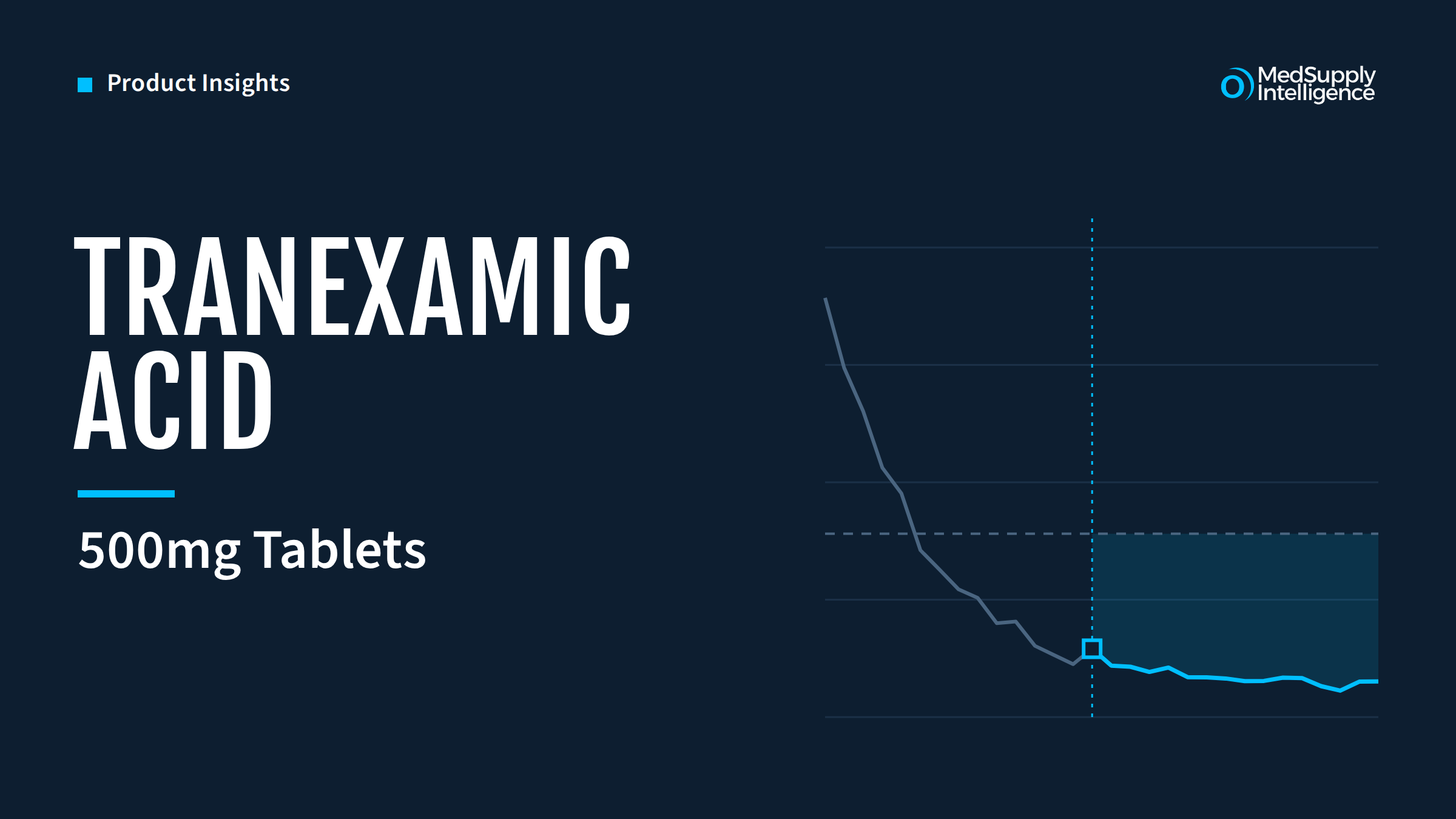
Stability Is Not the Same as Security.
Tranexamic acid is one of the UK’s most prescribed haemostatic agents. Familiar, affordable, and deeply embedded in both primary and secondary care pathways - it rarely attracts attention.
That relative invisibility is part of what makes it worth examining closely.
This review sets out the observable signals across market structure, pricing, prescribing behaviour and international supply. It does not draw directional conclusions. It presents what the data shows.
The Molecule
Tranexamic acid (TXA) is a synthetic lysine analogue that inhibits fibrinolysis by blocking the binding of plasminogen to fibrin. It is used across a wide range of clinical indications including menorrhagia, trauma-associated haemorrhage, surgical blood loss, and dental procedures in anticoagulated patients.
The molecule is available in several formulations - oral tablets, injections, mouthwash and oral liquid - but prescribing activity and commercial exposure in the UK are overwhelmingly concentrated in the 500mg tablet presentation.
This is not incidental. The tablet corridor has become the structural centre of gravity for the molecule, and it is where supply, pricing and demand signals converge.
**What the Market is Showing Familiar **
**1. Supplier Depth has Narrowed **
Over the past decade, the number of active marketing authorisation holders for tranexamic acid 500mg tablets in the UK has declined. Several well-known generic operators exited during 2019, with further withdrawals occurring after 2021.
Current supply remains operational. However, the number of genuinely independent manufacturing bases behind that supply is lower than it once was. Some active suppliers are distribution-led rather than manufacturer-led, which affects true redundancy within the system.
Fewer suppliers does not mean shortage. It does mean reduced flexibility if pressure arrives.
**2. Reimbursement has compressed materially **
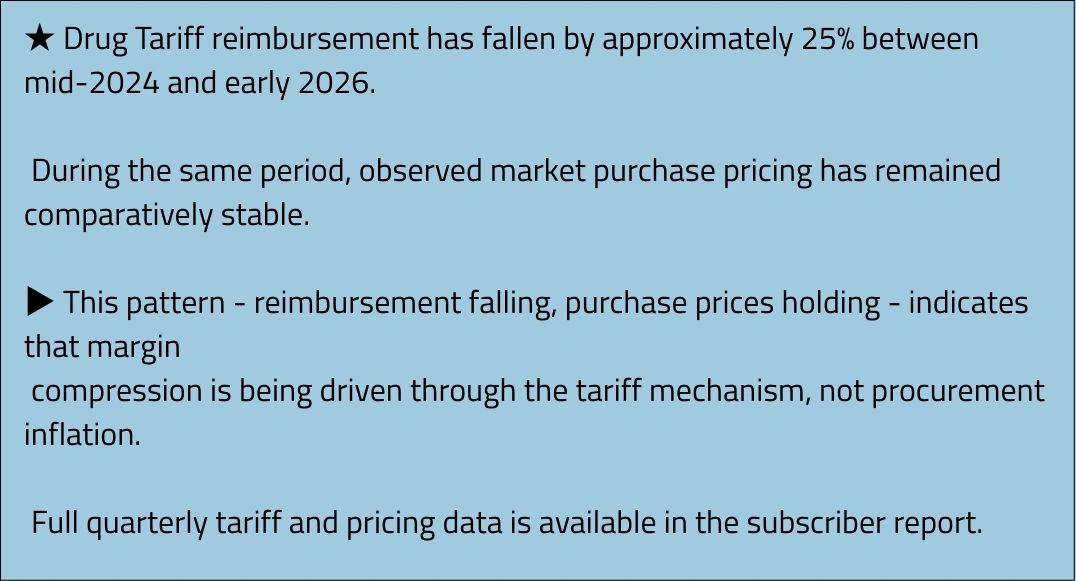
Tranexamic acid 500mg tablets sit within Category M of the Drug Tariff. Reimbursement for the standard 60-tablet pack has declined significantly since mid 2024.
**3. Demand is structurally rising **
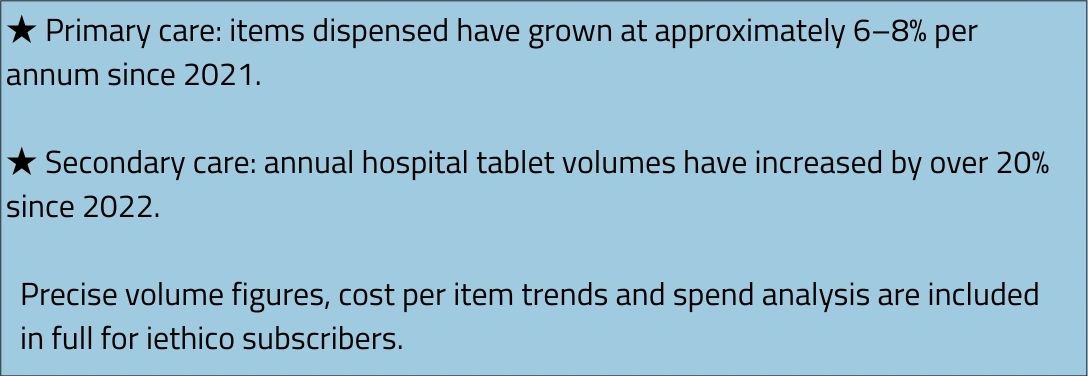
Community prescribing volumes have grown consistently since 2021, with annual items increasing year on year across the period. Growth has continued even during periods when individual wholesalers reported temporary out-of-stock notices - suggesting that demand is structurally embedded rather than episodic.
Hospital usage has followed the same trajectory. Secondary care volumes have risen across 2022 to 2025 while unit costs per tablet have fallen. Volume growth alongside unit cost compression reflects the same economics being observed in community settings.
**4. International supply alerts are accumulating **
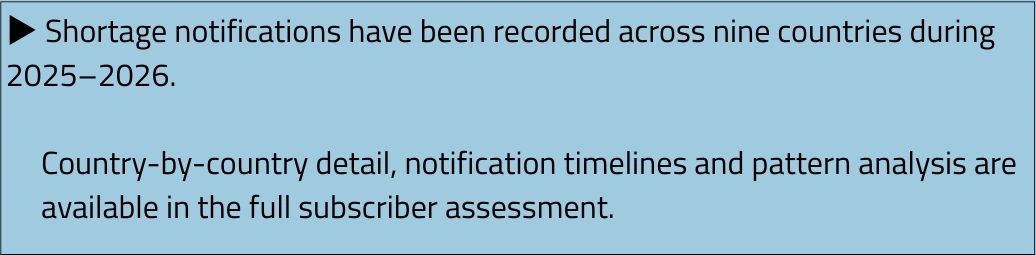
Throughout 2025 and into 2026, shortage notifications affecting tranexamic acid 500mg tablets and related presentations have been issued across multiple European markets and in Australia.
Reported causes vary and include manufacturing constraints, increased demand, and distribution issues. The UK has not entered a sustained national shortage phase, though intermittent wholesaler out-of-stock notices have occurred, particularly for the branded Cyklokapron presentation.
The pattern is notable because it indicates upstream strain and demand displacement effects rather than a single localised disruption.
**The concentration risk **
One feature of this molecule that does not always receive attention is how concentrated operational exposure has become.
Tranexamic acid exists across multiple formulations. In practice, the 500mg tablet carries almost all of the prescribing weight. Oral liquids and injectables are not scalable substitutes for routine tablet-based prescribing in primary care, and alternative formulations do not show comparable behavioural volume.
The molecule appears diversified. The risk is not.
**Where this leaves the market **
Tranexamic acid 500mg tablets remain available in the UK. Supply is operational.
The observable signals - narrowing supplier depth, sustained reimbursement decline, rising demand in both care settings, and accumulating international notifications - point to a market operating with less resilience than in previous years.
Supply continues. The system has absorbed pressure so far. The question is how much shock absorption remains.