The shortage was not the first sign of disruption
Originally analysed June 2026 | Updated September 2026
When a formal shortage alert appears, it is easy to treat that moment as the beginning of the problem. Verteporfin shows why that can be misleading. The UK shortage recognised in spring 2026 was part of a much longer period of constrained global supply, with pressure around this specialist ophthalmology medicine extending back several years.
That history matters because it changes how we interpret the latest alert. Rather than a sudden failure in an otherwise stable market, Verteporfin illustrates what can happen when a medicine operates with limited manufacturing resilience for a prolonged period. New disruption does not arrive into a neutral system. It arrives into a market that may already have spent years adapting to restricted supply.
A shortage with a long history
Verteporfin 15mg powder for solution is used in photodynamic therapy for retinal conditions and ocular oncology. Its supply difficulties are not new. The Royal College of Ophthalmologists reported that the medicine had been in short supply globally since late 2020 because of capacity constraints at the manufacturing site. In the UK, limited stock has repeatedly required prioritisation so that the patients with the greatest clinical need can continue to receive treatment.
By April 2026, the Royal College reported that remaining licensed supplies and available unlicensed imports would be reserved for ocular cancer and selected photodynamic therapy for central serous chorioretinopathy, with the shortage then expected to continue until September 2026. This was therefore not simply an isolated 2026 event. It was the latest stage of a supply problem with a much longer history.
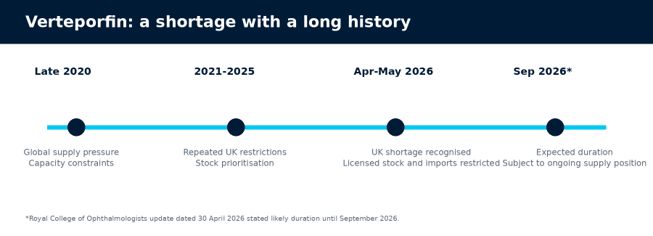
Figure 1. Publicly visible milestones in the Verteporfin supply story.
Why specialist medicines behave differently
A shortage affecting a specialist medicine can look very different from one affecting a high-volume generic. The number of patients may be smaller, but the consequences of constrained supply can be substantial when manufacturing capacity is limited and therapeutic options are narrow.
In these markets, resilience depends on more than whether stock is available today. It also depends on how much spare capacity exists, whether alternative sources can be accessed, how quickly production can recover and whether healthcare systems have realistic alternatives if supply tightens again. When those options are limited, relatively small changes in production or availability can have disproportionate downstream effects.
Verteporfin demonstrates this particularly clearly. The response to constrained supply has included clinical prioritisation and careful management of remaining stock. Those measures help protect access for patients with the greatest need, but they also reveal something about the underlying market: there is little room for supply disruption to be absorbed invisibly.
The alert is a milestone, not necessarily the start
One of the recurring challenges in medicines supply is that formal notifications are highly visible while the conditions preceding them are not. An alert gives the market a clear reference point, but it may arrive after manufacturers, regulators, procurement teams and clinical services have already been responding to pressure for some time.
This does not reduce the importance of formal alerts. They are essential for coordinating action and communicating risk. It does, however, mean that an alert should be interpreted in context. For a medicine such as Verteporfin, the more useful question is not simply when the latest shortage was announced, but what the preceding history tells us about the resilience of the market in which that shortage occurred.
What this case highlights
Verteporfin is a useful reminder that supply resilience is cumulative. A market can adapt to one disruption, then another, and continue to provide treatment through prioritisation, imports and careful stock management. From the outside, that adaptation can look like stability. In reality, the system may be operating with progressively fewer options.
The distinction matters for early intelligence. The objective is not to assume that every historical disruption will recur, or that a long-running supply issue makes a future shortage inevitable. It is to recognise that the same new event can have very different consequences depending on the resilience of the market it enters.
Looking beyond the latest shortage
The Verteporfin story is therefore less about predicting a single shortage than understanding the conditions around it. Public evidence shows repeated constraints, prolonged prioritisation and continuing limits on supply. The latest alert matters, but so does the history that came before it.
For organisations responsible for medicines supply, that wider perspective can change the question from “Is this medicine currently in shortage?” to “How much resilience does this market have if pressure returns?”
That is a more difficult question to answer, but it is also the one that creates the opportunity to recognise vulnerability before the next disruption becomes obvious.
Public sources
· Royal College of Ophthalmologists, Medicines shortages, Verteporfin 15mg powder for solution for infusion vials, updated 30 April 2026.
· Royal College of Ophthalmologists, Shortage of verteporfin (Visudyne) 15mg powder for solution for injection: update, 18 October 2023.
· Royal College of Ophthalmologists, clinical prioritisation guidance for limited stock of Verteporfin for photodynamic therapy.