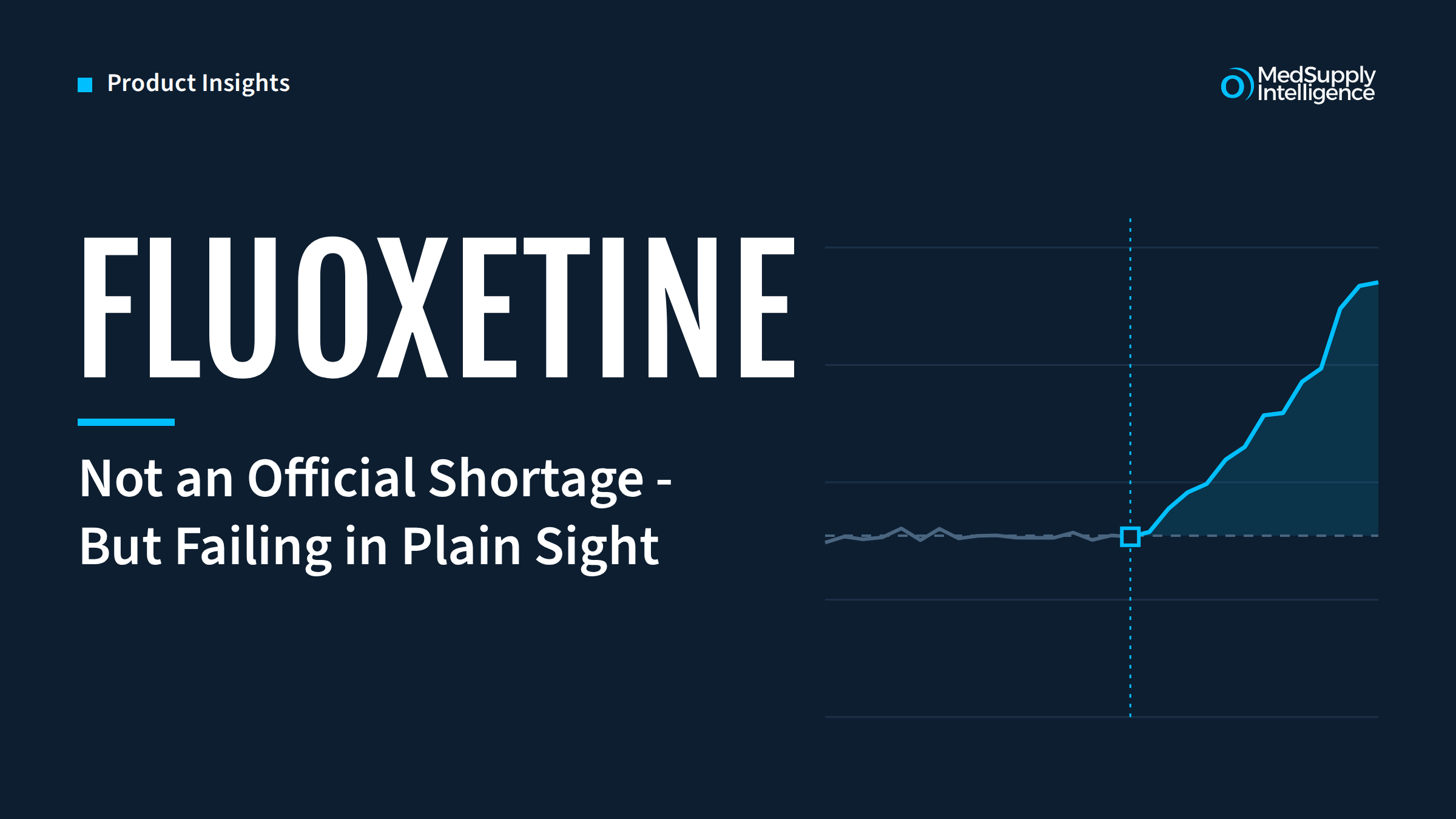
Fluoxetine is one of the most established medicines in modern mental healthcare. It is widely prescribed, long off-patent, and assumed to be low risk from a supply perspective.
That assumption is no longer supported by the evidence.
Across the past year, fluoxetine has exhibited a familiar but often-missed pattern: early upstream disruption, accumulating international alerts, delayed UK recognition, pricing distortion, and frontline impact - all without ever being formally labelled a “shortage.”
This is exactly the type of medicine where early signal monitoring matters most.
The First Signals: Quality Disruption Outside the UK
The earliest warning signs did not come from UK systems at all.
In 2025, fluoxetine products were subject to multiple international recalls across major regulatory jurisdictions, including the United States, Canada, and Singapore. These recalls were driven by nitrosamine impurities (N-nitroso-fluoxetine) exceeding interim acceptable intake limits.
While framed as quality events rather than supply failures, the practical impact is the same:
-
affected batches are withdrawn
-
alternative supply is required at short notice
-
manufacturing lines face disruption and scrutiny
-
and effective global supply tightens
Crucially, these recalls affected core fluoxetine strengths, including 20mg capsules - the backbone of routine prescribing.
At this stage, none of this was visible in UK shortage reporting.
International Alerts: Pressure Builds, Quietly
Following the recall activity, fluoxetine began to generate a steady accumulation of non-UK supply alerts: shortage notifications, export certificates, out-of-stock notices, and discontinuations.
There was no single dramatic spike. Instead, alerts built gradually over time, month after month, across different regions and notification types.
This persistence is the key signal.
It marks the pre-shortage phase - where supply resilience is eroding, but not yet acknowledged.
This same pattern was observed with rosuvastatin. Fluoxetine is tracing the same path.
UK Signals Arrive Late - but Consistently
Only much later did the first UK-facing signals begin to appear.
In early 2026:
-
community pharmacies started reporting supply alerts for fluoxetine 20mg capsules
-
wholesalers reported out-of-stock notices
-
and manufacturers’ products became intermittently unavailable
These were not policy announcements. They were front-line warnings.
By the time wholesalers are reporting depletion, upstream disruption has already propagated through the system.
Yet even at this point, fluoxetine remained officially “available”.
Pricing Confirms What Supply Signals Suggested
Pricing data removes any remaining ambiguity.
Acquisition Prices Diverge
Over the past six months, UK acquisition prices for fluoxetine have diverged sharply by formulation and strength.
Most strikingly, fluoxetine 20mg capsules - the highest-volume presentation - show a substantial cumulative increase, while other strengths soften or decline.
This is not inflation. It is concentrated supply stress.
Tariff Lag Creates Risk Transfer
Over the same period, the drug tariff price remains flat or declines slightly, signalling stability that does not exist in the market.
This mismatch matters.
When tariff prices lag real acquisition costs, financial risk is pushed downstream - onto wholesalers and community pharmacies.
Order and Quotation Prices Reveal Scarcity
The divergence becomes stark when viewed across pricing layers:
-
order prices spike suddenly in early 2026
-
quotation prices surge to multiples of historical norms
-
emergency sourcing replaces routine supply
At this point, availability is no longer reliable. It is conditional.
Primary Care: Rigid Demand Meets Fragile Supply
Fluoxetine’s risk profile is amplified by primary care showing deep, inflexible demand.
Prescribing is:
-
continuous
-
repeat-based
-
and clinically cautious to change
Once patients are established, switching molecules or formulations is not trivial.
This creates a structural imbalance: demand does not flex when supply tightens.
The fact that the most disrupted presentation is also the most heavily prescribed in primary care is not coincidence — it is causality.
Secondary Care: The Last Illusion Falls Away
Secondary care data shows stable, embedded use of fluoxetine 20 mg capsules over time.
Hospitals are partially insulated by contracts and stockholding — but only temporarily.
Once upstream disruption persists:
-
contract pricing becomes misaligned
-
spot purchasing increases
-
and secondary care is exposed to the same distorted market as community pharmacy
When a routine antidepressant reaches hospital procurement friction, the system is already late.
What “Availability” Looks Like in Practice
Live wholesaler listings tell the final part of the story.
Fluoxetine is listed —> but:
-
at wildly divergent prices for the same molecule
-
with inconsistent availability flags
-
and with liquid and specialist formulations among the most volatile
Prices range from under £1 to over £12 per pack depending on supplier and presentation.
This is not resilience. It is fragmentation.
When the Data Reaches the Counter
The final signal does not come from dashboards.
It comes from pharmacists.
Community pharmacy posts now describe being asked to pay to dispense fluoxetine, as acquisition prices exceed reimbursement.
This is not an operational failure at pharmacy level. It is the inevitable consequence of delayed recognition.
By the time pharmacists speak publicly about loss-making supply, the shortage is no longer emerging - it is embedded.
The Repeatable Failure Pattern
Fluoxetine follows a now-familiar sequence:
-
Upstream quality disruption outside the UK
-
Sustained international supply alerts
-
Delayed UK pharmacy warnings
-
Wholesaler and manufacturer out-of-stocks
-
Pricing divergence and tariff lag
-
Pharmacies absorbing financial and clinical risk
This is not sudden. It is predictable.
The Insight
Fluoxetine does not need to disappear from shelves to be in trouble.
When a high-volume primary care medicine becomes:
-
unevenly available
-
economically unstable
-
and clinically hard to substitute
the shortage has already begun - even if it hasn’t been named.
The failure is not lack of data. It is how late the system chooses to listen.
Early signal monitoring doesn’t predict shortages. It recognises them while there is still time to act.