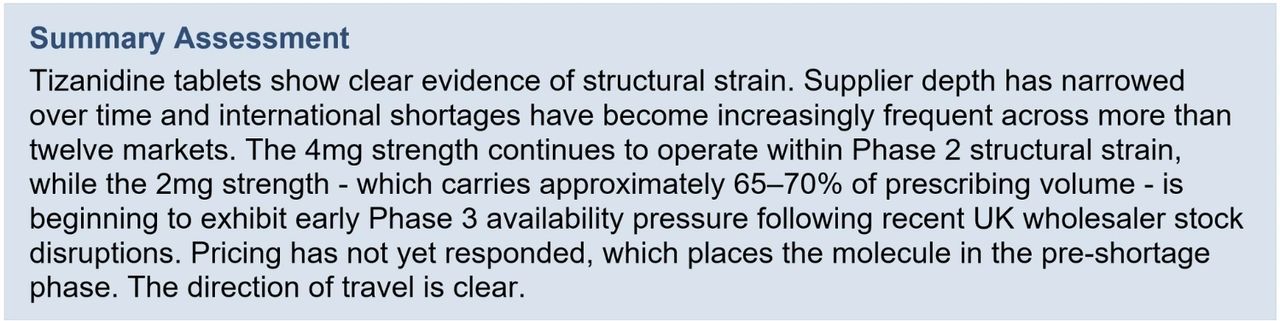
Tizanidine is a mature generic molecule used in the management of spasticity, with stable, well-established prescribing across both primary and secondary care in England. For much of its history as a generic, it has been an unremarkable market. That is beginning to change. A pattern of supply signals - emerging first across European markets and now visible within the UK distribution layer - indicates that this molecule is entering a period of structural stress that warrants close attention from procurement teams, pharmacy buyers and medicines management leads.
This analysis draws on six months of supply alert data, international shortage notifications, pricing movements and prescribing volumes to assess the current position and the direction of travel.
1. Demand Context
Understanding the demand picture is the starting point for any supply analysis, because it establishes whether disruption is being driven by demand expansion or supply contraction. In the case of tizanidine, the answer is unambiguous.
Annual prescribing in England is approximately two million items across both strengths. The split between them is consistent:
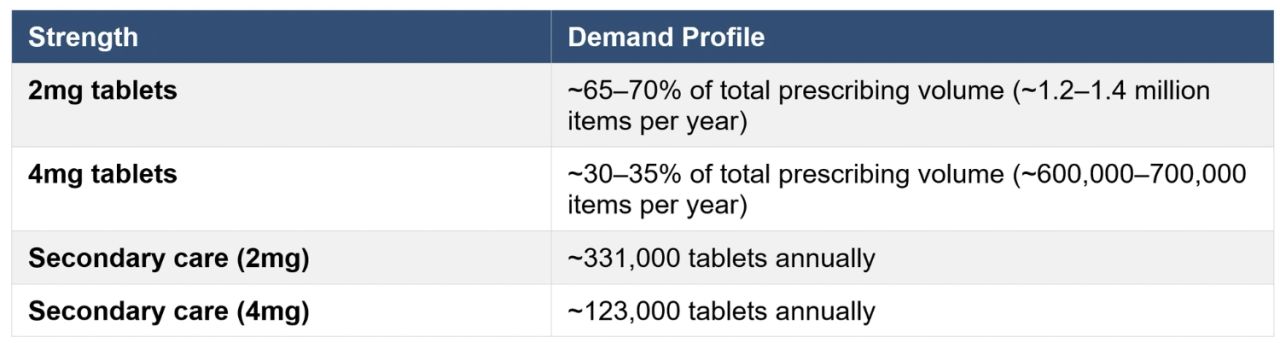
Prescribing volumes are stable. There is no evidence of a recent demand shock or significant shift in clinical practice that would explain emerging supply pressure. Any disruption to availability is therefore more likely to reflect conditions on the supply side than changes in demand.
2. Supplier Structure
The headline licence count for tizanidine tablets appears moderate. However, the active AMPP dataset tells a more revealing story: 25 product presentations have been discontinued, compared to 16 that remain active. A discontinuation-to-active ratio of approximately 1.6:1 reflects sustained long-term attrition within this market.
This is a pattern common to mature generic molecules where years of sustained price compression have gradually reduced supplier participation. Several of the remaining active licences represent distribution arrangements rather than independent manufacturing sources, which means the true effective supply base is narrower than the licence count implies.

3. International Supply Signals
Over the six months to March 2026, supply alerts and shortage notifications for tizanidine tablets have been recorded across more than twelve countries. The breadth of this geographic spread is significant.
3.1 Countries Reporting Disruption
• Baltic states: Lithuania, Estonia, Latvia - repeated notifications, early in the sequence
• Northern and Western Europe: Netherlands, Denmark, Austria - persistent alerts including consecutive notifications in the Netherlands across December 2025 and January 2026
• Southern Europe: Portugal, Slovenia, Spain
• Western Europe: Ireland - manufacturing delays cited by a major supplier
• Wider: Czech Republic, Canada
• United Kingdom: wholesaler-level stock disruption from February 2026 onward
The sequence matters. Smaller European markets tend to experience supply disruption first, because manufacturers typically prioritise supply allocation toward higher-volume markets. When shortages begin in peripheral markets and then migrate toward major western markets over a three-to-nine-month period, it is a recognised early-warning pattern. That sequence is playing out here.
3.2 Alert Volume by Strength
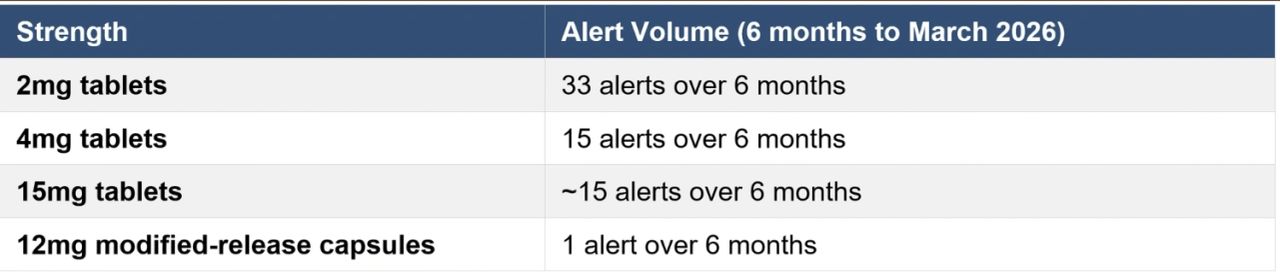
The concentration of alerts in the 2mg strength is not coincidental. Lowest-strength presentations are typically the first to destabilise in a shortage cascade: they carry thinner commercial margins, fewer manufacturing lines are dedicated to them, and they are used for titration - meaning patient demand cannot easily be redirected to a higher strength.
3.3 Export Restrictions
In February 2026, Portuguese authorities introduced export restrictions on multiple tizanidine 2mg presentations, citing limited availability. Export bans of this kind represent a material escalation. They occur when domestic supply has tightened to the point where parallel trade risks depleting local stock, and regulators intervene to protect their own market. Historically, export restrictions appearing before any significant price movement indicate a market that is typically six to twelve months from a formal shortage.
**3.4 Reported Causes **
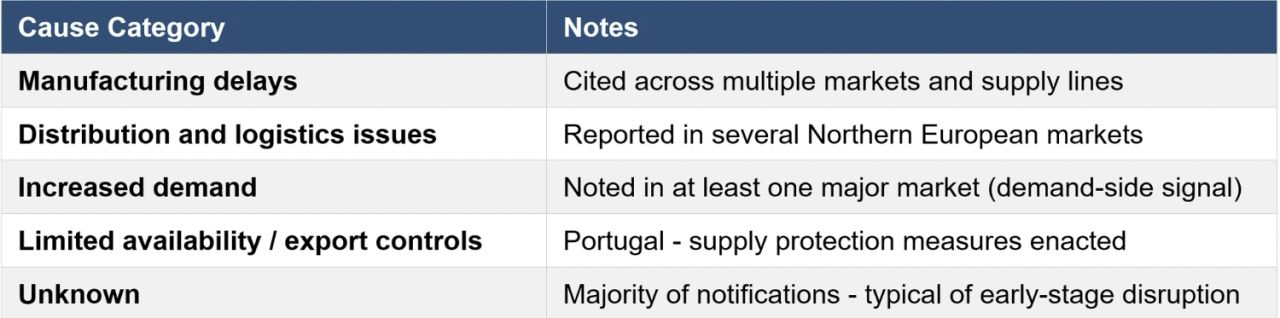
The diversity of reported causes is itself informative. When a single molecule generates disruption notifications across multiple markets with multiple stated causes, it typically indicates systemic supply fragility rather than an isolated manufacturing incident. A single site failure tends to produce a cluster of notifications with a common cause. What is visible here looks more like broad structural pressure across the supply chain.
4. UK Supply Signals
Supply pressure that begins in European peripheral markets generally takes several months to become visible in the UK distribution layer. For tizanidine, that transmission is now underway.
From February 2026 onward, the UK has seen a sequence of wholesaler-level out-of-stock notices and community pharmacy supply alerts. These are not yet formal shortage notifications, but they represent the earliest stage of domestic distribution disruption - a point at which stock is still circulating through the market but redundancy is visibly reducing.
The alert activity is concentrated in the 2mg strength, consistent with the international pattern. The 4mg strength has also seen a UK community pharmacy supply alert, which may indicate the early stages of cascade progression to the next strength.
5. Pricing Behaviour
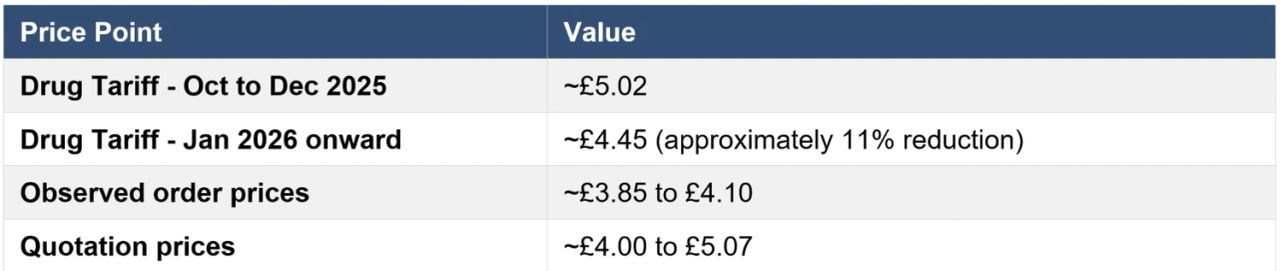
Pricing data is available for both main strengths and covers the six-month period from October 2025 to March 2026.
5.1 Tizanidine 2mg Tablets
5.2 Tizanidine 4mg Tablets
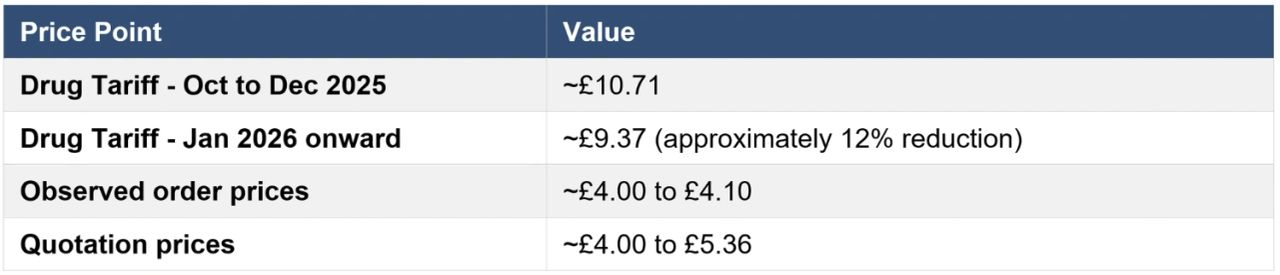
The pricing picture is notable for what it does not show. Across both strengths, tariff prices have fallen and order prices remain stable. In a market where supply alerts are rising and international shortages are multiplying, this divergence between supply stress and pricing behaviour is unusual - and instructive.
It indicates that the commercial layer has not yet recognised or responded to the underlying supply risk. Suppliers are still competing on price. Stock is still moving. The market looks, from a pricing perspective, broadly normal. This is the characteristic appearance of the pre-shortage phase: structural pressure building beneath a surface that has not yet shifted.

6. Supply Chain Concentration
Reading across the international alert dataset, a pattern emerges beyond the simple count of notifications. A significant proportion of the disruption notifications across multiple European markets reference the same branded product lineages - products associated with a small number of manufacturing sources that appear to supply a broad spread of national markets.
When shortages appear simultaneously across markets as geographically and commercially distinct as the Baltic states, the Netherlands, Ireland, Portugal and the UK, a common explanation is more likely than a series of unrelated local events. Markets that do not share wholesalers or distribution infrastructure can still share upstream manufacturing supply. Simultaneous multi-country disruption strongly suggests that the root cause sits at the manufacturing or API supply level, upstream of national distribution.
This has a specific implication for supply resilience. A market that appears to have multiple suppliers - based on licence counts - may in practice have significant concentration at the manufacturing level, where several apparent competitors draw from the same production source or the same active pharmaceutical ingredient supply chain. When that upstream source experiences disruption, the effect propagates across the entire downstream market simultaneously, regardless of how many brand names or licence holders are nominally present.

7. Phase Assessment Summary
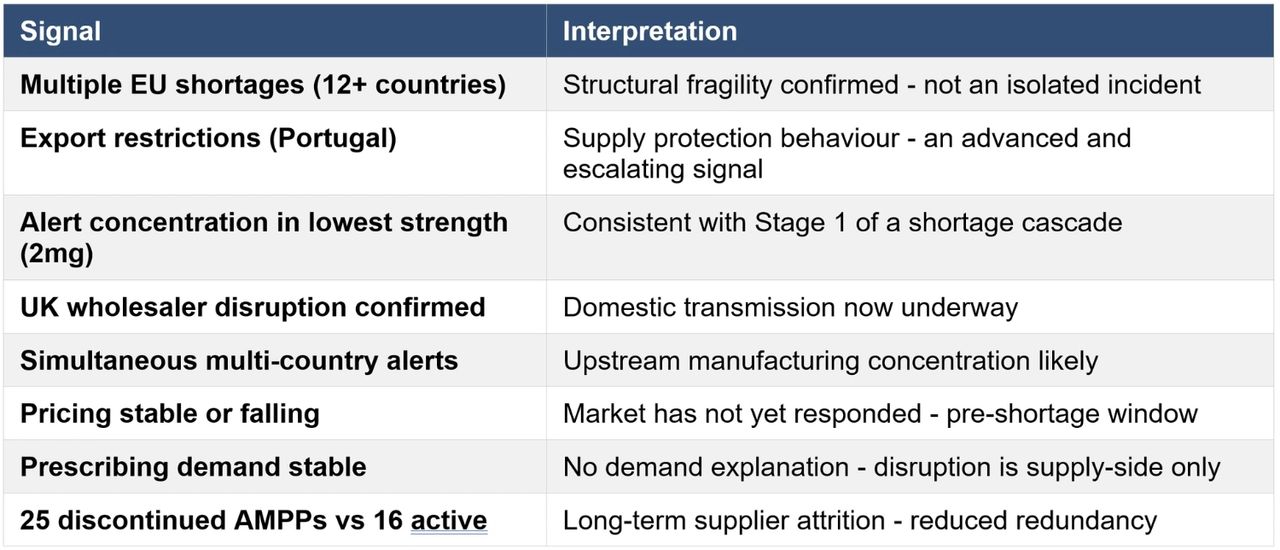
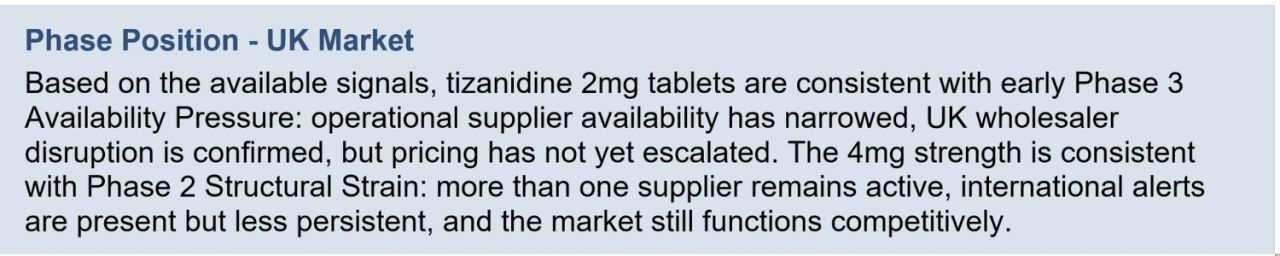
Taken together, tizanidine tablets appear to be transitioning from structural strain toward availability pressure, with the 2mg strength leading that transition. The market continues to supply demand, but with materially reduced resilience. The conditions that typically precede a formal shortage - narrowing supplier base, international cascade, domestic distribution disruption - are visible and progressing.
8. What to Watch Next
The two signals most likely to indicate that the molecule is moving from pre-shortage into active shortage are:
• UK price concession granted for tizanidine 2mg - this would be the formal acknowledgement that supply cannot meet demand at current tariff prices, and typically precedes a significant period of disruption
• Supply alerts increasing materially for the 4mg strength - the early UK community pharmacy alert for 4mg already warrants monitoring; escalation here would indicate the cascade is progressing to the second strength
Beyond those two triggers, the international situation in the Netherlands warrants particular attention. Consecutive shortage notifications with no published end dates suggest an unresolved supply problem that has now persisted for several months - and the Netherlands has historically been an early indicator of broader European shortage trajectories.
9. Market Implication
For procurement teams, medicines management pharmacists and pharmacy buyers, the picture that emerges from this analysis is one of a market that still functions but carries significantly less redundancy than it did. The time to assess supply arrangements is before a formal shortage is declared, not after.
For the 2mg strength in particular, the combination of high prescribing volume - representing the majority of all tizanidine demand - and a supply base that has contracted over time creates a situation where relatively modest further disruption could have a disproportionate impact on availability.
Suppliers with robust, independent supply chains that are not exposed to the manufacturing concentration risk visible in this dataset are in a position to offer meaningful continuity of supply during a period when that cannot be taken for granted. The window in which to establish those supply relationships - before pricing moves and before demand for alternatives intensifies - is open now, but the signals suggest it may not remain open for long.