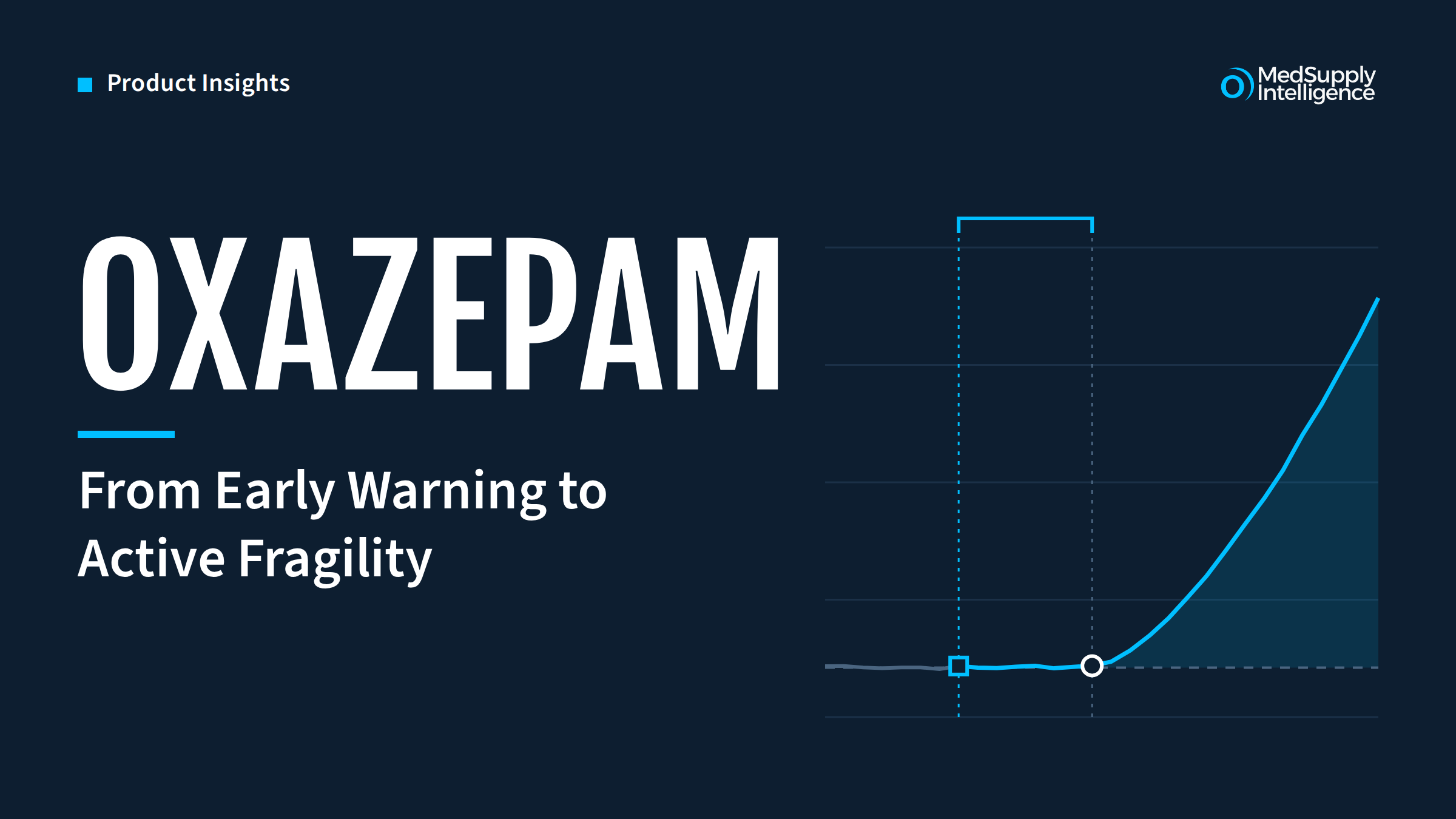
In December, we analysed the UK oxazepam market and concluded that it was entering a high-risk phase.
The signals were not dramatic at the time, but they were consistent:
-
Sustained decline in prescribing volumes
-
Withdrawal of major generic manufacturers
-
Absence from acute and mental health formularies
-
Increasing supply alerts
-
Narrowing commercial viability
Individually, each of these can be managed.
In combination, they indicate structural weakness.
At that point, the instability could still be interpreted as intermittent pressure, largely affecting the 10mg strength.
Three months later, that interpretation is no longer supported by the data.
What Has Changed?
Disruption Across Multiple Strengths
Recent weeks have seen repeated supply alerts for both 10mg and 15mg presentations.
When instability spreads across strengths, it rarely reflects localised distribution issues. It signals upstream fragility - whether in manufacturing depth, API sourcing, or commercial incentive to supply.
This is no longer isolated volatility.
It is portfolio-level instability.
Concession Pricing Across Strengths
Since January, price concessions have been issued for both strengths, with notable increases in reimbursement levels.
Concessions across multiple presentations do not occur in stable markets. They reflect sustained imbalance between available supply and dispensing demand.
Where concessions persist, structural stress is typically already embedded.
No Recovery in Supplier Depth
The supplier base remains narrow.
Major manufacturers have previously exited, and there has been no meaningful replenishment of active commercial supply. While marketing authorisations may exist on paper, effective availability remains concentrated among a very small number of functioning suppliers.
Markets with limited depth are not inherently unstable - but they are exposed.
When demand is declining and secondary care support is absent, that exposure increases.
The Structural Context
The underlying conditions identified in December remain unchanged:
-
Prescribing volumes continue to trend downward
-
Demand is geographically concentrated
-
Secondary care does not initiate or anchor procurement
-
The product relies primarily on long-term community patients
Without institutional demand support or a growing initiation base, commercial resilience erodes gradually.
When that erosion coincides with manufacturing consolidation, instability becomes predictable.
The Pattern
What we are observing follows a recognisable progression often seen in legacy generics markets:
-
Demand declines
-
Manufacturer participation reduces
-
Supply depth narrows
-
Alerts increase in frequency
-
Concessions appear
-
Operational burden escalates
By the time multi-strength concessions and repeated alerts are visible, fragility has typically been developing for some time.
Short-term availability may continue.
That does not equate to structural stability.
Beyond a Single Molecule
Oxazepam is not simply a product story.
It illustrates a broader vulnerability within segments of the generics market where:
-
Prices remain suppressed until supply stress emerges
-
Secondary care disengages
-
Supplier attrition occurs gradually
-
Early signals are interpreted as temporary
The ability to distinguish between noise and structural progression is increasingly important.
Our December analysis was not based on isolated indicators, but on the interaction between prescribing behaviour, formulary positioning, supplier participation and pricing signals.
When those elements align, markets move through identifiable phases.
Oxazepam has now transitioned from early warning to active fragility.
The more important question is how many other molecules share similar characteristics - and which phase they are currently in.
Talk to Us
If you would like to explore structural risk exposure within your portfolio or understand how fragility patterns develop before disruption becomes operational, we are happy to discuss.