Is Britain’s generic medicines market losing its ability to absorb shocks?
An iethico analysis of reimbursement pressure, price concessions and market resilience.
A price concession exists because, for a particular medicine in a particular month, the standard Drug Tariff reimbursement price is no longer adequately reflecting prevailing market conditions.
It is, in effect, a correction mechanism. But what happens when the correction mechanism starts being used far more often?
In 2025, an average of 99.6 Medicinal Products per month received a price concession. Between January and July 2026, that average had risen to 198.7. Almost exactly double. June reached 249.
Something changed.
The obvious conclusion would be that medicine supply simply became more difficult in 2026. Our analysis suggests the more interesting question is what was happening before the concessions appeared.
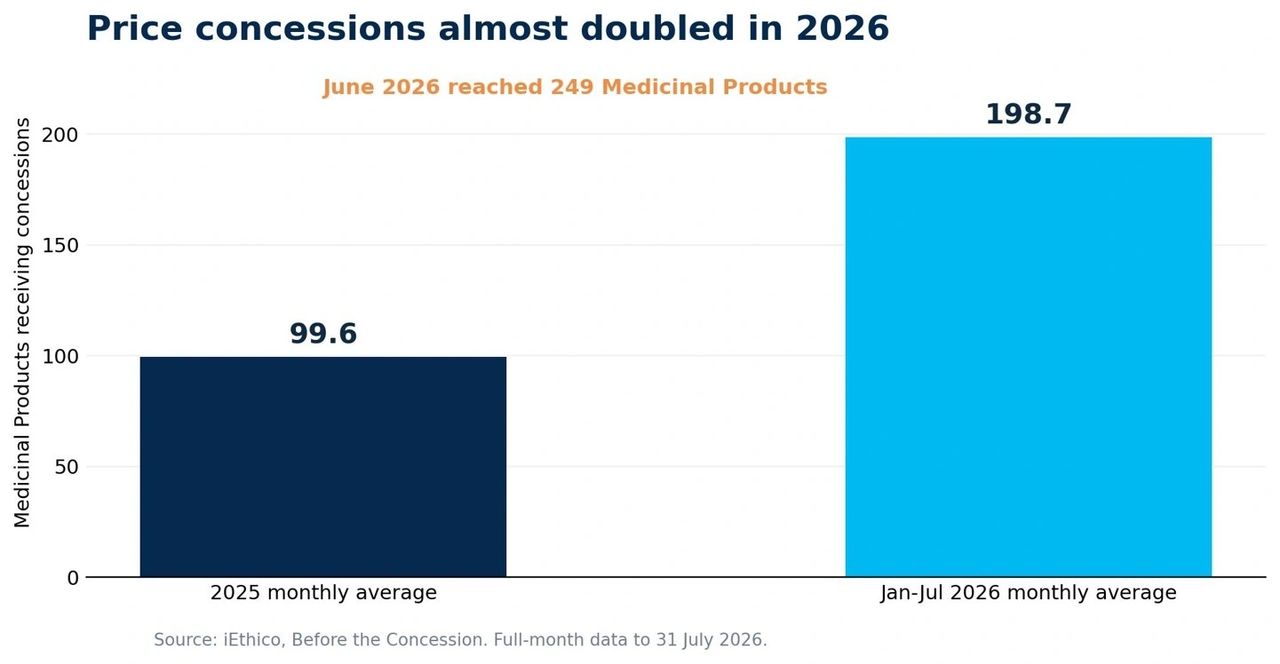
Figure 1. Price concessions became markedly more common in 2026. Source: iethico, Before the Concession.
The story starts in 2025, not 2026
To understand the rise in concessions, it is worth looking at the reimbursement environment that preceded it.
During 2025/26, the NHS was recovering previously over-delivered medicines margin from community pharmacy. That recovery mattered because it put downward pressure on reimbursement.
But there was another, less widely discussed part of the agreement. The 2025/26 Community Pharmacy Contractual Framework stated that while excess margin was being recovered, concessionary prices would be constrained so they did not undermine that recoupment.
That creates an interesting tension inside the system. On one side, recover excess medicines margin. On the other, respond when real market conditions move beyond Drug Tariff reimbursement.
Those objectives are not necessarily incompatible. But when the market is under pressure, they can start pulling in opposite directions.
During 2025, Category M reimbursement was subject to repeated adjustments as medicines margin was reconciled. Then, in 2026, the policy direction began to change.
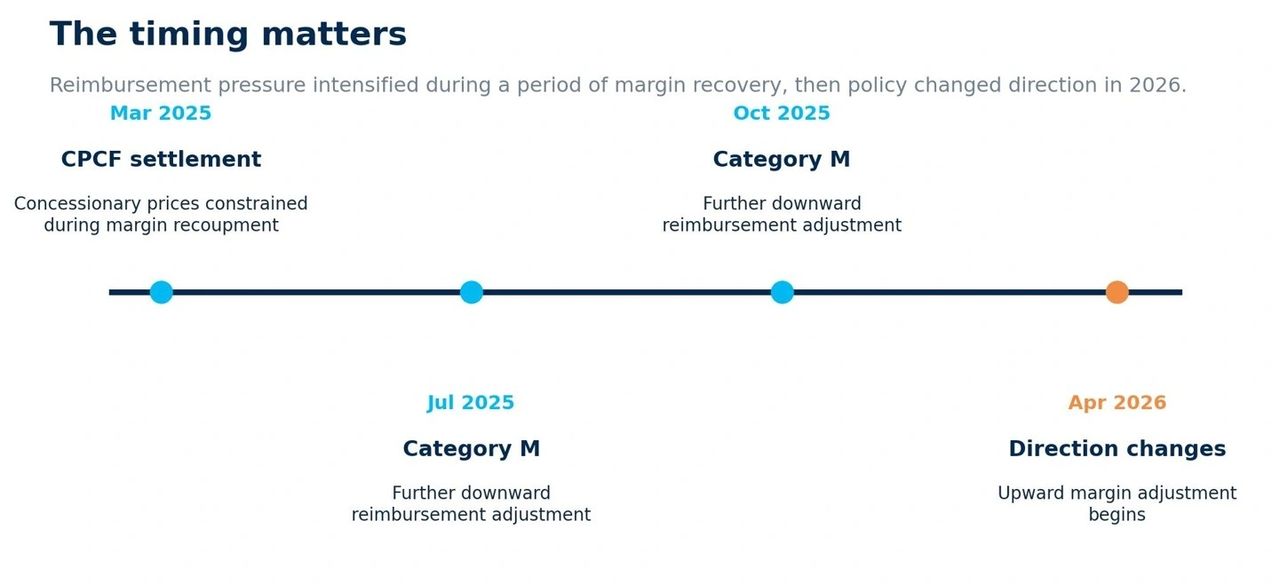
Figure 2. A simplified policy timeline. The purpose is to show direction and timing, not to attribute causation.
2026 looks different
The change is difficult to dismiss as normal monthly volatility. Concessions became progressively more common through the first half of 2026, culminating in the June peak.
But counting concessions alone only tells us when the reimbursement system finally responded. It does not necessarily tell us when the underlying pressure began.
That distinction matters. Our wider medicine intelligence work has found that commercial and supply pressure often develops as a sequence, with different parts of the market responding at different times. International supply evidence, availability, quotations, completed procurement prices, Drug Tariff and concessions need not move simultaneously.
Across the historical concession events examined in our Before the Concession research, 73.6% had relevant supply evidence during the preceding six months.
The answer is not straightforward. That is precisely why it is interesting.
Not every falling price tells the same story
One of the dangers in analysing medicine pricing is assuming that every large price reduction has the same meaning. It does not.
Take apixaban. Its reimbursement price fell dramatically, but apixaban had undergone loss of exclusivity and substantial generic competition. A steep decline in price in that environment is not, by itself, evidence of a dysfunctional market. It may be evidence of the generic medicines system doing exactly what it is supposed to do.
The same consideration applies to other medicines experiencing patent expiry, new generic competition or significant changes in market structure.
Likewise, some medicines entering concession have experienced identifiable supply disruption. Manufacturing problems happen. Demand changes. Suppliers exit markets. Raw-material availability changes. Regulatory interventions occur.
None of these events can reasonably be attributed to Drug Tariff pricing simply because reimbursement happened to fall beforehand. So we deliberately avoided that conclusion.
Instead, we looked at the pattern more broadly. And that revealed something more interesting.
What happens when an efficient market gets a shock?
The generic medicines market is designed to generate competition. Competition drives prices down. That is one of the reasons the UK has historically been able to procure many established medicines at extraordinarily low prices.
But price efficiency and market resilience are not necessarily the same thing.
Consider a market where several manufacturers compete for a medicine with sufficient economic headroom for suppliers to hold capacity, respond to demand and tolerate temporary changes in input costs. One manufacturer experiences a production problem. Other suppliers may have room to respond.
Now imagine the same market after years of aggressive price competition. The manufacturing problem has not been caused by the reimbursement price. But there may be less economic headroom, fewer attractive sources of marginal capacity and less incentive for additional supply to enter quickly.
When 94p became £9
Consider ezetimibe 10mg tablets. This is an established generic medicine. By June 2026, its Drug Tariff price was £0.94.
Market conditions subsequently required a price concession. The first concession price was £6.99. Following further representations from Community Pharmacy England, DHSC redetermined the concession. The final June price became £9.00.
That was nearly ten times the original Drug Tariff reimbursement price.
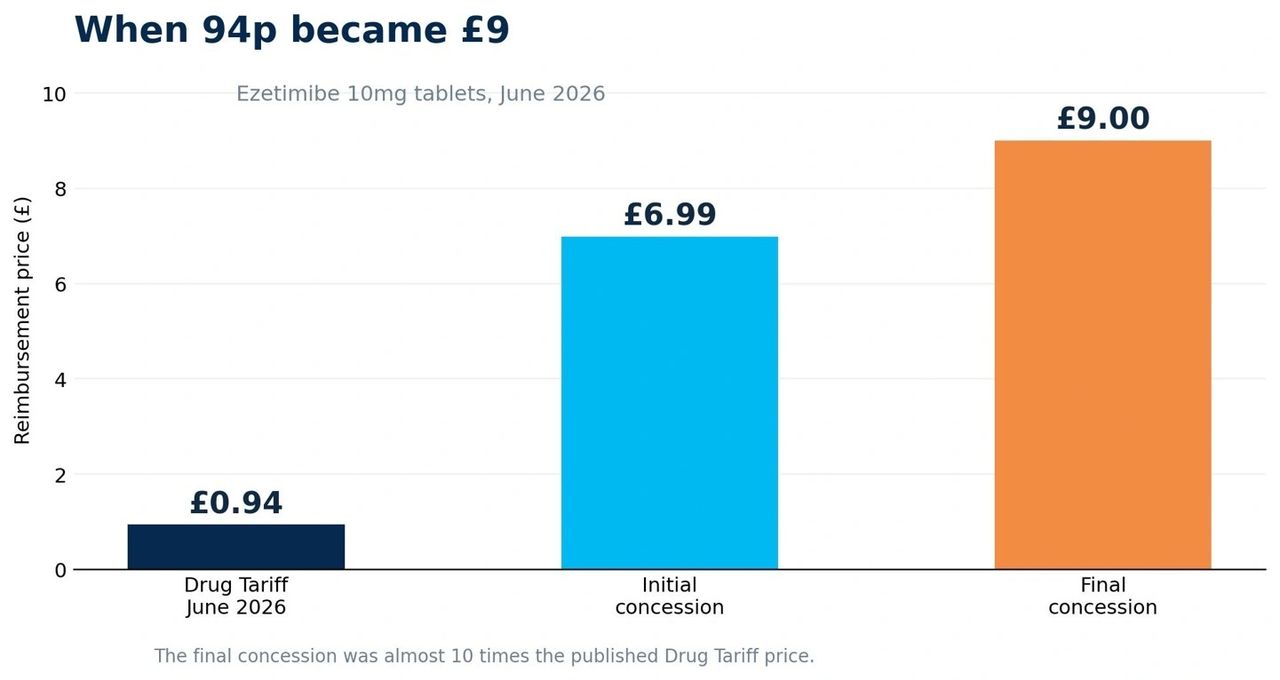
Figure 3. Ezetimibe 10mg tablets in June 2026. The concession mechanism ultimately moved reimbursement from £0.94 to £9.00.
That does not prove that the 94p tariff caused a supply problem. It tells us something different.
At that moment, the standard reimbursement benchmark and the market conditions facing pharmacies had become profoundly disconnected. And the correction mechanism itself needed correcting.
The pattern isn’t confined to one medicine
Other established generics show similarly striking trajectories. Fluoxetine oral solution experienced a substantial reduction in reimbursement before subsequently requiring concessionary pricing. Venlafaxine 75mg tablets moved from materially higher historical reimbursement to a much lower Drug Tariff before requiring a concession. Later in 2026, a formal supply notification was also issued for the presentation.
Lamotrigine, nicorandil, betahistine, esomeprazole and other established generic medicines appear within the wider pattern.
The important point is not the exact percentage movement of any one product. Nor is it that every one of these medicines followed an identical pathway. They did not. That variability is itself informative.
Our previous research found exactly this phenomenon: medicine pressure does not manifest simultaneously in every dataset. Availability, quotations, completed acquisition prices and reimbursement can diverge substantially during the same episode.
What matters is the accumulating pattern. And in 2026 that pattern became considerably harder to ignore.
The reimbursement system started changing direction too
There is another reason the timing matters. As concessions accelerated, reimbursement policy itself began moving in the opposite direction.
From April 2026, Category M received an upward medicines-margin adjustment. The 2026/27 settlement subsequently increased allowed medicines margin from £900 million to £1.1 billion, while substantial historic over-delivery was written off rather than continuing to be recovered through lower prices.
In other words, after a period characterised by recovering margin and downward reimbursement adjustments, the system began putting money back in. Yet concession activity remained elevated.
There is another warning sign
Our Before the Concession analysis looks beyond published reimbursement alone. Among tariff-matched packs observed through iethico’s UK community-pharmacy procurement panel, the share whose median completed-order price exceeded Drug Tariff rose from 6.3% in January 2026 to 10.6% in July, reaching 12.4% in June.

More strikingly, among those observed packs already above tariff, the proportion without a concession rose from 9.5% in January to 20.0% in July.
That distinction is important. A concession is visible. It is published. It is measurable. But it may be one of the later manifestations of the problem. The market can move first.
The exception is becoming the signal
There is a tendency to view price concessions as administrative noise. A product becomes temporarily expensive. A concession is granted. The market normalises. Move on.
At low volumes, that interpretation may be reasonable. But when concessions approximately double year on year, their collective meaning changes.
The exception itself becomes information.
Not necessarily information that a shortage exists. Not proof that reimbursement policy caused the problem. And certainly not evidence that every low-priced generic is economically unsustainable.
It is something subtler. It is evidence of a growing number of occasions on which normal reimbursement is no longer sufficient for prevailing market conditions.
Once that happens often enough, the important question is no longer why an individual product required a concession. It is why the system requires so many exceptions in the first place.
Cheap medicines are valuable. Fragile medicines are not.
There should be no argument against competition. Nor against obtaining value for taxpayers. Generic competition has generated enormous savings for the NHS and should continue to do so.
But the lowest theoretical acquisition price cannot be the only measure of whether a medicines market is functioning well.
Resilience has value too. Multiple viable suppliers have value. Spare manufacturing capacity has value. Commercial incentives to re-enter a stressed market have value. And the ability to absorb an unexpected manufacturing, demand or supply-chain shock has value.
Those things are difficult to see when the system is functioning normally. Their value becomes apparent when something goes wrong.
Perhaps the issue is not that low medicine prices create supply shocks. Manufacturing problems, demand surges and supplier exits will happen regardless.
The more important possibility is that relentless price compression can leave a market less able to absorb them when they do. If that is happening, price concessions are not merely administrative corrections. They are telling us something about the condition of the underlying market.
A different question for medicine pricing
For years, much of the debate around generic medicine reimbursement has understandably focused on one question: How cheaply can the NHS buy this medicine?
We should not pretend that question has a simple answer.
Our analysis does not establish that Drug Tariff reductions cause medicine shortages. Temporal association is not causation, and a concession should not itself be interpreted as evidence of patient-facing unavailability. That distinction is fundamental to our research.
But the direction of the evidence deserves attention. Concessions have approximately doubled. More observed acquisition prices are moving beyond standard reimbursement. Some established generic medicines have required extraordinary corrections between their published Tariff and subsequent concession prices. And the reimbursement system itself has changed direction after a sustained period of margin recovery.
None of those observations proves the thesis individually. Together, they create a signal that should be difficult to ignore.
Perhaps the most important lesson from 2026 is not that medicines suddenly became expensive. It is that after years of focusing on making them cheaper, we may finally be seeing what happens when parts of the market run out of room to absorb the unexpected.
About this analysis
This article draws on iethico’s connected medicine intelligence and the findings published in Before the Concession. It reports selected evidence and analytical outputs while deliberately protecting iethico’s proprietary source architecture, entity-resolution, transformations, signal selection, thresholds, weighting and detection logic.
The analysis is intended to identify and interpret market patterns. It does not establish causation and does not treat a price concession as proof of a national shortage or patient-facing unavailability.
Selected sources
· iethico. Before the Concession: What connected medicine data reveals about emerging UK supply pressure. August 2026.
· Department of Health and Social Care. Community Pharmacy Contractual Framework 2024 to 2025 and 2025 to 2026.
· NHS Business Services Authority. Drug Tariff, Part VIII and Category M reimbursement updates.
· Community Pharmacy England. Price concessions and June 2026 ezetimibe 10mg redetermination.