..and the Question of Structural Strain
A five-domain convergence analysis of England’s most prescribed medicines.
Recent parliamentary scrutiny - including the House of Lords inquiry into medicines supply resilience - has understandably focused on how we define a shortage. Clear definitions are important. They allow reporting, benchmarking and accountability. They give policymakers and system leaders a common language.
However, definitions describe a point in time. They do not explain how a medicine moves towards instability.
Under the iethico Supply Stress Framework, shortages are viewed as the final visible stage of a longer progression. Medicines do not move from stability to shortage overnight. Resilience narrows gradually. Signals accumulate. Only later does formal declaration occur.
When we applied the framework to England’s most prescribed medicines, the outcome was not dramatic. It was more subtle than that - and arguably more concerning.
THE FRAMEWORK
A Shift away from Stable Conditions
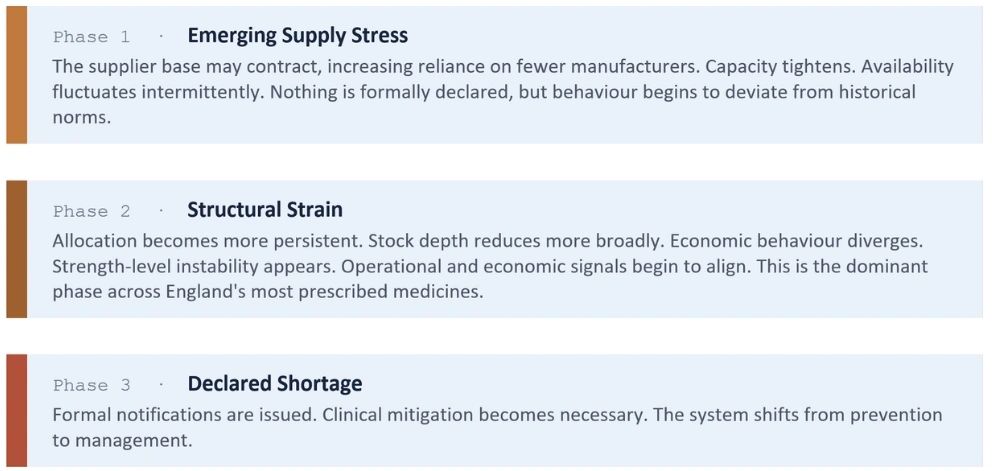
The framework describes three visible phases of supply stress before recovery.
KEY THEME 1
**Structural Thinning as a Common Thread **
The most consistent pattern across the prescribing base is structural thinning.
Over time, supplier exits have reduced redundancy in several high-volume molecules. In some cases, active licence counts still appear reasonable. However, effective depth is increasingly concentrated within a smaller group of manufacturers.
This is not immediately visible in day-to-day dispensing. But it changes the system’s resilience.
KEY THEME 2
Availability Clustering and International Reinforcement
Availability signals are also increasingly convergent.
International shortage notifications and UK supply alerts are more frequently aligning across jurisdictions and distribution channels. While individual alerts may appear manageable in isolation, clustering reduces substitution flexibility and increases system sensitivity.
Multi-country reinforcement matters. When pressure is visible across several markets simultaneously, the system’s ability to rebalance through redistribution narrows. What might previously have been absorbed through cross-border flexibility becomes structurally constrained.
KEY THEME 3
Economic Behaviour as an Early Indicator
Another recurring theme is economic divergence. In regulated environments, this can present as concession clustering or increasing reimbursement tension. Elsewhere, it may appear through tender strain or price instability.
When acquisition prices repeatedly deviate from tariff expectations, the signal is not simply financial. It suggests that underlying supply conditions are tightening.
KEY THEME 4
Strength and Presentation Dynamics
Instability rarely affects an entire molecule evenly. It often begins in specific strengths or formulations. As clinicians adapt, demand shifts between presentations. Pressure redistributes rather than disappears.
At a surface level, this can look like routine market movement. Within the framework, it is recognised as cross-strength convergence - one of the clearest indicators that structural strain is developing.
WHAT DECLARATION TELLS US
Declaration as Confirmation
Phase 3 - Declared Shortage - is marked by formal national notification. A small but meaningful proportion of high-volume medicines have now crossed into this stage.
What is notable is that these medicines sit within the core prescribing architecture. They are not peripheral or niche products. And in each case, Phase 2 signals were already present before declaration.
Structural thinning had occurred. Availability signals had clustered. Economic divergence was visible. Cross-strength interaction had begun.
THE BROADER IMPLICATION
A System Carrying Structural Pressure
The question facing the system is not whether shortages exist. They do.
The more important question is whether the prescribing base retains sufficient elasticity to absorb future shocks.
When high-volume maintenance medicines operate predominantly in Phase 2 rather than Phase 0, resilience becomes a question of accumulated strain rather than isolated disruption. Procurement complexity increases. Clinical switching becomes more common. Economic pressure becomes persistent rather than episodic. Operational friction becomes normalised.
None of this necessarily constitutes crisis. But it does indicate a system that is carrying ongoing structural pressure.
A PROGRESSION CHALLENGE
Prevention Requires Earlier Attention
The call for definitional clarity is understandable and necessary. However, focusing solely on the moment of declaration risks missing the more consequential stage that precedes it.
A medicine does not become unstable at the point of formal shortage notification. By that stage, resilience has already narrowed and stress signals have already aligned.
Across England’s most prescribed medicines, the dominant pattern is not collapse. It is convergence - structural signals, availability clustering, economic divergence and cross-strength interaction aligning gradually across foundational therapeutic corridors.
THE FIVE-DOMAIN MODEL
How the Framework Measures Stress
The iethico Supply Stress Framework assesses each medicine across five domains. Together, these capture the full architecture of supply risk - from structural foundations through to formal escalation.
Structural Fragility
Reflects the resilience of the supplier base. It captures supplier exits, licence attrition, reduced anchor coverage and increasing reliance on fewer active manufacturers. A medicine can remain available while becoming structurally thinner. High scores indicate rising fragility within the underlying supply architecture.
Availability
Reflects operational stress signals across jurisdictions. It captures clustering of UK supply alerts, sustained wholesaler or manufacturer out-of-stock patterns, and international shortage notifications that align across multiple countries. International reinforcement is particularly important - multi-country pressure reduces substitution flexibility. High scores indicate sustained or converging availability signals.
Economic Divergence
Reflects deviation from historically stable pricing behaviour - sustained quote-to-tariff divergence, concession issuance or concession clustering. Economic stress frequently emerges after availability signals begin to cluster, but before formal shortage declaration. High scores indicate persistent pricing friction consistent with structural strain.
Cross-Strength Convergence
Captures interaction across strengths or formulations within a molecule. Early stress often begins in a single strength. As pressure increases, adjacent strengths tighten and elasticity reduces. Products with technically complex presentations - injectables, modified-release formats, device-dependent formulations - are particularly sensitive. High scores indicate reduced substitution flexibility and growing systemic pressure across the molecule.
Behavioural Dynamics
Captures how demand and system response evolve over time. Includes prescribing trends, utilisation growth, guideline changes and cohort expansion, as well as adaptive behaviour - therapeutic switching, strength migration, procurement adjustments. Demand growth can narrow elasticity even in the absence of immediate supply disruption. High signal intensity indicates either expanding demand within a constrained architecture, or active system adaptation to emerging strain.
Escalation Status
Reflects formal progression into declared shortage territory. This does not measure fragility - it measures confirmation. By the time escalation occurs, structural and economic strain have typically been present for some time. High scores indicate that stress has progressed from structural strain to visible system disruption.
MedSupply Intelligence · UK Pharmaceutical Supply Intelligence · iethico.com
This public insight presents the iethico Supply Stress Framework and its application to England’s most prescribed medicines. Molecule-level analysis, phase classifications, scoring workings and forward risk assessments are available to iethico subscribers. This document does not constitute procurement, clinical or commercial advice.