Recent parliamentary scrutiny, including the House of Lords inquiry into medicine supply resilience, has called for a more consistent definition of a “shortage.”
That call reflects a legitimate policy concern. Definitions create clarity. They enable reporting, benchmarking and accountability.
However, definitions describe a point in time. They do not explain progression.
The more consequential question is not how to define a shortage.
It is how to recognise when a medicine is moving towards one.
The definition of a shortage also varies across countries. A medicine classified as a shortage in one jurisdiction may not meet the threshold in another. Some systems rely on manufacturer notification. Others focus on duration, availability thresholds or patient impact. This variation complicates international comparison and reinforces a deeper limitation: definitions capture the visible stage of disruption, not the accumulation of stress that precedes it.
A medicine does not become unstable at the moment it is formally declared a shortage. By that stage, availability has already tightened, allocation decisions have already been made, procurement friction has increased and clinical adaptation may already be underway.
At iethico, we approach this as a progression challenge rather than a binary classification exercise. The Supply Stress Framework connects structural architecture, operational availability, economic behaviour and demand dynamics into a coherent lifecycle model that applies across primary care, hospital medicines, biologics, injectables and specialist therapies.
It is anchored to supply architecture rather than declaration thresholds.
The Three Phases of Supply Stress
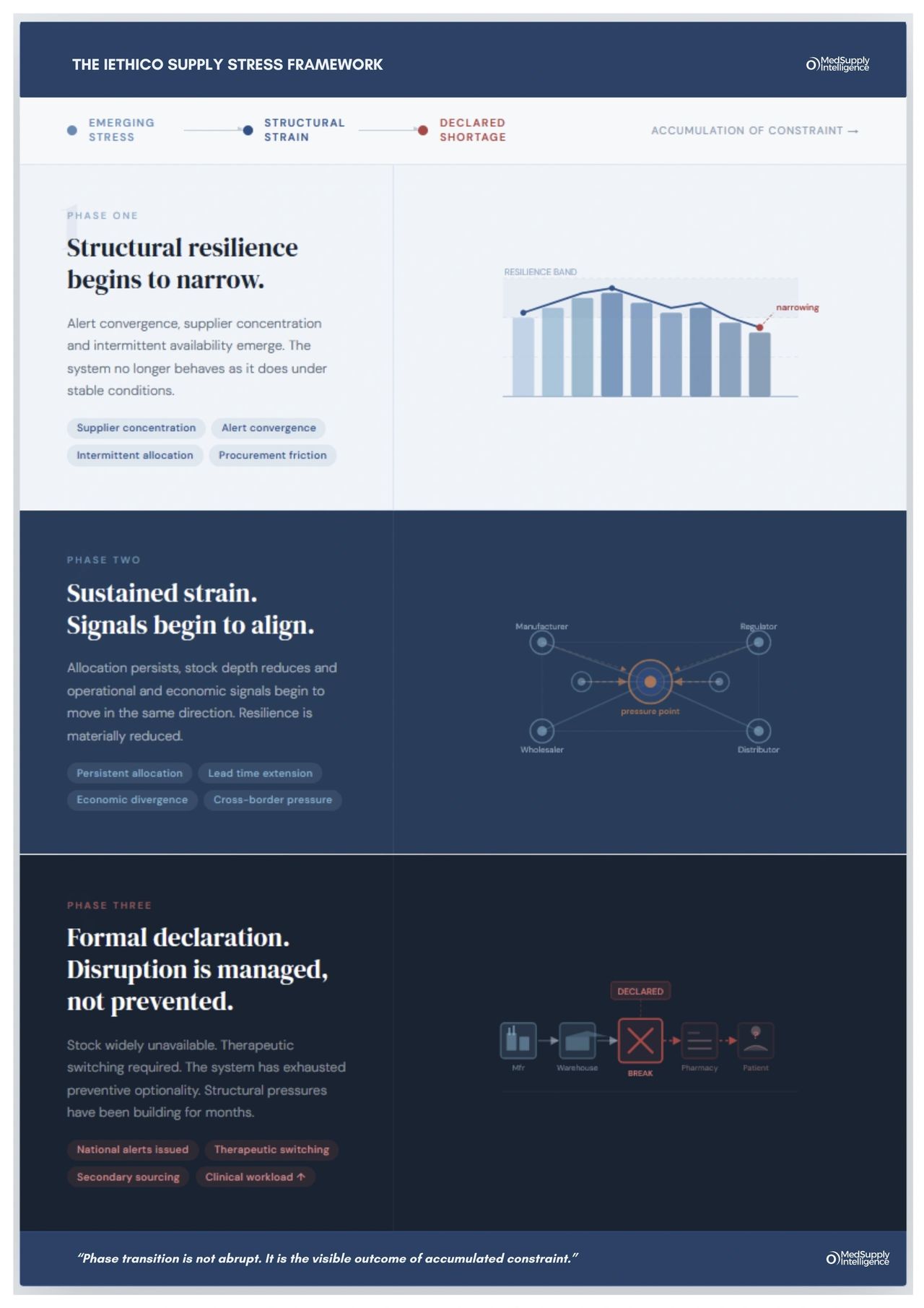
Supply instability rarely appears suddenly. It tends to evolve through recognisable phases as resilience narrows and constraints accumulate.
We describe this progression in three phases.
Phase 1 – Emerging Supply Stress
This phase captures the earliest visible signals that structural resilience is narrowing.
Supplier concentration may increase. Manufacturing capacity may tighten. Alert activity may begin to converge across jurisdictions. Availability may fluctuate intermittently. Allocation may appear in isolated channels. Procurement friction increases, though not yet consistently.
Nothing is formally declared at this stage. However, the system no longer behaves as it does under stable conditions.
In some cases, pressure stabilises. In others, additional signals accumulate and reinforce one another.
Phase 2 – Structural Strain
Phase 2 reflects sustained strain rather than episodic volatility.
Allocation becomes more persistent. Stock depth reduces more broadly. Lead times extend. Economic behaviour begins to diverge from historical norms. In regulated environments, reimbursement tension or concession clustering may emerge. In other markets, tender strain or cross-border redistribution becomes more visible.
Strength and formulation dynamics frequently become material at this stage. Instability may concentrate in specific strengths before affecting the wider molecule. Products with limited substitution flexibility, including complex presentations or care-setting-specific formulations, tend to surface structural constraints earlier than standardised, interchangeable formats. Demand may also migrate between presentations as clinicians adapt, redistributing pressure rather than resolving it.
Operational and economic signals begin to align.
Resilience is materially reduced.
Phase 3 – Declared Shortage
This is the final visible stage.
Stock becomes widely unavailable across distribution channels. National alerts or formal shortage notifications are issued. Therapeutic switching becomes necessary. Secondary sourcing becomes active. Clinical and procurement workload increases significantly.
By Phase 3, the system is managing disruption rather than preventing it.
The structural pressures that led to this point have typically been building for months.
What Drives Progression between Phases?
Escalation is rarely the result of a single event. It reflects the gradual alignment of structural pressures within the supply system.
Under stable conditions, capacity, demand and distribution remain in relative balance. Progression begins when that balance narrows. Manufacturing may be more concentrated than outwardly apparent. Upstream inputs may originate from a limited number of global facilities. Apparent redundancy proves thinner than assumed.
Demand patterns evolve as well. Volume may shift between strengths, formulations or care settings. A change that appears modest at molecule level can become material when concentrated in a particular presentation. Where substitution flexibility is limited, structural pressure becomes visible more quickly and is harder to absorb.
Economic behaviour adjusts in parallel. Pricing patterns drift from established norms. Reimbursement mechanisms come under strain. Allocation intensifies. Cross-border flows respond to relative availability. These signals are not separate from operational stress. They are expressions of it.
Geography compounds this dynamic. Allocation pools frequently extend beyond national borders. Pressure in one jurisdiction can influence supply posture elsewhere before formal recognition occurs.
No individual factor determines progression.
What matters is cumulative reinforcement.
When structural concentration, operational friction, demand redistribution and economic adjustment begin to move in the same direction, resilience reduces materially.
From Definition to Anticipation
A consistent definition of shortage may improve reporting. It does not, on its own, improve resilience.
By the time a medicine reaches Declared Shortage, alternatives are fewer, prices are more distorted and operational flexibility is reduced. The system is responding under constraint rather than planning with optionality.
The Supply Stress Framework shifts attention upstream. It enables manufacturers to examine capacity exposure earlier. It allows wholesalers to position inventory more deliberately. It supports NHS Trusts in modelling substitution before urgency escalates. It provides policy stakeholders with visibility of structural fragility before it manifests publicly.
Shortages are rarely sudden events.
They are the final, visible stage of accumulated pressure within a tightly interconnected supply architecture.
Clarity of definition has value.
Clarity of progression has consequence.
Understanding how shortages form is what ultimately determines whether they can be mitigated before they become unavoidable. That understanding is what separates anticipation from reaction.