The prolonged UK shortage of Scopoderm® (hyoscine hydrobromide) transdermal patches is often framed as a discrete supply disruption. In practice, it reveals something more consequential: how sustained instability can reshape prescribing behaviour long before a medicine disappears entirely.
UK supply of licensed Scopoderm® patches has been disrupted since 2023, with intermittent availability preceding the complete exhaustion of licensed stock in April 2025. While the immediate cause has been attributed to a manufacturing site transfer requiring MHRA approval, Baxter has not publicly clarified whether the intermittent availability observed from 2023 onwards was directly attributable to this transfer or to other underlying production or supply constraints. The downstream effects of this uncertainty have instead played out across prescribing behaviour, procurement pathways, and NHS expenditure.
Taken together, the evidence shows this was not a sudden failure, nor a pan-European withdrawal. It was a prolonged period of uncertainty that eroded confidence, drove adaptation, and quietly shifted both demand and cost elsewhere in the system.
UK supply timeline: instability without resolution
The UK supply position for Scopoderm® deteriorated gradually, marked by repeated deferral of anticipated resupply dates over an 18‑month period. What began as a short‑term shortage evolved into a structurally unstable supply situation, culminating in the exhaustion of licensed UK stock in April 2025.
Figure 1. Timeline of UK Scopoderm® supply disruption, showing repeated deferral of anticipated resupply dates from 2023 to 2025, followed by removal of a defined return date.
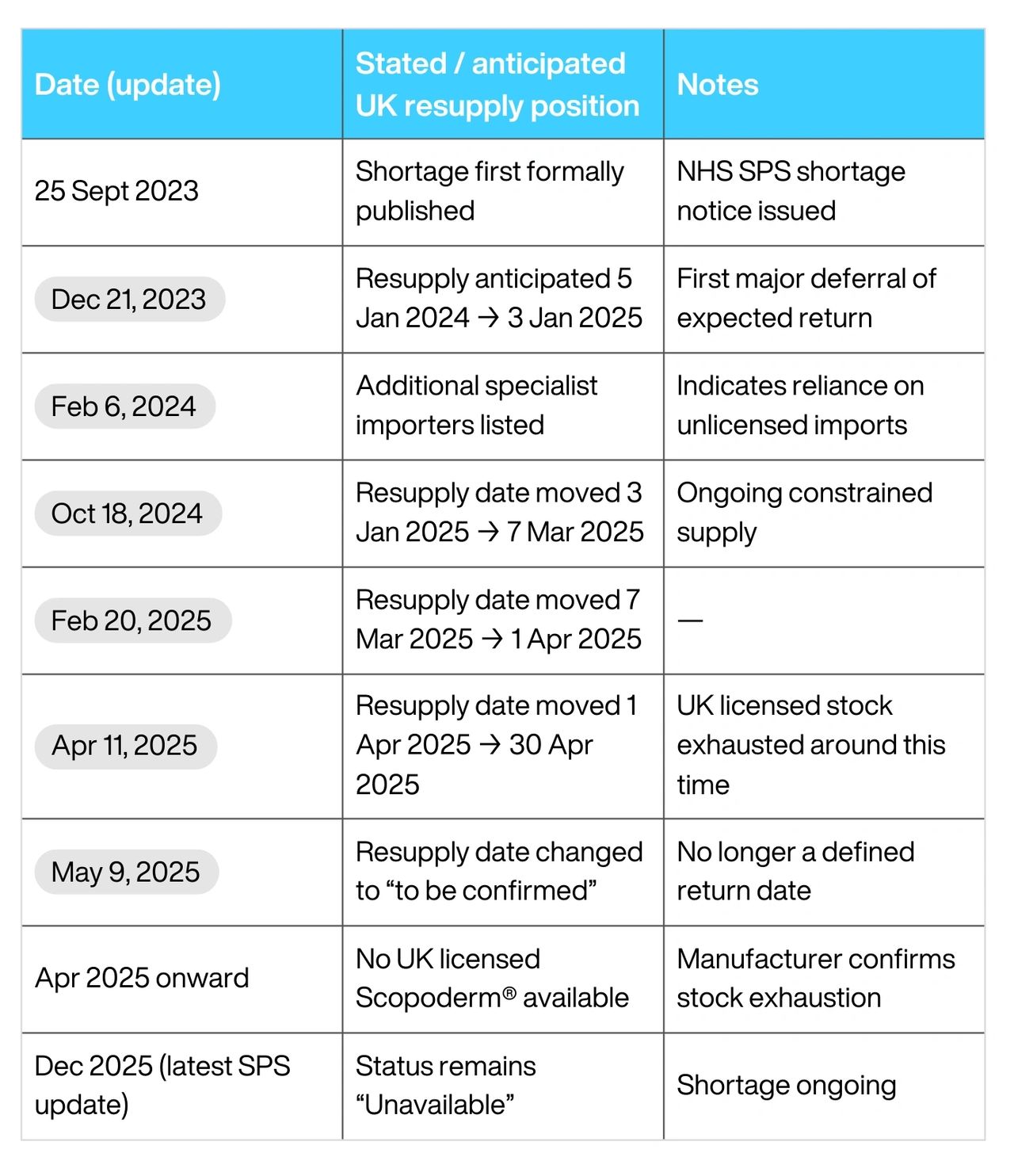
The pattern is notable not simply for its duration, but for the absence of a clear recovery signal. Repeated movement of resupply dates, followed by the removal of any defined return, is more consistent with a structural supply issue than a short‑term logistics interruption.
European context: a UK‑specific disruption
Scopoderm® is not authorised via the EMA’s centralised procedure and remains a nationally authorised product. Review of publicly available national medicines registers and shortage communications shows the following:-
This assessment is based on a review of publicly available national medicines registers and official shortage communications across European markets where Scopoderm® is authorised, including Germany, France, Denmark, Finland, Greece, the Netherlands, Sweden, and Norway. No evidence of a prolonged, nationally reported shortage comparable to the UK experience between 2023 and 2025 was identified.
Figure 2. Authorisation status and shortage signals based on review of publicly available national medicines registers and shortage communications. Absence of a reported shortage does not exclude short‑term or local supply disruption.
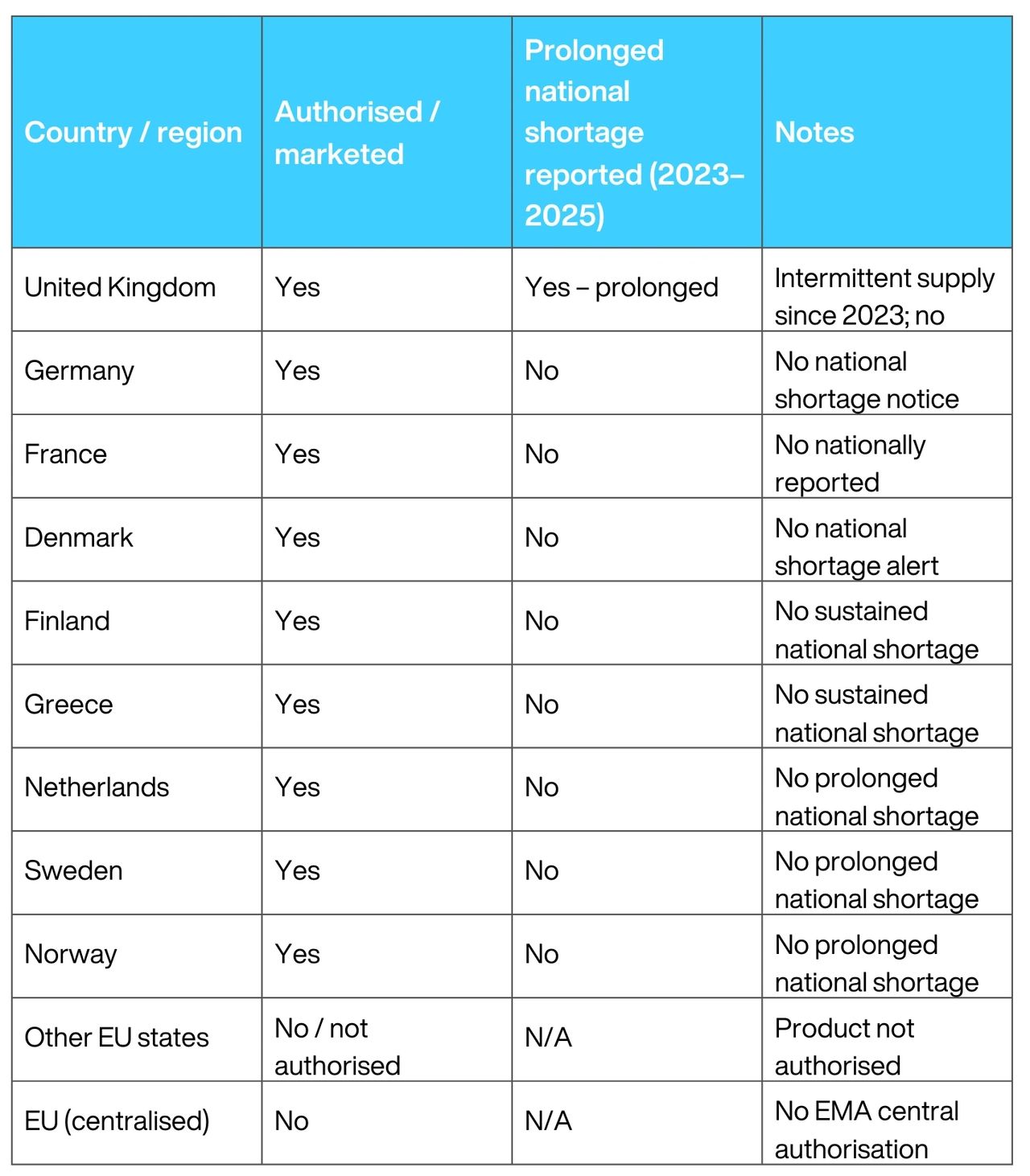
Taken together, this suggests the UK disruption does not reflect a pan‑European withdrawal or universal manufacturing failure, but is more consistent with UK‑specific regulatory and supply factors.
When instability drives disengagement
One of the most striking features of the Scopoderm® shortage is the timing of changes in prescribing behaviour.
Primary care prescribing peaked during 2021–2022 and began to decline steadily from early 2023 onwards. By 2024, volumes had fallen sharply, and by 2025 usage had reduced to a minimal residual level. Importantly, this decline preceded the complete exhaustion of licensed UK stock in April 2025.
Importantly, this behavioural shift occurred in the absence of new clinical evidence, suggesting that prescriber disengagement was driven primarily by availability signals and precautionary guidance rather than by changes in therapeutic value.
Figure 3. Primary care prescribing of Scopoderm® 1 mg / 72‑hour patches in England, showing a sustained decline from 2023 and minimal use by 2024–2025, preceding complete exhaustion of UK licensed supply.
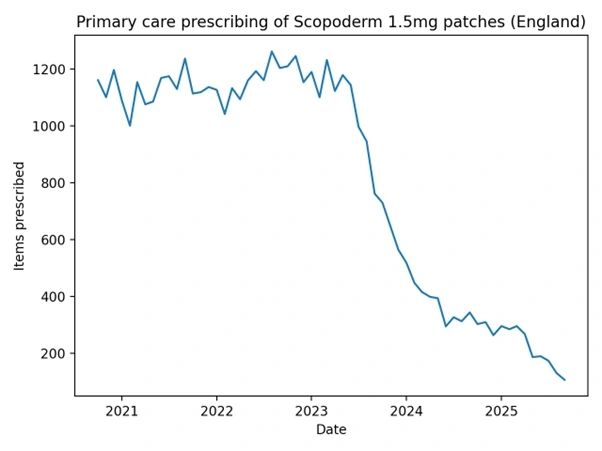
The timing aligns closely with intermittent and unpredictable availability, national guidance advising against initiation of new patients, and increased reliance on alternative antimuscarinic therapies. Prescribers adapted away from Scopoderm® not because it had disappeared, but because it had become unreliable.
Once confidence is lost, prescribing behaviour changes and it does not automatically revert when supply returns.
Interpreting the market shift
There is no evidence that the observed decline in Scopoderm® prescribing reflects new safety concerns, changes in efficacy, or updated clinical guidance against its use. Instead, the timing and pattern of disengagement align closely with supply instability and national guidance advising against initiation of new patients during periods of constrained availability.
The market shift observed is therefore best understood as supply-driven rather than clinically driven.
Secondary care: mitigation rather than abandonment
The impact in secondary care followed a different trajectory. Hospital prescribing volumes remained relatively stable through 2024 and declined more gradually during 2025.
This divergence reflects greater flexibility within secondary care to mitigate shortages, including use of unlicensed imported scopolamine patches, tolerance of higher acquisition costs, and established governance pathways for unlicensed procurement. Rather than abandoning therapy, hospital services prioritised continuity for patients with limited oral options or palliative needs.
The hidden cost of continuity
Despite escalating disruption, the Drug Tariff price for licensed hyoscine 1 mg / 72‑hour patches remained fixed at £12.87 per 2‑patch pack throughout 2023–2025. No price concession was applied even as licensed stock disappeared.
In contrast, secondary care increasingly relied on unlicensed imported scopolamine patches supplied in 4‑patch packs at an average cost of £44.60. On an equivalent four‑patch basis, this represents an incremental cost of £18.86 per pack. On a monthly basis, this price differential translates to an estimated additional NHS expenditure of approximately £150,000–£190,000 per month, depending on secondary care prescribing volumes. This equates to approximately £1.8-£2.3 million in additional annual NHS expenditure based on observed prescribing volumes.
These costs are largely invisible in Drug Tariff data. The system did not avoid expenditure; it displaced it from primary care to secondary care, and from transparent pricing to higher‑cost mitigation. The absence of any price concession or adjustment during a prolonged period of instability highlights a broader structural limitation: limited system flexibility to support recovery of supply for low-priced, legacy medicines when manufacturing disruption occurs.
What this shortage really tells us
The Scopoderm® case illustrates broader supply‑side dynamics:
-
Prolonged instability reshapes demand before stock is exhausted.
-
Confidence erosion can permanently alter prescribing behaviour.
-
Low‑priced, legacy products are structurally vulnerable when flexibility is limited.
-
Costs do not disappear during shortages - they move, often out of sight.
In practical terms, Scopoderm® was prescribed less because it became unreliable to obtain, rather than becoming unavailable because it was prescribed less.
Looking ahead
Baxter has confirmed that the disruption is linked to a manufacturing site transfer requiring MHRA approval, but no timeline for resupply has been provided. In the absence of licensed UK supply, continued reliance on alternatives and unlicensed imports remains necessary.
Even if licensed supply resumes, Scopoderm® is likely to return to a materially smaller and more specialist UK market than existed prior to 2023. Re‑establishing its role would require active re‑engagement not simply the reappearance of stock.
More broadly, this case underscores a critical lesson for healthcare systems and suppliers alike: stability matters as much as availability. In volatile markets, early signals and sustained visibility determine not just how shortages are managed, but how markets evolve long after disruption has passed.
Baxter was offered the opportunity to provide further comment on the ongoing supply position but declined.