Valaciclovir Market Analysis: Supply Chain Shock
In June 2025, a temporary shortage of Valaciclovir 250mg tablets was announced in the UK, linked to production and quality issues affecting the branded product, Valtrex (GSK). By January 2026, the shortage was formally resolved.
On paper, the issue closed.
In practice, markets rebalance - they do not reset.
This insight sets out what we are observing now, how that redistribution has reshaped the structure of supply, and what historically follows under comparable conditions.
1. Observation: Demand Has Shifted - and Stayed Shifted
During the 250mg shortage window, substitution was decisive.
Primary Care
-
250mg usage fell from 3.5% to 1.6%
-
500mg items increased by approximately 30%
Secondary Care
-
250mg usage fell by 75%
-
500mg hospital volume increased by 13%
The dominant strength became the shock absorber.
While the shortage notice has been lifted, the redistribution remains embedded in prescribing behaviour. The pressure did not disappear. It shifted.
2. Structural Diagnosis: The 500mg Strength Is Carrying Concentrated Stress
The 500mg strength is now absorbing higher sustained demand within a thinner supply structure. Several indicators confirm this:
Sustained Wholesale–Tariff Detachment
-
Pack of 10: Drug Tariff ~£3.92; observed order prices ~£12.50, with higher quotations recorded.
-
Pack of 42: Clearing prices between £49 and £60, trading near prior concession levels.
This is not short-term volatility. It reflects persistent clearing above reimbursement.
Supplier Depth
dm+d data shows visible attrition in supplier redundancy. Fewer effective suppliers means lower tolerance for disruption.
Alert Density
-
152 supply alerts over the last six months
-
13 alerts in the last month alone
Sustained alert frequency indicates continued friction within the supply chain.
International Context
Multi-country notifications suggest the UK position is not isolated.
Taken together, these factors indicate that the 500mg strength is operating with reduced structural resilience. This is not a pricing anomaly. It is redistribution-driven concentration of demand onto a thinner supply base.
3. Projection: What Markets Have Historically Done Under These Conditions
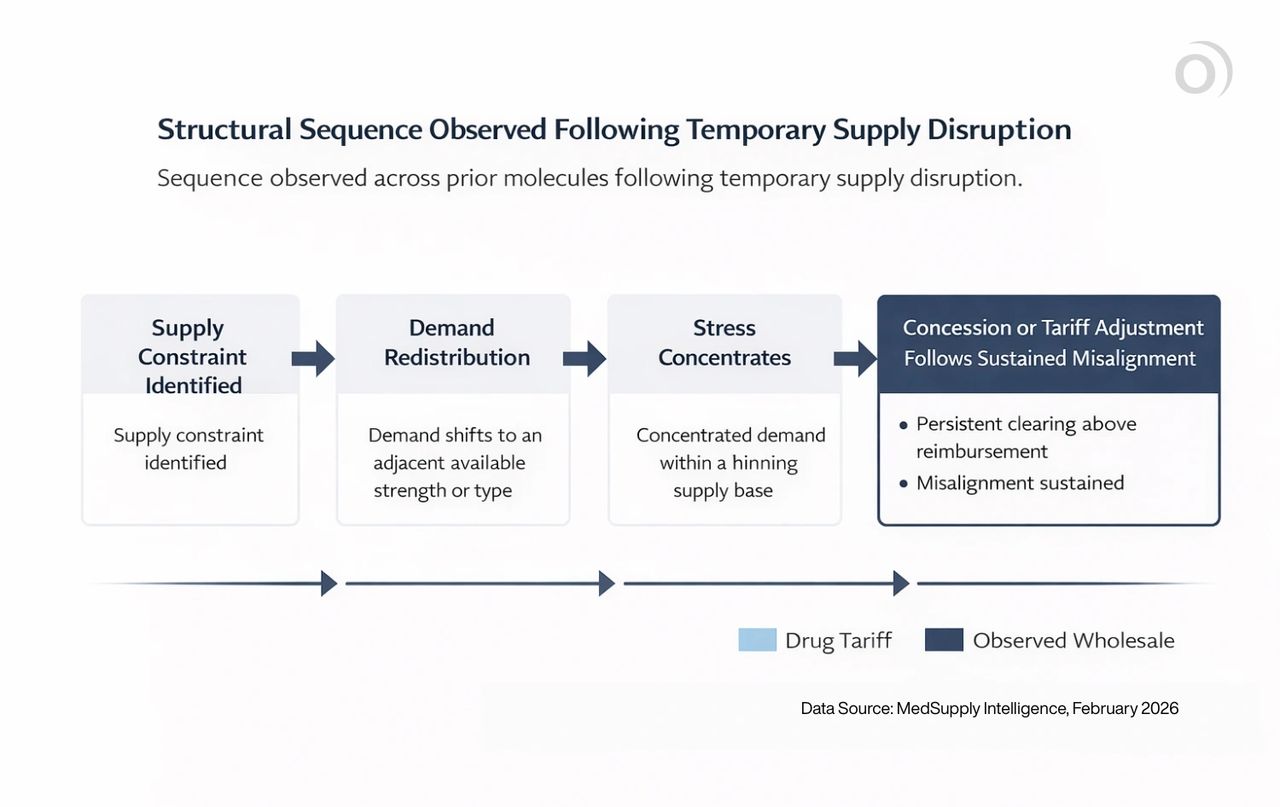
When comparable conditions have occurred in other molecules, the sequence has been consistent:
 Valaciclovir Market Analysis: Supply Chain Shock
-
Temporary disruption in one strength.
-
Demand redistribution into an adjacent strength.
-
Concentrated pressure on a narrower supplier base.
-
Sustained wholesale clearing above tariff.
-
Reimbursement correction.
This is not a theoretical model. It is observable behaviour across prior cycles.
Where sustained misalignment between wholesale price and reimbursement persists — particularly alongside supplier thinning and elevated alert density — correction has repeatedly followed.
The current position of Valaciclovir 500mg aligns with that pattern. This does not rely on speculation. It reflects structural precedent.
What This Means
The 250mg shortage has been resolved administratively. But structurally, the system has been reshaped:
-
Demand has been redistributed.
-
Buffers have thinned.
-
Pricing dispersion has widened.
-
The dominant strength is absorbing residual stress.
Temporary supply shocks do not simply create gaps. They alter strength mix, supplier depth, and price behaviour.
Where those changes push a market into sustained reimbursement misalignment, historical experience shows that markets reconcile. The mechanism of reconciliation is rarely immediate — but it has been consistent.
Final Observation
This sequence illustrates how we approach supply analysis: observation, structural diagnosis, and where warranted, projection.
Where data reveals repeatable structural mechanics, we move to diagnosis. And where those mechanics have repeatedly led to defined outcomes, we are prepared to state that trajectory clearly.
The Valaciclovir case is not about a shortage that was. It is about how temporary shocks reshape markets — and how that reshaping creates the next pressure point.