What Sumatriptan tablets tell us about emerging supply pressure
Originally analysed June 2026 | Updated September 2026
Medicine supply disruption can appear sudden when viewed from the point at which it becomes widely visible. A shortage notification is published, pharmacies struggle to source stock or prices move sharply, and the market appears to have changed almost overnight.
In reality, the underlying pressure can have been developing for considerably longer.
Sumatriptan tablets provide a useful example. When we first examined the developing market in June 2026, supply notifications and shortage reports had already appeared across multiple international markets and manufacturers. The important feature was not any single notification, but the accumulation of evidence around the same medicine while the eventual scale of the UK commercial impact was still unclear.
Several months later, we can now look at what happened next.
The early picture was not primarily about price
The history of Sumatriptan illustrates why medicine supply intelligence cannot rely on a single type of observation. Supply notifications were already visible from September 2025, while UK order prices observed through iethico’s community-pharmacy procurement panel remained predominantly below £1. Out-of-stock signals appeared in February 2026, followed by community-pharmacy supply alerts from April.
At this stage, the significance of the developing pattern was not that a dramatic price movement had already occurred. It was that evidence of pressure was accumulating while the commercial manifestation remained comparatively subdued.
That distinction is important. If market monitoring begins only when acquisition prices rise sharply or a concession appears, much of the preceding history is invisible.
By May, that changed. Observed order prices became markedly higher and more dispersed, with both branded and generic products recording repeated multi-pound and double-digit observations. At the same time, the reimbursement system began to respond.
For Sumatriptan 50mg tablets, the Drug Tariff price immediately before the first concession was just £0.72. The concession subsequently moved to £6.26 in May, £6.95 in June and £16.00 in July.

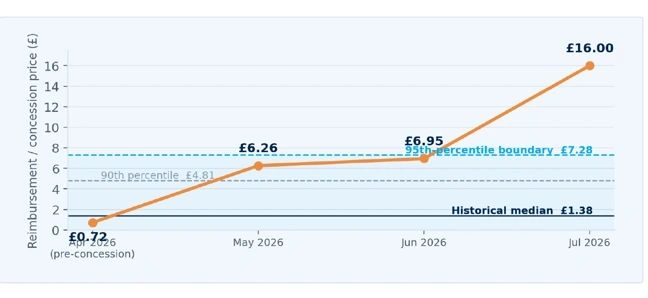
Sumatriptan 50mg: pre-concession Drug Tariff and realised May to July 2026 concession trajectory. Historical range is retrospective and conditional on a concession occurring, not a deterministic forecast. Source: iethico, Before the Concession.
The concession was an outcome, not the beginning
A price concession is a highly visible signal because it tells us that prevailing purchasing conditions have moved sufficiently far from standard reimbursement to require intervention. It is therefore useful evidence of market pressure, but Sumatriptan demonstrates why it should not automatically be treated as the beginning of the episode.
In this case, the sequence extended from earlier shortage notifications, through out-of-stock and community-pharmacy signals, into changes in acquisition-price behaviour and finally substantial reimbursement intervention. Our subsequent analysis puts roughly eight months between the first recorded shortage-notification period and the pronounced commercial escalation observed in May 2026.
This does not mean that the earlier evidence made the eventual £16 concession inevitable. Supply issues can resolve, additional capacity can enter the market and interventions can prevent developing pressure from becoming a wider problem. That uncertainty is precisely why early intelligence is valuable.
The objective is not to label every early signal as a future shortage. It is to understand when the evidence surrounding a medicine is changing sufficiently to warrant attention.
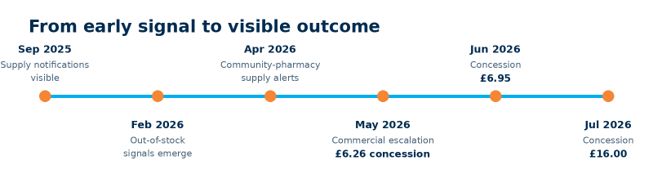
A simplified public chronology of the episode. It shows the sequence of observable outcomes without disclosing iethico’s underlying detection rules or weighting logic.
The real cost of seeing a signal late
The cost of late visibility is sometimes expressed in financial terms. A medicine becomes more expensive, procurement costs increase or exceptional reimbursement becomes necessary. There is another cost that is harder to quantify: the loss of decision time.
When developing pressure is recognised early, procurement and supply teams have more opportunity to understand their exposure, review stock cover, investigate sourcing options, consider alternatives and determine whether an isolated event is developing into something more persistent.
As the market tightens, those choices can become progressively narrower. What begins as a question of preparedness can eventually become a question of where stock can be obtained at all.
This was the central argument in our original Sumatriptan analysis: the value of early visibility is not the ability to predict the future with certainty. It is recognising when multiple small signals are beginning to form a larger pattern while there is still time to respond. What has happened since makes that distinction clearer.
Looking back at the sequence
There is a temptation when analysing a case retrospectively to start with the most dramatic outcome and work backwards. With Sumatriptan, that would mean beginning with the £16 concession. Doing so misses much of what makes the case interesting.
The earlier market looked quite different. Supply evidence was accumulating while observed UK order prices remained low. Availability signals then strengthened. Pharmacy alerts followed. Commercial behaviour subsequently changed and reimbursement responded.
The sequence matters because the different signals did not move together. That finding is consistent with iethico’s wider analysis of medicine supply pressure. Quotations, completed acquisition prices, availability, international supply evidence and reimbursement can each change at different stages of the same episode. Treating them as one signal can obscure rather than clarify what is happening.
What Sumatriptan tells us
Sumatriptan is not evidence that every international supply notification will become a UK shortage, nor that every early availability signal should trigger intervention. It demonstrates something more useful: the point at which a market problem becomes obvious may be considerably later than the point at which it begins to become observable.
That difference creates an intelligence opportunity. If organisations can understand how evidence is developing around the same medicine across markets, availability, procurement and reimbursement, they do not have to wait for every part of the system to confirm the same problem before deciding that something deserves closer attention.
For Sumatriptan, the £16 concession was an extraordinary and highly visible outcome. The more important question is what could already be seen before the outcome became obvious.

Signal lesson
The value of early visibility is not predicting the future. It is creating time to investigate, assess exposure, understand alternatives and make decisions while there are still meaningful options available.
Because the most expensive point at which to discover that a medicines market has changed is often the point at which everyone else can see it too.
Sources and notes
• iethico, Before the Concession: What connected medicine data reveals about emerging UK supply pressure, 2026.
• Community Pharmacy England, May 2026 price concession updates, including the redetermined Sumatriptan 50mg concession of £6.26.
• Community Pharmacy England, June 2026 price concessions: Sumatriptan 50mg £6.95 and Sumatriptan 100mg £3.99.
• Price concessions are monthly reimbursement interventions and should not be interpreted as proof of a national shortage or patient-facing unavailability.