What Ramipril tells us about the difference between a shortage event and a developing market pattern
Originally analysed June 2026 | Updated September 2026
When a shortage alert is published, it can feel as though the market has changed suddenly. In practice, medicine supply disruption often develops over a longer period, with availability, sourcing, pricing and formal notifications moving at different times.
Ramipril provides a useful example. When we first examined Ramipril 1.25mg capsules in June 2026, the formal SPS alert published in April was already the visible point in a longer sequence. Earlier availability concerns had been evident during 2025, further pressure had emerged later in the year, and by early 2026 community pharmacies were experiencing increasing difficulty sourcing stock through normal wholesale channels.
The subsequent months add another dimension to that story. The issue did not simply disappear once the alert had been published. Reimbursement pressure persisted, and by August price concessions were being granted across several Ramipril strengths and both capsule and tablet presentations. That does not prove that one shortage spread from one presentation to another. It does show why a medicine should sometimes be viewed as a developing market pattern rather than as a single dated event.
The alert was a milestone, not necessarily the beginning
The original Ramipril analysis made a simple distinction: the date on which a shortage becomes formally visible is not always the date on which the underlying pressure began. For Ramipril 1.25mg capsules, the April 2026 alert followed a period in which repeated market signals had already suggested that availability was becoming less stable.
That distinction matters because formal notifications are extremely useful, but they are necessarily part of a wider chronology. A procurement team experiencing difficulty sourcing a product may encounter the operational effects before the market has a single, widely recognised description of the problem. Conversely, an alert can remain relevant after publication while the commercial and reimbursement consequences continue to evolve.
What happened next
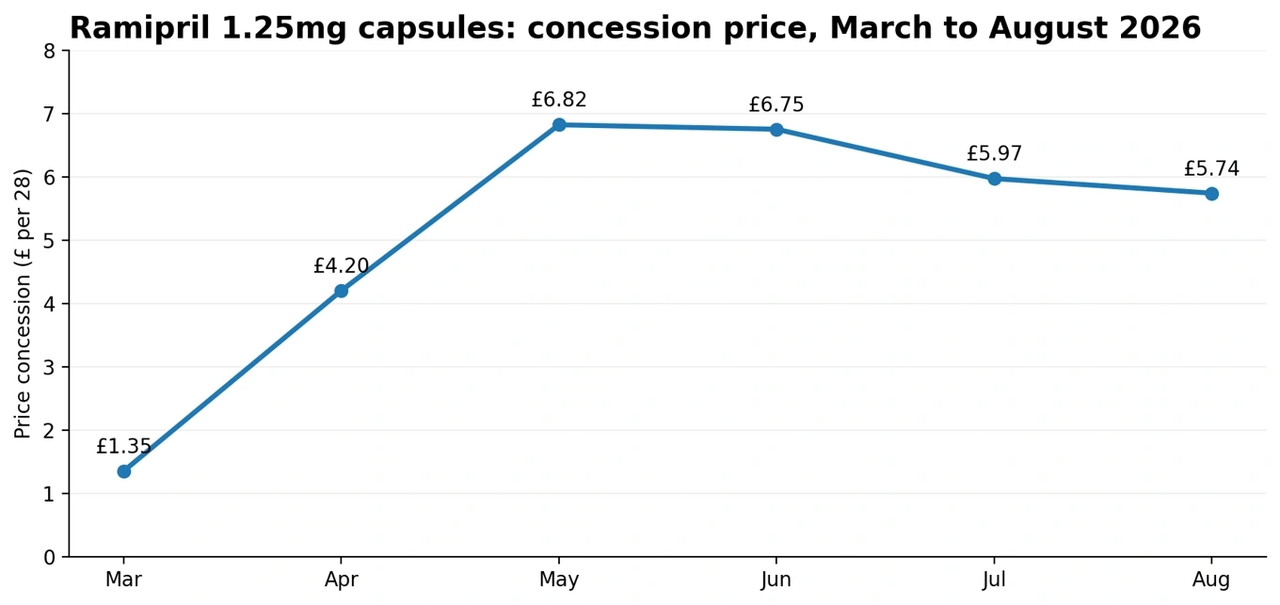
The reimbursement history of Ramipril 1.25mg capsules is particularly instructive. The presentation received a price concession of £1.35 in March 2026. In April, the concession was ultimately improved to £4.20. It then rose to £6.82 in May and remained elevated at £6.75 in June, £5.97 in July and £5.74 in August.
A price concession does not establish the cause of a supply problem, nor is it proof of a national shortage. It has a narrower meaning: community pharmacies have reported that a medicine cannot be sourced at or below its Drug Tariff reimbursement price, and DHSC has agreed exceptional reimbursement for that month. In this case, however, the persistence of concessions after the formal alert is useful evidence that the market continued to require exceptional reimbursement.
From one presentation to a wider reimbursement pattern
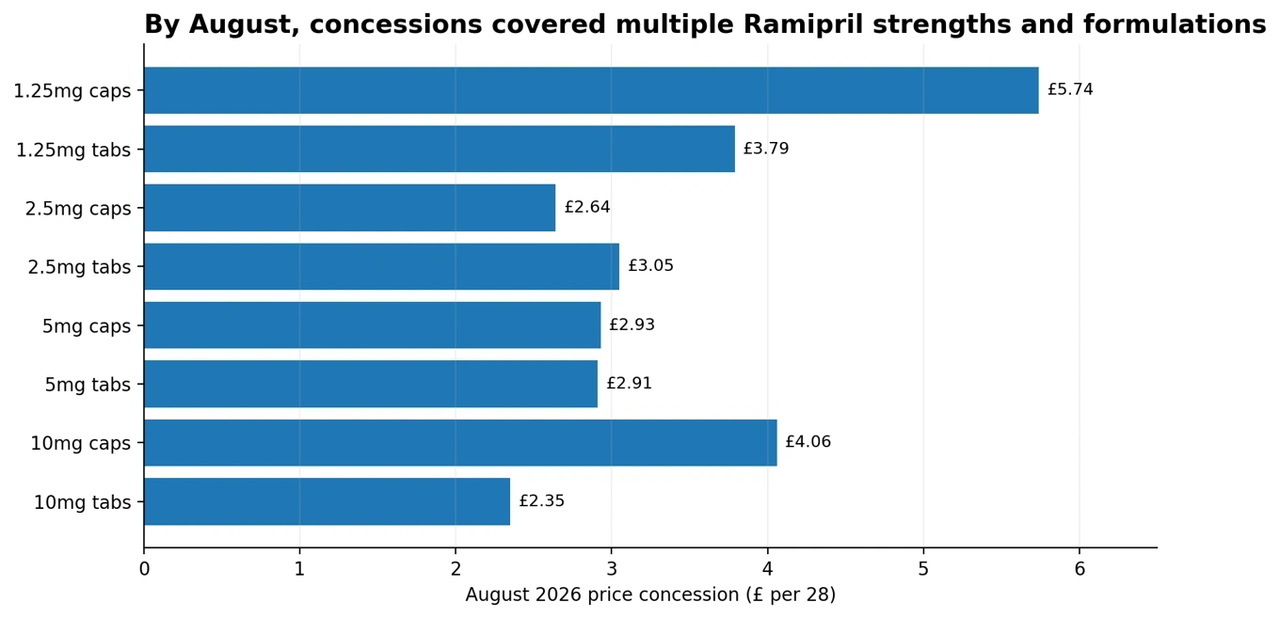
By August, the reimbursement picture had broadened. Price concessions were published for Ramipril 1.25mg, 2.5mg, 5mg and 10mg presentations, covering capsules and tablets. The 10mg capsule concession was subsequently improved from £3.68 to £4.06 following representations from Community Pharmacy England.
It would be easy to over-interpret that development. Multiple concessions across a medicine do not, by themselves, demonstrate a common root cause or prove that disruption has propagated from one strength to another. Each presentation can have its own supplier base, demand profile and purchasing dynamics.
What the breadth does tell us is that, by August, exceptional reimbursement was no longer confined to the 1.25mg capsule presentation that had anchored the earlier analysis. The commercial pressure visible through the concession mechanism had become relevant across a wider part of the Ramipril market.
Clinical severity and operational severity are not the same thing
Ramipril also illustrates another important distinction. A medicine shortage does not need to have very limited therapeutic alternatives to create significant pressure across the health system.
For many patients, disruption to a particular Ramipril strength or formulation may be clinically manageable. Depending on the individual, prescribers may be able to use another strength, alter dosing or consider another appropriate ACE inhibitor. That can reduce clinical severity, but it does not make the disruption operationally simple.
Ramipril is widely used in primary care. When a high-volume medicine is affected, even a clinically manageable supply issue can create substantial work. Prescriptions may need to be amended, pharmacies may need to source alternatives or contact prescribers, patients may require explanation, and demand can shift into neighbouring strengths or formulations.
This is why resilience cannot be assessed only by asking whether an alternative medicine exists. The number of patients affected, the ease with which prescriptions can be changed, the capacity of alternative presentations and the duration of the disruption all influence the operational consequences.
Why the pattern matters
Looking only at the April alert would give us a clear date, but an incomplete account. Looking only at the later price concessions would show commercial pressure, but not the earlier history. The more useful view is longitudinal: signals emerge, sourcing becomes harder, formal recognition follows, and the market may continue to adjust afterwards.
This does not mean every early signal will develop into a prolonged problem. Nor does it mean that every subsequent concession is part of the same causal chain. The point is more modest, and more useful: medicine markets can change progressively, and different parts of that change become visible through different indicators at different times.
For procurement and supply teams, that changes the question. Instead of asking only whether a medicine is currently in shortage, it can be more useful to ask whether the pattern around that medicine is becoming more persistent, more widespread or more operationally significant.
Signal lesson
The market rarely changes overnight. What appears to be a sudden shortage can be one visible stage in a longer process, and publication of an alert does not necessarily mark the end of that process either.
Ramipril shows why the period before and after a formal notification both matter. Earlier signals help explain how pressure developed. Later reimbursement and sourcing evidence helps show whether the market has stabilised or whether exceptional conditions are persisting.
The advantage is not in attaching certainty to every early warning. It is in maintaining enough visibility across the sequence to recognise when an isolated issue is beginning to look like a market pattern.
Sources and interpretation
Original iethico analysis: The market rarely changes overnight, June 2026.
Community Pharmacy England price concession updates, March to August 2026.
Price concessions indicate exceptional monthly reimbursement where pharmacies report they cannot source at or below the Drug Tariff price. They should not be interpreted as proof of the cause or severity of a shortage.