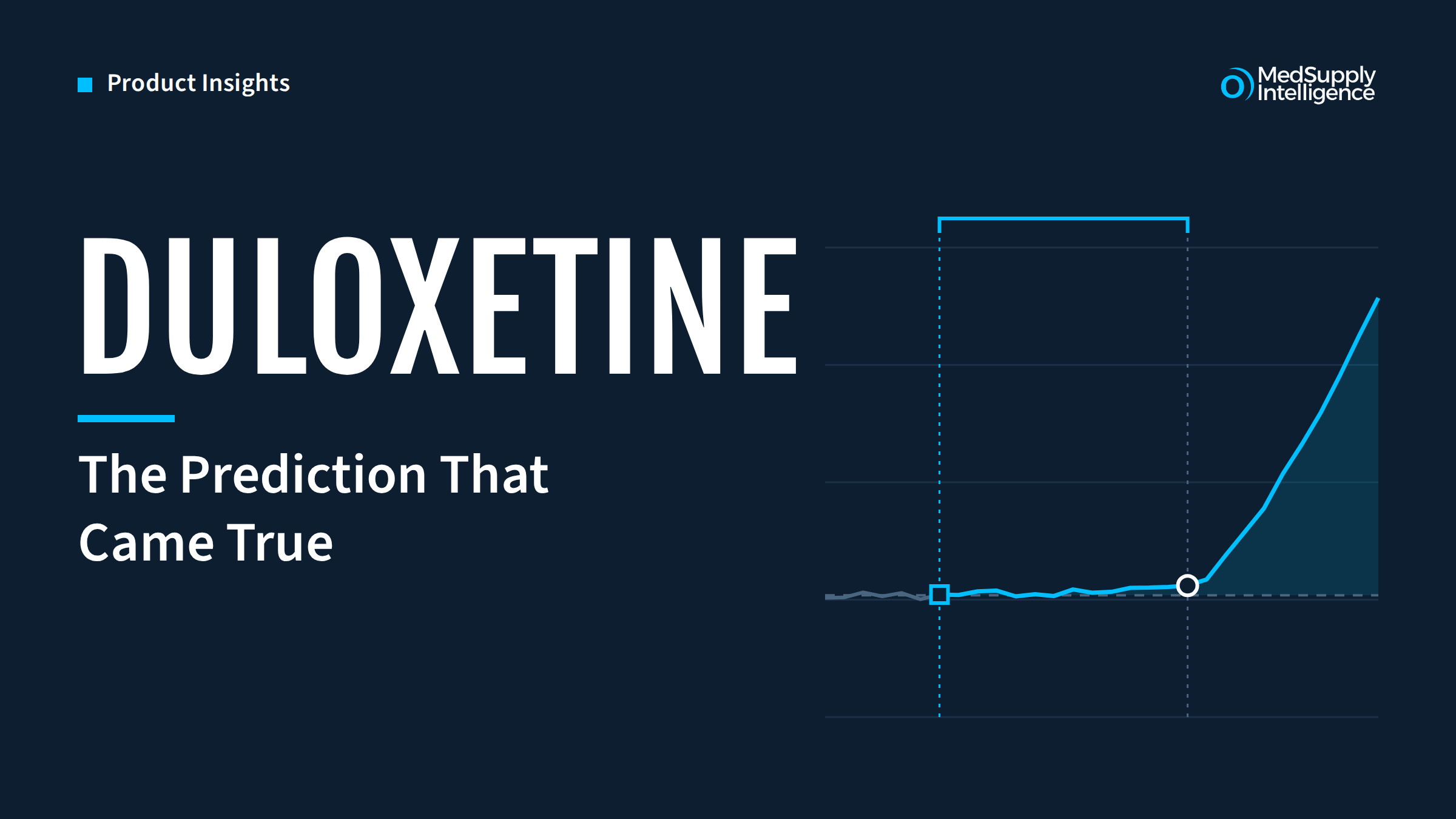
***The warning we issued in December is now playing out. ***
Three months ago, our data signalled an emerging supply disruption. The platform data now confirms it.
**In December 2025, we published a supply intelligence blog titled “Duloxetine: Global Warning Signs Point to an Impending Shortage”. At the time, UK suppliers reported having stock. DHSC had just reduced the Drug Tariff price. The market looked, on the surface, stable. **
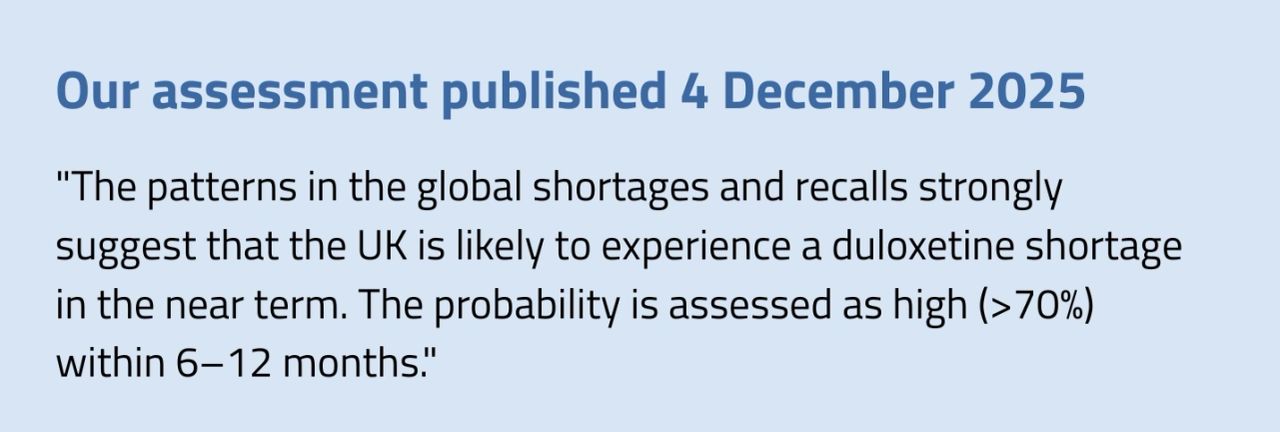
Three months later, the UK market is now showing the supply stress our data indicated. This document presents the platform evidence - across all duloxetine strengths - that confirms the prediction.
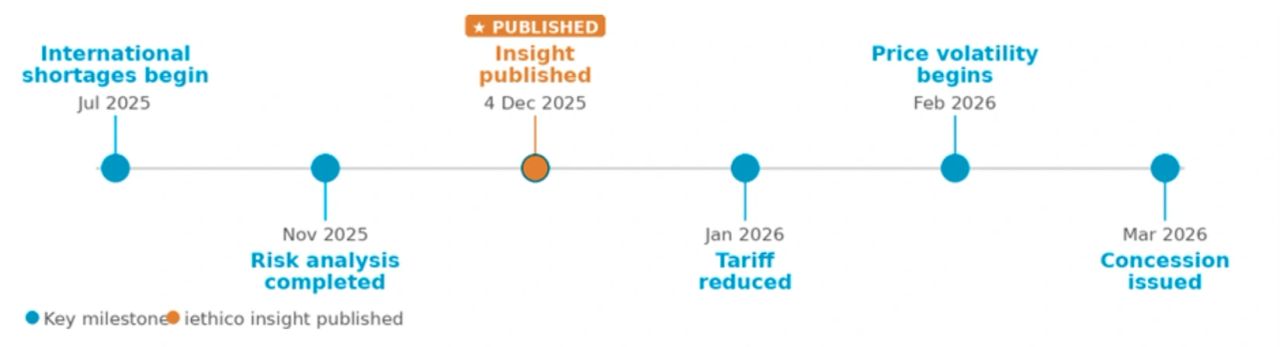
From Signal to Confirmed Stress: The Timeline
The timeline from first international signal (July 2025) to UK concession (March 2026) was approximately eight months, consistent with the lead times observed in previous UK shortages.
What We Saw in July-November 2025
Our analysis - completed in late November 2025 and published on 4 December 2025 - identified the following warning pattern for duloxetine:
• Clustering of international shortage notifications across 15+ countries from early-to-mid 2025
• Manufacturing disruptions concentrated at a small number of Spanish production sites supplying the majority of global duloxetine
• Nitrosamine-related recalls in Ireland, Portugal, Germany, France, Italy and Canada - a classic precursor pattern
• Wholesaler out-of-stock notices beginning to appear from Q3 2025
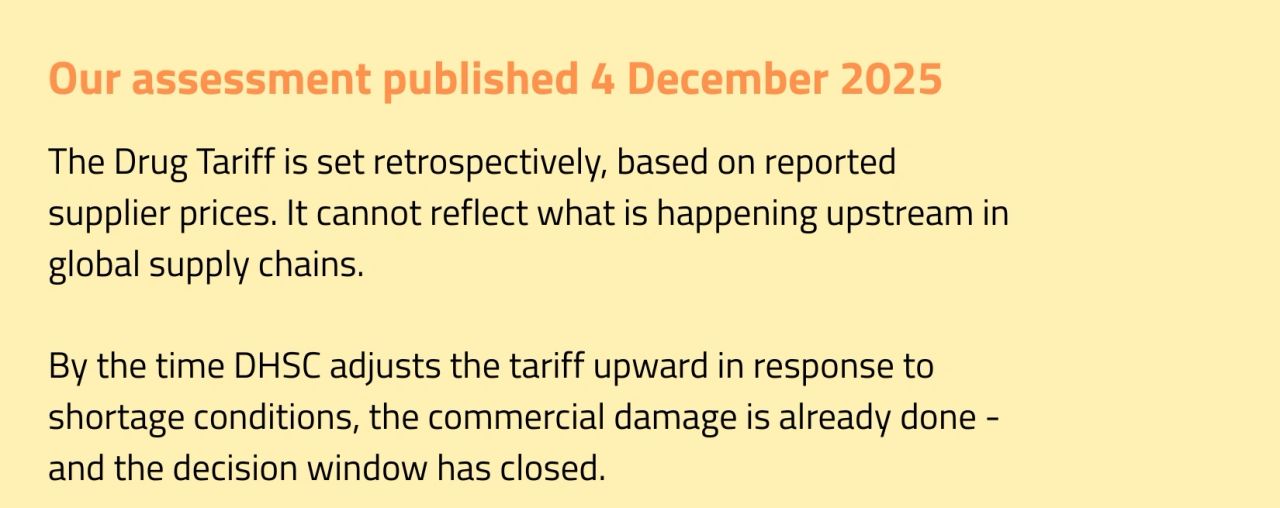
• Drug Tariff concession price spikes despite an official tariff reduction - a contradiction only explainable by supply constraint
The Tariff Paradox: A Signal Within the Signal
In January 2026, DHSC reduced the duloxetine tariff price - at precisely the moment the market was exhibiting clear supply stress signals. For those without upstream visibility, this looked reassuring. For those tracking the international data, it was a confirmation that the official UK pricing mechanism was running months behind real-world supply conditions.
MedSupply Evidence: What the Data Shows Now (March 2026)
The following data is drawn directly from the MedSupply Intelligence platform on 6 March 2026. It covers the last three months across all duloxetine strengths.
Supply Alerts: All Duloxetine Strengths - Critical Heat Map
Every duloxetine strength is registering supply alerts. The 60mg and 30mg capsules - the two highest-volume strengths are at Critical and High severity respectively, with 48 and 35 alerts in the last three months alone.
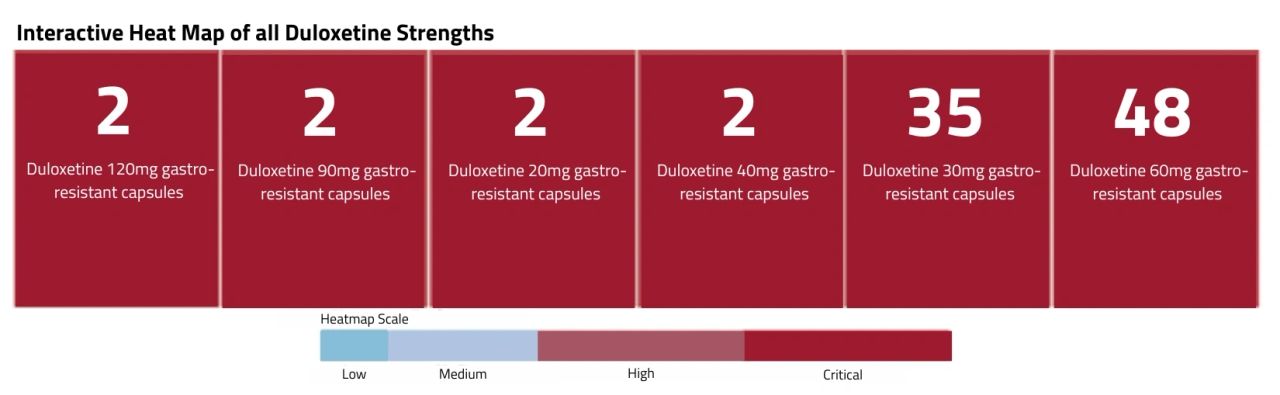
MedSupply Intelligence - Heat Map of Top 50 Supply Alerts, all duloxetine strengths, last 3 months (Mar 2026). Every strength is at Critical or High severity.
Price Fluctuations Heatmap: Direction of Travel
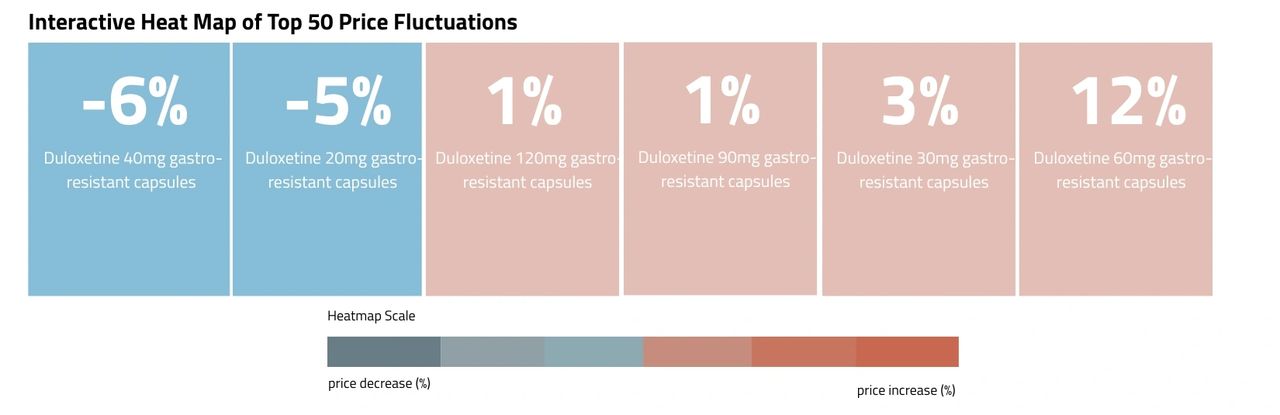
The price heatmap tells the other half of the story. The 60mg strength - the most prescribed - has seen a +12% price increase over three months. This is the UK market repricing ahead of a constrained supply environment.
Strength-by-Strength Evidence
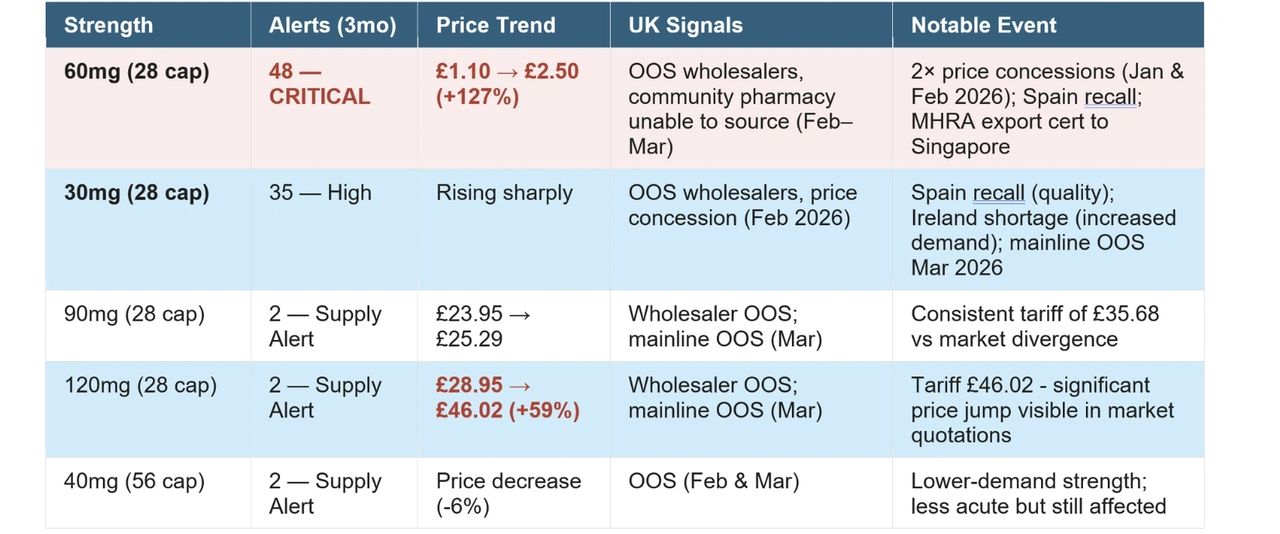
The table below summarises the supply stress picture across all duloxetine strengths, drawn from the platform data:
Duloxetine 60mg: The Clearest Signal
The 60mg strength presents the most acute picture. 48 supply alerts in three months places it firmly in the Critical category. The alert volume spiked sharply in January–February 2026, coinciding with the period our model identified as the critical transition point.
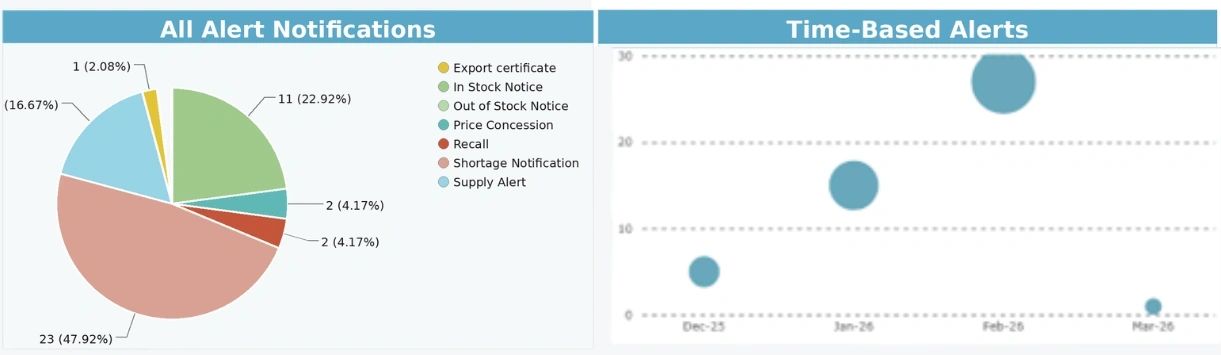
Duloxetine 60mg - Alert Notifications and Time-Based Alerts (last 3 months). 48 alerts; 47.92% shortage notifications. Sharp spike Jan-Feb 2026.
The pricing data for the 60mg strength is equally stark. Market quotation prices have climbed from £1.10 in January 2026 to £2.50 by March 2026 - a 127% increase in under three months - while the Drug Tariff price has remained flat. Two price concessions were issued in January and February 2026.
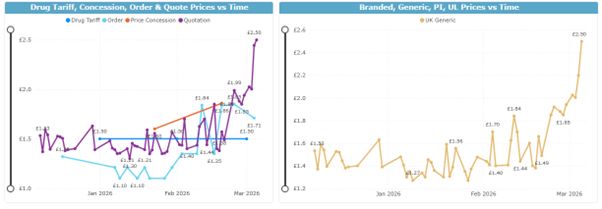
Duloxetine 60mg gastro-resistant capsules 28-cap - Drug Tariff, Concession and Quotation Prices (Jan–Mar 2026). Quotation prices: £1.10 → £2.50 (+127%). Two concessions issued.
Duloxetine 30mg: Following the Same Pattern
The 30mg strength mirrors the 60mg trajectory with a slight lag - consistent with the wave pattern our model predicts. 35 supply alerts in three months (High severity), wholesaler out-of-stock notices from multiple suppliers, and a price concession issued in February 2026.
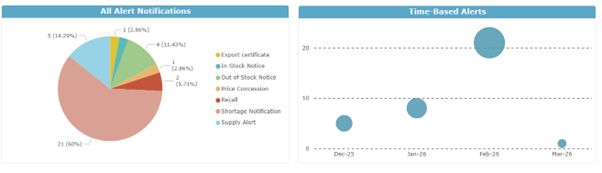
Duloxetine 30mg - Alert Notifications and Time-Based Alerts (last 3 months). 35 alerts; 60% shortage notifications. Peak Feb 2026, continuing into March.
The 30mg price chart shows the same characteristic instability - frequent volatility in quotation prices with a clear upward drift, and a concession issued on 19 February 2026 at £1.45.
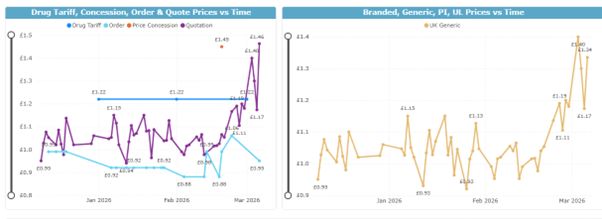
Duloxetine 30mg gastro-resistant capsules 28-cap - Drug Tariff and Quotation Prices (Jan–Mar 2026). Concession issued 19 Feb 2026 at £1.45; quotation prices rising sharply into March.
Additional Signals Across the Period
• 21 January 2026: MHRA issued an electronic export certificate for duloxetine 60mg capsules - destination Singapore. Export certificates are issued when product is leaving the UK market to higher-value destinations, reducing domestic supply.
• 21 January 2026: Spain quality recall of duloxetine 60mg (impurity above set limit) - the same manufacturing geography that was flagged in our July 2025 analysis.
• 25 February 2026: A second Spain recall for the 30mg strength (same impurity cause). The upstream manufacturing quality issue has not been resolved.
• Multiple community pharmacy supply alerts from UK-England flagged throughout February 2026 - indicating the stress had reached patient-facing dispensing level.
• 2–3 March 2026: Mainline wholesalers reported out of stock across multiple strengths simultaneously - the point at which supply stress becomes a patient access issue.
The Repeatable Pattern
Duloxetine is not an isolated case.
The same upstream signal sequence - international alerts, pricing divergence, and wholesaler tightening - has now appeared across several molecules monitored by the platform.
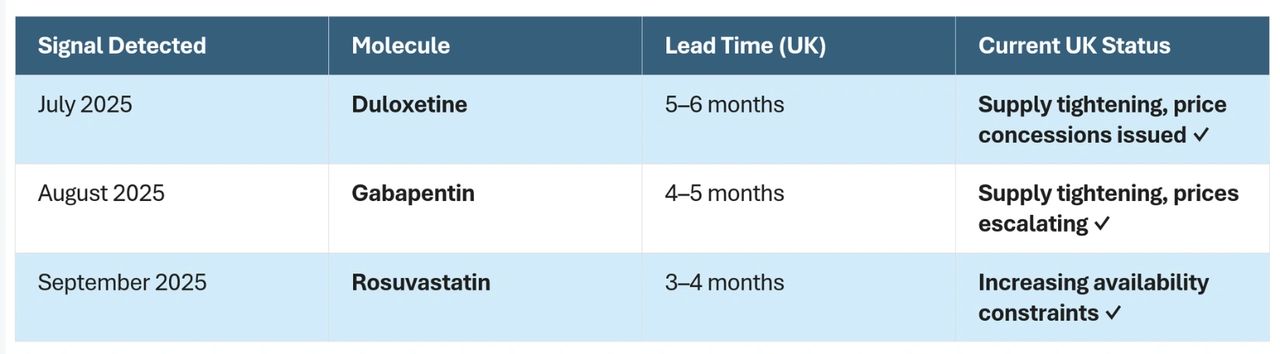
In each case, the signal appeared internationally before the UK market tightened. In each case, the practical decision window sat between the upstream signal and the UK availability constraint. In each case, the UK Drug Tariff mechanism responded late.
What This Means for Medicines Procurement
The duloxetine case, now validated in full, illustrates a structural vulnerability in how UK medicines procurement currently works:
• Supply risk is typically identified reactively - when stock is unavailable, not when international signals emerge
• Tariff pricing provides a false sense of stability during the early formation of a shortage
• By the time a formal UK shortage is acknowledged, the market is at or beyond the optimal intervention point
• Export certificate activity signals product leaving the UK to higher-margin markets - a specific, observable early warning that domestic availability is about to tighten
• Commercial teams acting on upstream intelligence - not domestic notifications - consistently access better options, more time, and lower unit cost
About MedSupply Intelligence
MedSupply Intelligence, an iethico company, continuously monitors upstream supply signals across the global medicines supply chain - combining international shortage notifications, manufacturing intelligence, regulatory recall data, pricing dynamics, and market availability indicators to detect emerging supply stress before it becomes visible in national procurement systems or healthcare supply networks.
To learn more about how MedSupply Intelligence identifies supply stress signals before they reach healthcare markets, contact support@iethico.com