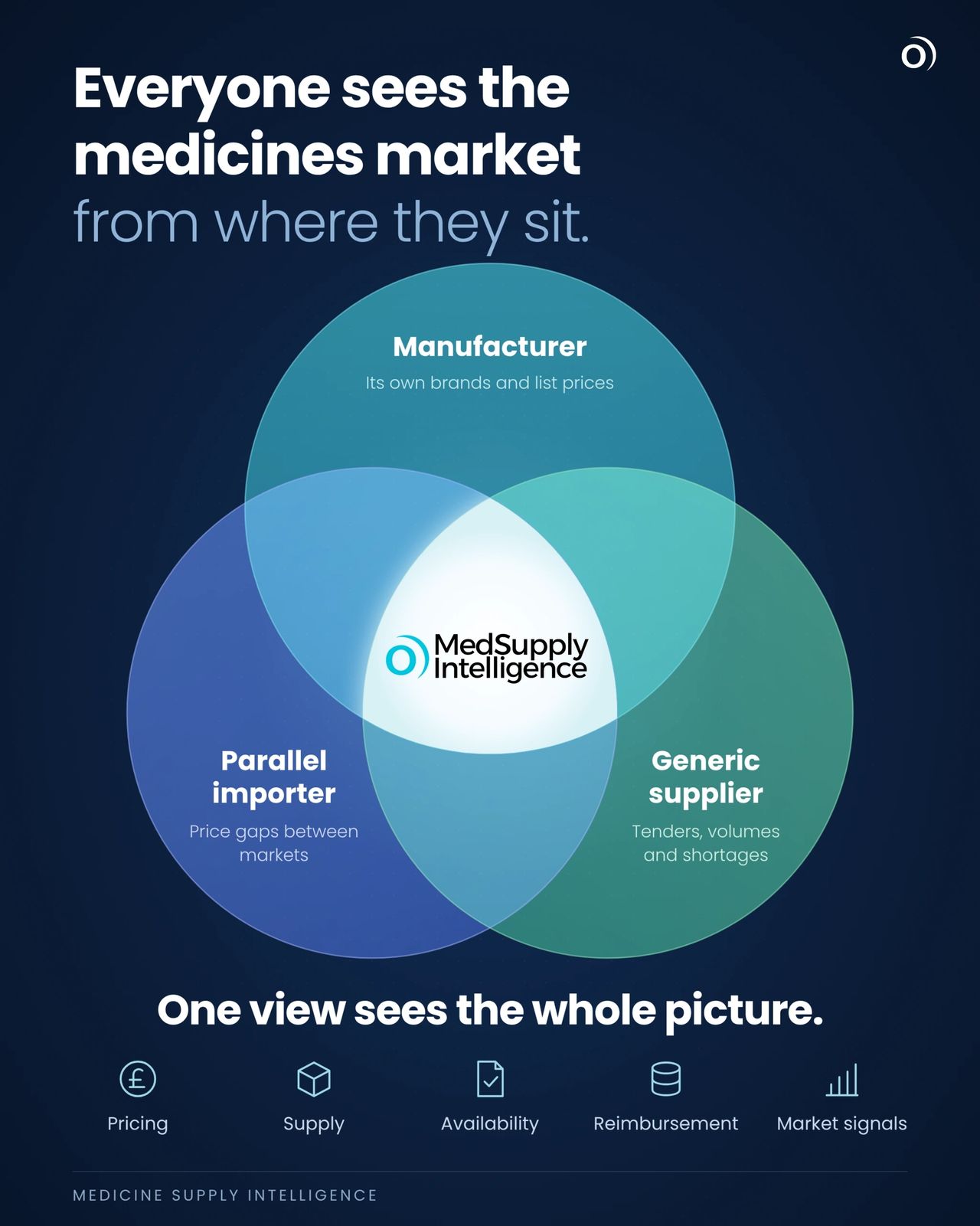
Everyone sees the medicines market from where they sit. Here’s why that’s a problem.
Ask a manufacturer what’s happening with a medicine and you’ll get one answer. Ask a parallel importer and you’ll get another. Ask a generic supplier, a wholesaler or a community pharmacist, and you’ll hear something different again.
None of them are wrong. They’re each describing the part of the market they can see.
A manufacturer knows its own brands and list prices. A parallel importer watches the price gaps between markets. A generic supplier lives in the world of tenders, volumes and shortages. A pharmacist sees what’s arriving on the shelf and what isn’t. Each view is accurate, and each one is incomplete.
That’s how the UK medicines market has always worked: lots of well-informed people, each looking through a different window. The trouble is that the things that matter most, like a shortage building, a price starting to move, or supply tightening overseas, rarely start where you happen to be looking.
The cost of a partial view
When pricing, availability and supply are tracked separately, problems tend to reach you as outcomes rather than signals. A medicine goes out of stock and the question becomes “what happened?” instead of “what’s coming?”
Published benchmarks tell you what a price was meant to be, not what people are actually paying. A shortage feed tells you something has already run out, not that it’s about to. An international supply problem might be well known in one market and invisible in another until it lands.
Each data point on its own is useful. The real insight sits in the connections between them.
One connected view of the market
That’s the thinking behind MedSupply Intelligence from iethico. Rather than adding another price feed or shortage list, MedSupply brings pricing, availability, supply and risk together around the medicines that matter, so you can see how they affect each other.
In practice, that means four things:
-
Pricing. Real acquisition and quoted prices, not just published benchmarks, so you can see what the market is actually paying.
-
Availability. Tracking where medicines are available, where supply is tightening and where products are moving out of stock.
-
Supply. UK and international supply signals connected around the same medicine, so developments abroad don’t arrive as a surprise at home.
-
Risk. Spotting emerging pressure before it becomes obvious in conventional reporting.
Behind this sit more than 3 million connected market signals, covering real-time pricing, live availability, international supply developments, and UK market intelligence on tariff, concessions and procurement behaviour.
What it looks like in practice: sumatriptan 50mg
The clearest way to show the value of a connected view is to look at a real medicine.
In September 2025, supply pressure on sumatriptan 50mg was already visible in the data, while UK prices were still mostly below £1. On price alone, nothing looked wrong.
By February 2026, out-of-stock signals were appearing. In April 2026, pharmacies were receiving supply alerts. By May 2026, the situation had become a commercial escalation.
For anyone watching a single signal, the story started in February or later. For anyone watching the connected picture, it started around eight months earlier. That’s roughly eight months of advance visibility: time to adjust purchasing, review stock positions, talk to suppliers and plan, instead of reacting.
From visibility to better decisions
Seeing more is only valuable if it helps you act. Depending on where you sit in the market, a connected view supports different decisions.
-
If you buy medicines, it helps you understand availability, acquisition pricing and sourcing pressure.
-
If you manage a portfolio, it helps you track pricing and market movement across the products you care about.
-
If you’re looking for growth, it helps you identify emerging demand, market gaps and commercial opportunities.
The aim is simple: see what’s happening, understand why it’s happening, and anticipate what happens next.
Built with the people closest to the market
Community pharmacies see supply pressure first-hand, often before anyone else. Through the iethico Pharmacy Panel, pharmacies can contribute their weekly order data and receive personalised intelligence back on pricing, availability and emerging supply pressure. Their contribution improves the whole picture, and they benefit from it directly.
Seeing the whole picture
The medicines market will always involve different players with different priorities. That won’t change. What can change is how much of the market each of them can see.
When pricing, availability, supply and risk are connected, the view from where you sit stops being a limitation. You still see your part of the market clearly, but now you also see how it fits with everything else.
If you’d like to see how a connected view of the market could work for your organisation, request a demo. If you’re a community pharmacy interested in the Pharmacy Panel, get in touch and we’ll explore how we can help you find emerging issues.