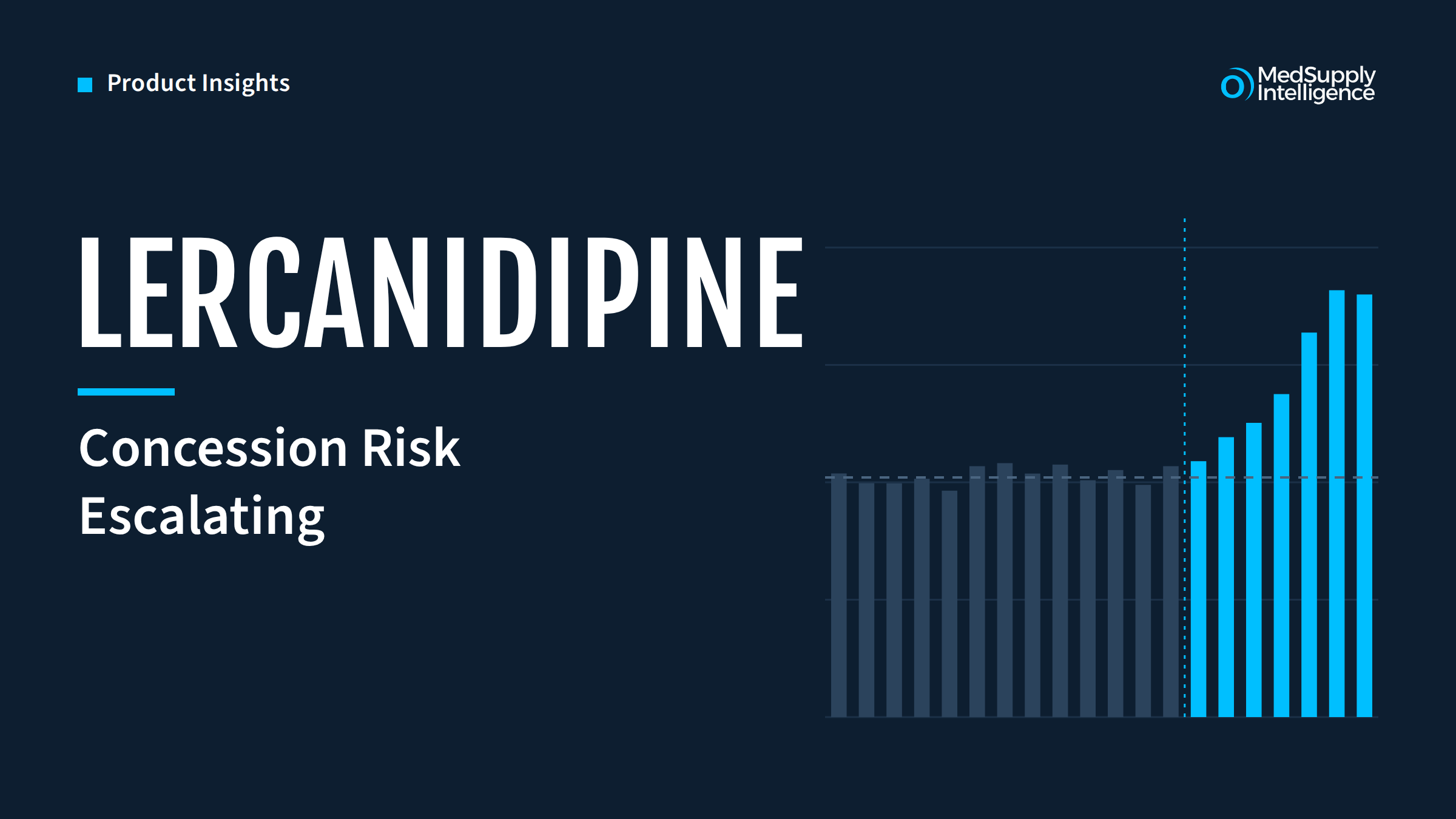
There is currently no official shortage notice for Lercanidipine 10mg or 20mg. The market has seen no national supply alert and no formal escalation. Yet, market signals indicate an elevated near-term risk, and the supply chain is already behaving as though a concession is inevitable.
In medicines markets, stress tends to progress in predictable stages. This usually begins with supplier thinning and quote volatility, before wholesale pricing detaches from the tariff. This is followed by selective availability, concession grants, and sometimes formal shortage recognition. Right now, Lercanidipine sits squarely in the middle of this progression.
The most credible signal of this stress is not found in a press release. It is visible in the widening gap between the Drug Tariff and live wholesale pricing.
The Leading Indicator: Wholesale Detaches from Tariff
When wholesale pricing clears materially above reimbursement levels, a concession typically follows. We are currently observing this sustained detachment with Lercanidipine.
For a 28-tablet pack, the current Drug Tariff sets 10mg at approximately £1.24 and 20mg at approximately £1.96. However, live wholesale pricing for lines that are actually in stock tells a very different story:
-
10mg: Trading between £2.00 and £3.50
-
20mg: Trading between £4.29 and £6.69
This places the 10mg strength trading at 60% to 180% above the tariff. Meanwhile, the 20mg strength is trading at 120% to 240% above the tariff. This is not a minor fluctuation. It is a sustained market clearing above reimbursement, which historically serves as a precursor to a concession.
Structural Risk Factors in the Supply Chain
The molecule itself is not in crisis, but it has become structurally fragile. Several factors have converged to thin the market and reduce supplier redundancy.
Firstly, primary care prescribing volumes have increased materially since 2021. Secondary care continues to provide a steady baseline pull, particularly for the 20mg strength. As a result, the system is carrying more volume than it did during previous concession events.
At the same time, supplier redundancy has quietly narrowed across both strengths. The market has experienced multiple AMP discontinuations and ongoing EU supply alerts. While the brand version, Zanidip, remains available, it comes at a significant premium. With fewer truly interchangeable generic options, the market has less tolerance for shocks. Thin markets move much faster when stressed.
Historical Market Behaviour
We have seen this pattern before. During the last stress cycle, the concession for 10mg peaked between £3.64 and £4.15, representing a 60% to 80% uplift from its tariff. The 20mg concession peaked between £5.22 and £5.66, an uplift of roughly 45% to 50%.
Following that cycle, the concession was withdrawn, Category M was recalculated, and tariffs were reset sharply lower to the current baseline of £1.24 for 10mg and £1.96 for 20mg. The market did not strengthen; it simply repriced. Now, wholesale pricing has detached again, but it is doing so from a much lower baseline, and the divergence exceeds historical uplift percentages.
Forecast and Projected Concession Bands
Once wholesale consistently trades above the tariff, pharmacies dispense at a loss. As evidence accumulates, concession requests increase, and the concession aligns toward the clearing price.
Because the wholesale-to-tariff gap is already significant, the escalation window is compressed. If current wholesale pricing persists, there is a high probability of concession movement within one to three months.
Meta title: Lercanidipine Supply Risks and Wholesale Pricing Meta description: Lercanidipine is not officially in shortage, but wholesale prices have detached from the Drug Tariff. Read our analysis on the concession risks for 10mg and 20mg.
Based on where the market is already transacting, projected concession bands are:
-
10mg: A likely band of £2.40 to £2.80, with a central estimate of approximately £2.60.
-
20mg: A likely band of £4.50 to £5.20, with a central estimate of approximately £4.90.
The 20mg strength carries a high escalation risk and is the most likely to move first. Historically, it experiences a higher absolute concession uplift, a greater cost-per-item shock, and a larger tariff correction post-event. It currently shows a larger wholesale-to-tariff divergence and has greater exposure if hospital procurement tightens supply. The 10mg strength remains on elevated watch and would likely follow if pressure sustains or if dose-switching begins.
Strategic Lessons
Official shortages often serve as lagging indicators. The wholesale spread versus the Drug Tariff provides a much more accurate leading indicator.
While Lercanidipine is not officially in concession, it is already trading like it is. Markets rarely tolerate a sustained misalignment between the clearing price and reimbursement. When the correction arrives, it tends to happen quickly. Monitoring these early pricing signals provides a crucial window to act before formal supply issues are announced.