Six Months Later
What happened after we identified supply risk in England’s most prescribed medicines?
iethico Research | Medicine Supply Intelligence | September 2026
Executive summary
In February 2026, iethico assessed twenty of England’s most prescribed medicines for supply-chain vulnerability and ranked them according to the degree of underlying strain visible at that point in time.
Six months later, we returned to the same fixed cohort to ask a simple question: did the medicines identified as more vulnerable subsequently behave differently from those ranked lower?
The answer is yes.
The highest-risk medicines were more likely to show persistent or widening economic pressure, cross-strength involvement and formal supply intervention.
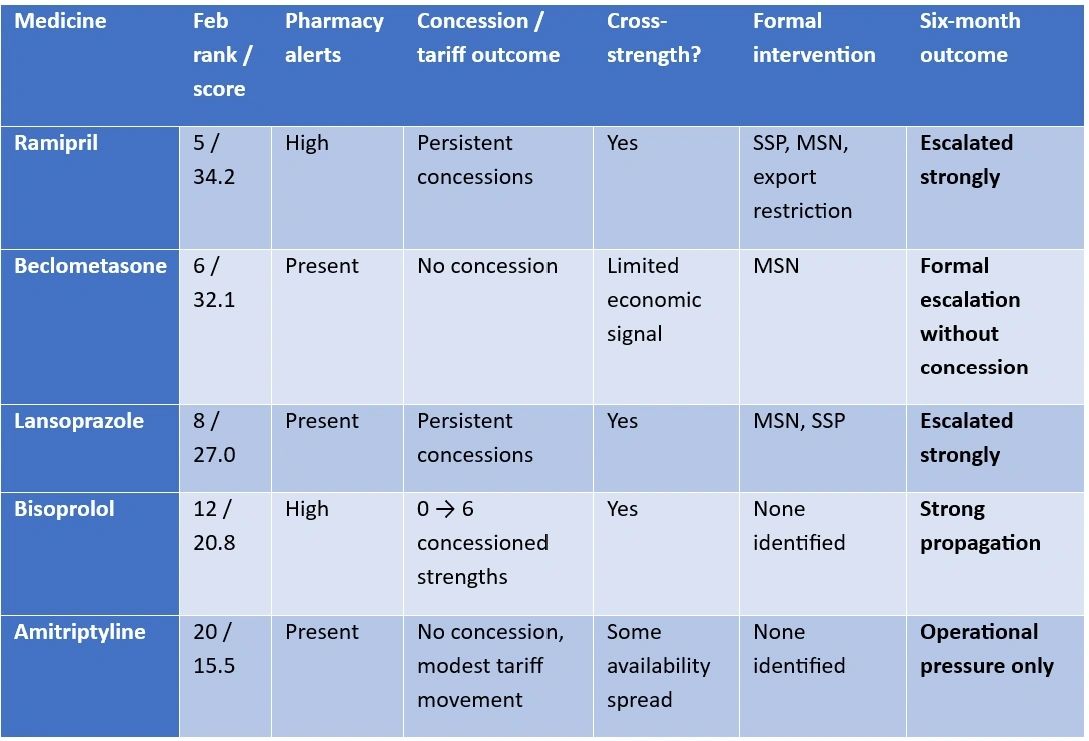
· Ramipril and Lansoprazole progressed into formal intervention after displaying earlier structural and economic stress.
· Bisoprolol moved from no concession activity in February to concessions affecting six strengths by July and August.
· Beclometasone, ranked sixth despite having no historic concession activity, subsequently became subject to a Medicine Supply Notification.
At the bottom of the February ranking, the picture was different.
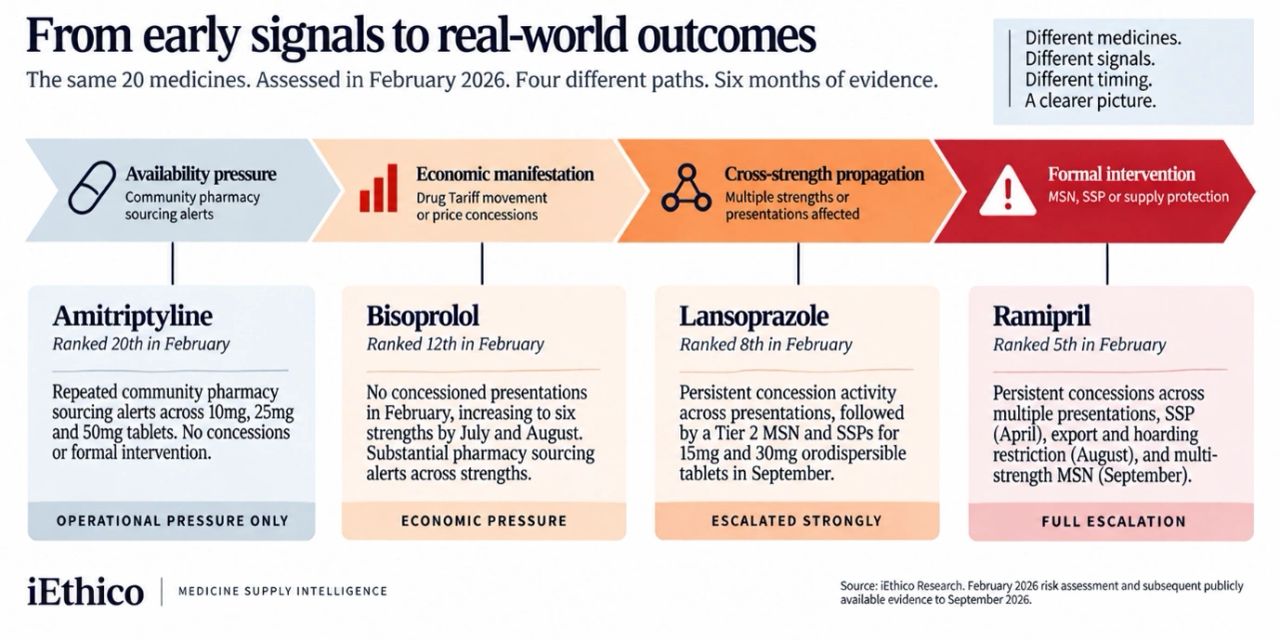
· Amitriptyline, Losartan and Clopidogrel all experienced community pharmacy sourcing alerts, but none progressed to the same level of sustained concession activity or formal intervention during the observation period. Their lower position therefore did not mean an absence of pressure; it corresponded more closely to less severe subsequent escalation.
This distinction matters. The February assessment was not designed to predict a binary shortage outcome. It was designed to identify relative vulnerability before the later manifestations were known. Six months of follow-up now provide prospective evidence that those differences in vulnerability were meaningful.
The findings also reinforce the central conclusion of iethico’s recent Before the Concession white paper: later UK pressure often has an observable history, and different data layers reveal different stages of that history.
A prospective test, not a retrospective one
The February cohort was established before the subsequent outcomes occurred. That is important because it avoids the common problem of beginning with known supply issues and working backwards to identify earlier warning signs.
The original assessment distinguished formal shortage from structural strain, recognising that supplier attrition, narrowing redundancy, availability pressure and economic divergence can precede a declared disruption.
The six-month review shows that this distinction had practical value.
Some medicines progressed materially. Some developed persistent but non-formal economic pressure. Others experienced sourcing friction without comparable escalation. That spread of outcomes is exactly what a relative risk model should be able to distinguish.
The clearest validations
Ramipril provides the strongest example of progressive escalation. It entered the period with visible structural and economic strain, then recorded persistent concessions across multiple presentations, moved into SSP intervention, was placed under export and hoarding restrictions, and by September had a multi-strength Medicine Supply Notification.
The significance is the sequence. The formal intervention arrived later than the February risk signal.
Lansoprazole followed a similar path. Recurrent concession activity persisted after February and was followed in September by a Tier 2 MSN and SSPs covering both 15mg and 30mg orodispersible tablets.
Bisoprolol is perhaps the clearest example of early economic prediction. It had no concessioned presentations in February, but the pattern subsequently developed to 1 in March, 1 in April, 2 in May, 4 in June and 6 in both July and August. By the end of the period, concession activity spanned the full 1.25mg to 10mg strength corridor. Community pharmacy alerts were also substantial across those strengths.
Beclometasone validates a different part of the model. It ranked highly despite no historic concession activity and subsequently received a Tier 2 MSN. This is important because it shows that the February ranking was not simply reproducing historical concession behaviour.
What happened at the lower end?
The bottom of the February ranking included Amitriptyline, Losartan and Clopidogrel.
All three subsequently generated community pharmacy sourcing alerts, so it would be wrong to call them unaffected. However, none progressed to the same degree of economic or formal escalation seen in the stronger cases.
That is a meaningful result.
The ranking appears to have separated background or operational supply friction from medicines more likely to progress into sustained reimbursement pressure, cross-strength propagation or formal intervention.
There were exceptions. Levothyroxine, Atorvastatin and Metformin were relatively low ranked but subsequently developed concession activity, which shows that the model was not perfectly ordered and should not be interpreted as deterministic. But the broader pattern still matters: several of the clearest formal and cross-strength outcomes were concentrated higher in the original ranking, while the least escalated medicines were concentrated towards the bottom.
Why concessions alone would have missed the picture
A concession-only analysis would have understated both the February signal and the subsequent validation.
Omeprazole and Citalopram did not receive concessions during the review period, yet both showed notable Drug Tariff movement across multiple presentations. Furosemide and Losartan also showed underlying tariff changes, while community pharmacy alerts provided additional evidence of sourcing friction.
At the same time, Beclometasone progressed to formal supply intervention without a concession signal.
This is consistent with Before the Concession, which showed that commercial, reimbursement and availability signals can diverge and that later reimbursement pressure often has a detectable history.
The implication is that prediction improves when medicines are followed across connected signals rather than judged by one endpoint.
What the six-month review shows
The February assessment did not predict twenty shortages, and it was not intended to. What it did was rank relative vulnerability before the later outcomes were known.
Six months later, that ranking has generated prospective evidence of discrimination.
Higher-risk medicines were more likely to progress into persistent economic pressure, broad cross-strength involvement or formal system intervention. Lower-ranked medicines still experienced sourcing difficulty, but generally with less subsequent escalation.
That is a stronger finding than simply saying that many medicines later had problems.
It suggests that the February model was identifying where pressure was more likely to become consequential, not merely where any supply noise might occur.
This aligns with the broader evidence in Before the Concession, where iethico found that 73.6% of concession Product-months had relevant supply evidence in the preceding six months and that forward high-risk cohorts achieved strong out-of-time precision across approximately 30-, 90- and 180-day horizons.
The Top 20 follow-up now adds something different: a named cohort, fixed prospectively, whose subsequent behaviour can be observed medicine by medicine.
Conclusion
The February 2026 assessment identified differing levels of vulnerability across twenty medicines central to routine NHS care. Six months later, those differences have begun to translate into materially different outcomes.
Some medicines progressed into formal shortage intervention. Others developed persistent or cross-strength economic pressure. Some showed availability friction without the same degree of escalation.
That pattern is the important result.
The value of early supply intelligence is not in predicting that every signal becomes a shortage. It is in distinguishing which medicines are more likely to see pressure persist, spread and become consequential before the formal system has fully responded.
The February cohort provides early prospective evidence that this distinction can be made.
That is also the central proposition of Before the Concession: medicine supply pressure develops as a sequence, and the predictive value lies in connecting those signals early enough to see where the sequence may be heading.
Methodological note
This follow-up reviews subsequent observable outcomes for the same cohort assessed in February 2026. It draws on community pharmacy availability evidence, Drug Tariff and concession behaviour, and formal UK supply interventions. These measures are treated as distinct indicators rather than interchangeable definitions of shortage.
The underlying iethico source architecture, entity-resolution processes, signal selection, transformations, thresholds and weighting remain proprietary. As with Before the Concession, the purpose is to demonstrate the predictive value of connected medicine-level intelligence without disclosing the methodology that produces it.