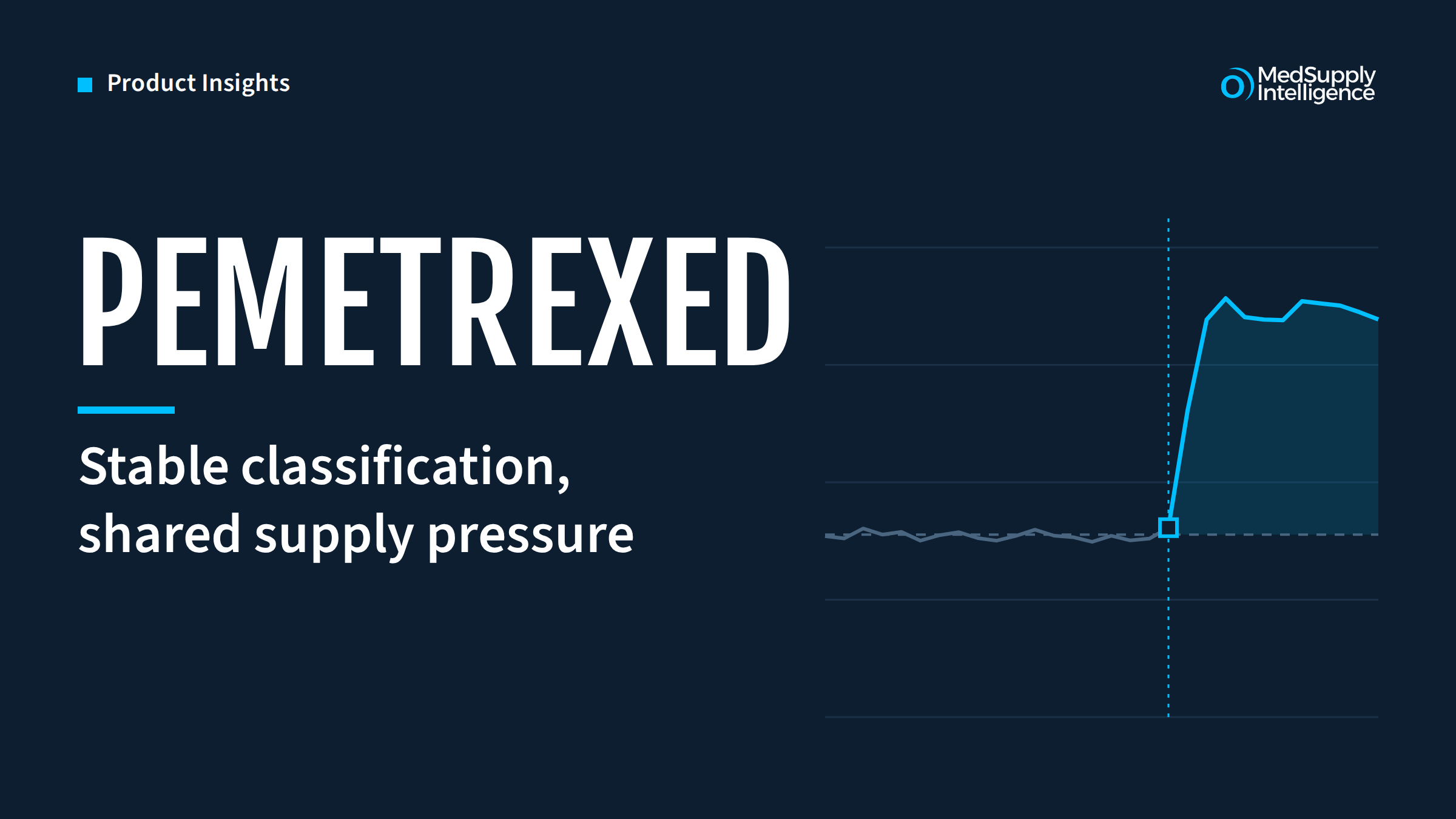
Pemetrexed is not currently classified as a formal shortage in the UK. On that basis, it would be reasonable to assume that supply is broadly stable.
However, when the UK position is considered alongside international supply signals, supplier structure and domestic pricing and procurement behaviour, a more nuanced picture emerges.
Over the past several years, pemetrexed has shown recurring disruption across multiple international markets. Shortages, discontinuations and manufacturing issues have been reported across Europe and Australia, often affecting different suppliers and presentations at different times. Rather than resolving cleanly, these disruptions appear to move across the market, suggesting a molecule operating with limited underlying resilience.
The UK retains a relatively broad licensed base, with multiple suppliers across concentrate vials, powder vials and infusion bags. In principle, this level of supplier coverage should provide stability.
However, the composition of that supplier base is important.
Several of the key UK suppliers, including Accord, Sun Pharma and Fresenius Kabi, are part of the same corporate networks that appear in overseas shortage notifications. Others, including Genus and Viatris, sit within wider European generic systems, corresponding to STADA / Thornton & Ross and Mylan respectively. These are not isolated supply routes. They form part of a broader network in which supplier participation, manufacturing capacity and market presence have been evolving over time.
This indicates that a significant proportion of UK supply is connected, either directly or indirectly, to the same upstream environment that has been under sustained pressure internationally.
The effect of this becomes visible in pricing behaviour.
NHS data shows a clear distinction between presentations. Some high-volume vial formats, such as 100mg/4ml and 500mg/20ml, exhibit relatively low price variation, consistent with stable supply and active competition. In contrast, other presentations, including powder vials and certain infusion bags, show much wider price dispersion, in some cases with variation approaching or exceeding the average price. This level of variation is more consistent with intermittent availability and changing sourcing routes than with normal market dynamics.
NHS secondary care procurement data shows a similar pattern. Unit costs for powder vials vary significantly across the period, while ready-to-use infusion bags remain consistently priced. This is notable given that hospital procurement processes typically smooth short-term volatility. The presence of variation at this level suggests that underlying supply inconsistency is reaching institutional buyers, not just the wholesaler channel.
Volume adds a further dimension. NHS procurement is not concentrated in the most stable formats. Higher-volume purchasing is largely associated with powder and vial presentations, which also show the greatest variability in both procurement cost and NHS pricing. More stable formats, such as infusion bags, account for a smaller share of total volume. This indicates that the parts of the market most exposed to shared upstream disruption are also those most relied upon in practice.
Taken together, these observations point to a consistent pattern. The UK market retains sufficient licensed products to avoid formal shortage classification, but effective supply conditions vary across presentations. Some parts of the market continue to function predictably, while others show signs of intermittent availability and variable sourcing.
More broadly, this illustrates a familiar progression. Supply pressure does not begin at the point a shortage is declared. By that stage, underlying changes in supplier reliability, international availability and pricing behaviour have often been visible for some time.
Closing line
Pemetrexed is not currently a shortage in the UK, but the combination of shared international supply exposure, uneven pricing behaviour and concentration of demand in more variable formats suggests that parts of the market are operating with reduced resilience.