Drug Tariff concessions are presented as temporary administrative corrections, issued when medicines cannot be sourced at the published tariff price.
If they were isolated responses to unexpected disruption, we would expect them to be rare, evenly distributed, and self-correcting.
The data shows something different.
-
Concessions are concentrated in lower-priced medicines.
-
They recur in the same products.
-
They increasingly follow tariff price reductions.
This is not random variation. It is a pattern.
1. Low-Priced Medicines Are Disproportionately Affected
The highest concession rates occur in the lowest price bands.
Products priced under £2 per pack are materially more likely to receive concessions than higher-priced medicines. The likelihood falls consistently as tariff price increases.
Concessions are not evenly spread across the market. They are concentrated where reimbursement is lowest.
That concentration matters. It indicates that instability is greatest in segments where prices have been compressed most aggressively.
If supply disruption were evenly distributed, concession rates would not follow a clear price gradient. They do.
The concentration is visible when concession incidence is grouped by Drug Tariff reimbursement level.
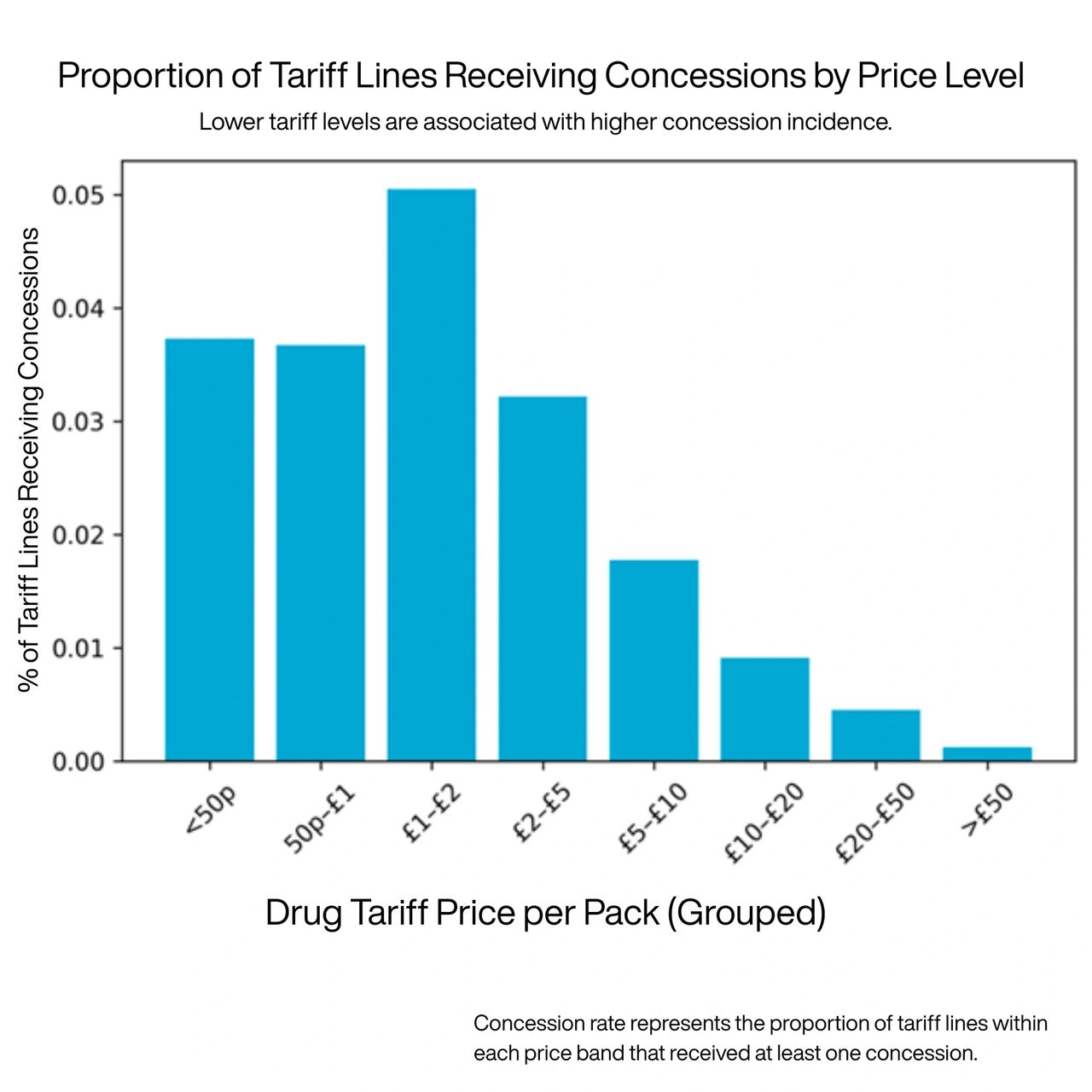
Medicines reimbursed at lower tariff levels are materially more likely to require concession. The gradient is consistent: as tariff price increases, concession incidence declines sharply.
2. The Same Products Reappear
If a concession restored stability, most affected products would disappear from subsequent lists.
Instead, many products that receive one concession receive another - often within the same year.
This is particularly evident in the £1–£5 range.
Repeat concessions are common.
When the same medicines require repeated price corrections, it indicates that the underlying tariff level is not consistently supporting sustainable supply.
3. Frequency Per Product Is Rising
Over time, two developments are visible:
-
More products are receiving concessions.
-
Those that do receive concessions are being corrected more frequently.
Several widely prescribed generics appear repeatedly.
These are not niche or specialist products. They are routine medicines used daily in primary care.
When everyday generics require multiple tariff adjustments within a year, it suggests persistent economic imbalance rather than isolated disruption.
4. Tariff Reductions Are Frequently Followed by Concessions
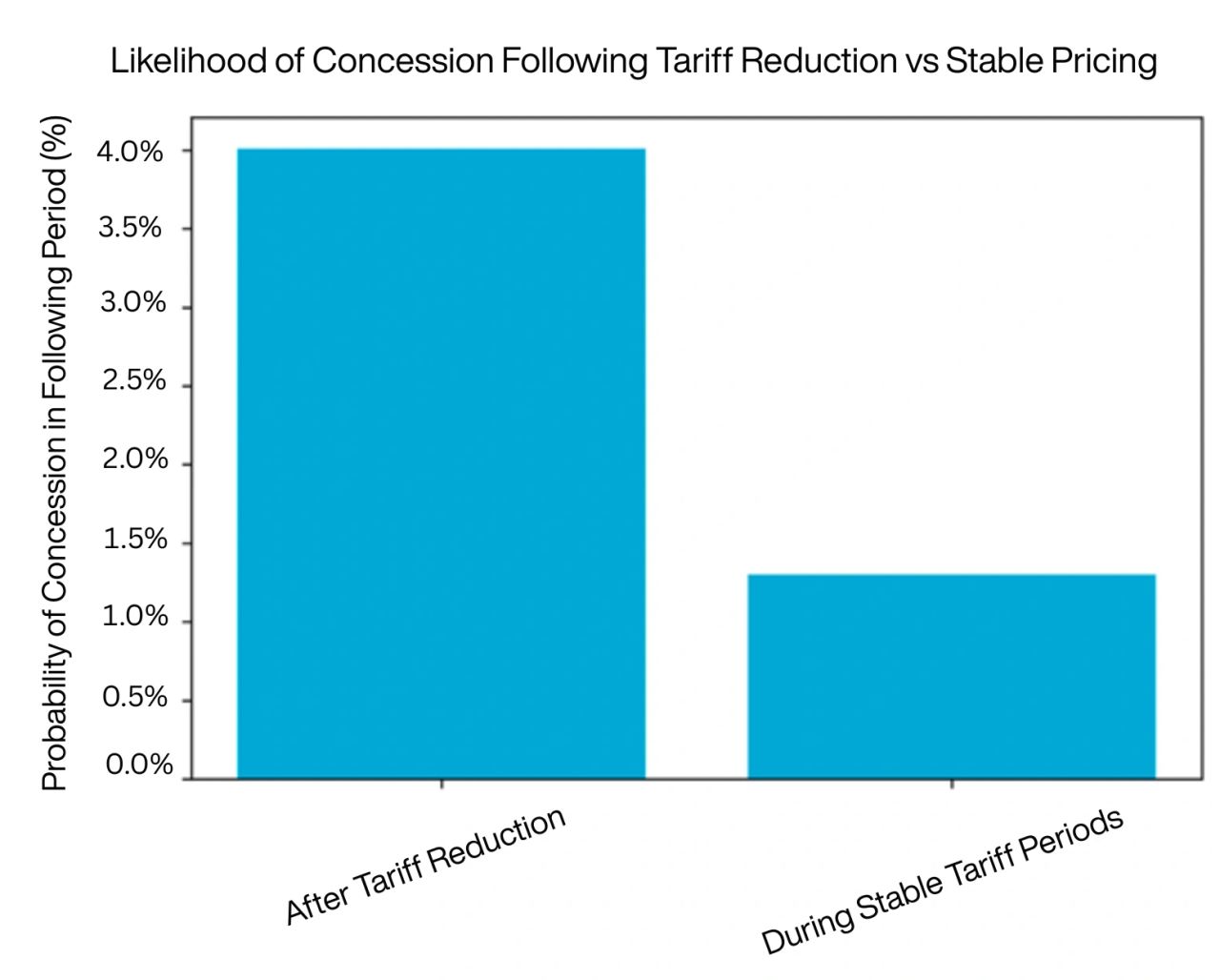
The relationship between tariff reductions and subsequent concessions is clear.
When a product’s Drug Tariff price decreases, the odds of a concession being issued in the following period are more than three times higher than during periods of stable pricing.
This does not prove direct causation.
However, the association is consistent and repeated.
Price reductions are frequently followed by price corrections.
Where tariff prices are compressed, concessions are more likely to follow.
This sequence raises an uncomfortable question: are price cuts stabilising the market, or are they pushing certain products below sustainable levels?
What This Pattern Indicates
If concessions were rare emergency measures, we would expect them to be:
-
evenly distributed across price bands
-
infrequent in repeat occurrence
-
independent of prior tariff adjustments
The data shows the opposite.
Concessions cluster in low-priced medicines.
They recur in the same products.
They are more likely after tariff reductions.
This suggests that parts of the tariff framework may be operating close to economic viability thresholds.
When reimbursement levels fall below what supply can reliably sustain, even minor disruption can make routine supply unviable, requiring retrospective correction through a concession.
Concessions are therefore not simply responses to unexpected supply events. In many cases, they appear to compensate for pricing that does not reliably support stable supply.
The Policy Implication
If the objective is to reduce concession frequency, addressing individual supply events may not be sufficient.
The concentration of concessions in lower price bands and their association with tariff compression indicate that pricing decisions themselves may be contributing to recurring instability.
Concessions are often described as exceptional.
The data suggests they are systemic.
If concession volumes continue to rise in predictable segments, the question is not only how to manage each event - but whether elements of the pricing model require structural adjustment.