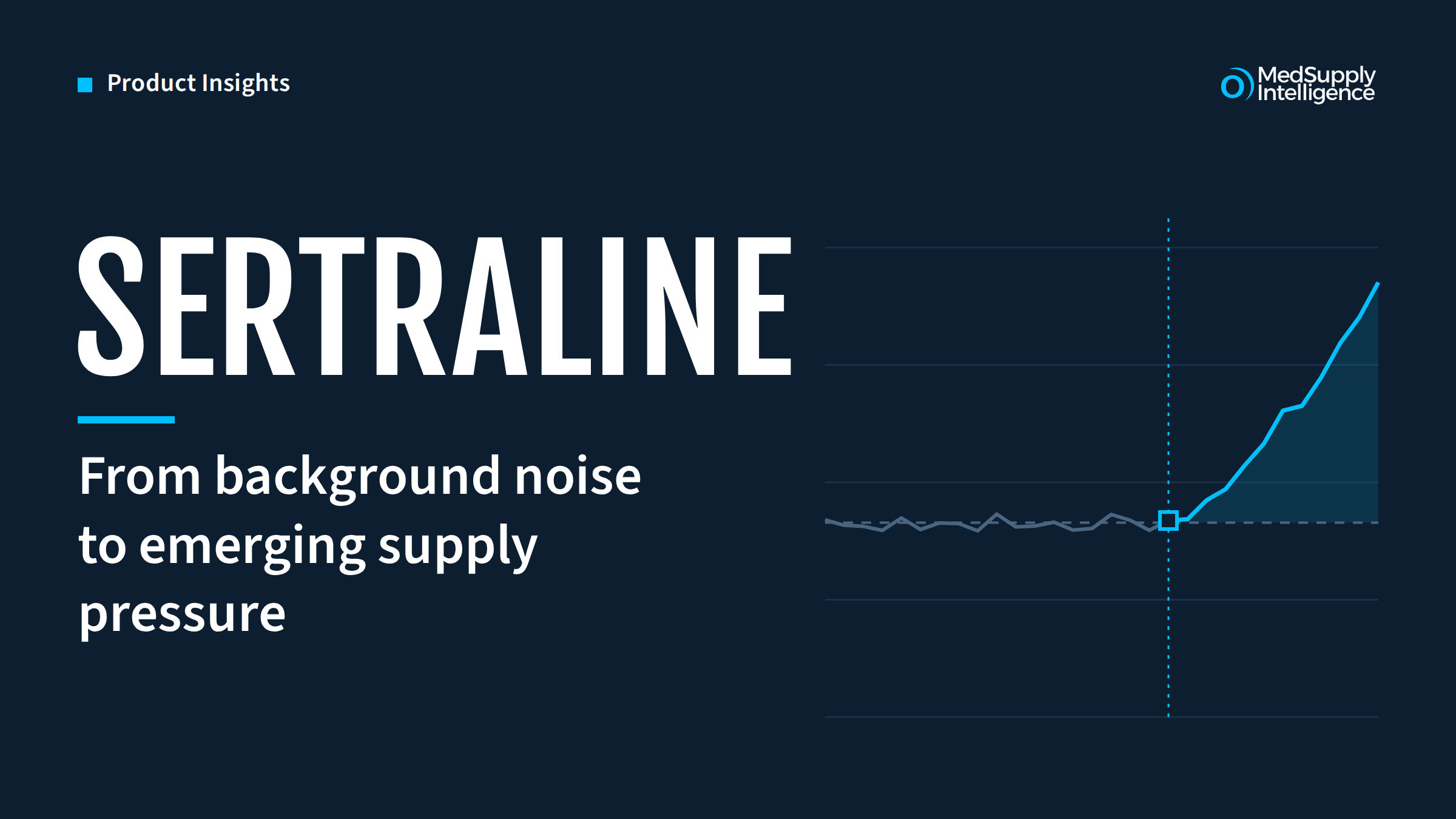
Sertraline has moved beyond routine generic market volatility into a more sustained supply pressure pattern.
There is still no formal UK shortage notification for the core strengths.
Primary care prescribing behaviour remains stable.
However, the wider supply picture has changed materially.
This is now a closely monitored molecule.
What has changed
A. Multi-country shortage clustering
Across both 50mg and 100mg tablets:
-
Repeated shortage notifications across Europe and Australia
-
Mixed causes including manufacturing issues, increased demand and logistics disruption
-
Geographic spread across Sweden, the Netherlands, Ireland, Italy, Greece, Austria, Belgium and others
This is not a single supplier issue.
Supply pressure is now appearing across multiple markets simultaneously.
B. Pressure emerging across both core strengths
Both core strengths are now showing signs of pressure:
-
100mg: international shortages, UK wholesaler out-of-stock notifications and quotation volatility
-
50mg: broader international shortage spread alongside a recall in Portugal
Normally, 50mg tablets can help absorb pressure when 100mg supply becomes unstable.
When both strengths come under pressure at the same time, flexibility within the market becomes more limited.
This is an important supply signal.
C. UK availability pressure
Within the UK:
-
Wholesaler out-of-stock clustering has increased during January and February 2026
-
Supply alerts are beginning to appear
-
No PI activity is visible due to low pricing
-
No formal UK shortage notification has been issued
At present, pressure is appearing through increasing sourcing difficulty and availability disruption rather than through a formal shortage declaration.
D. Economic pressure visible before concession
For 50mg tablets:
-
Tariff pricing reduced into January
-
Quotations increased sharply during February
-
A concession was granted at 81p in February
The concession indicates that acquisition prices had already moved materially above tariff pricing before DHSC intervention.
This is no longer simply an early warning signal.
The market impact is now becoming visible economically.
E. Primary care remains stable but lags behind market conditions
Primary care data up to December 2025 currently shows:
-
Stable prescribing volume for both 50mg and 100mg
-
No clear dose migration
-
Stable implied cost per item
However, primary care datasets lag behind real-time market conditions by approximately two months and do not yet reflect the January–February 2026 supply pressure window.
As a result, behavioural impact cannot yet be ruled out.
Current classification
Sertraline currently sits within:
Phase 2C – Economic and Structural Supply Pressure
Characteristics include:
-
A large but increasingly pressured supplier base
-
Multi-country shortage clustering
-
Pressure emerging across both core strengths
-
UK wholesaler out-of-stock clustering
-
Increasing divergence between quotations and tariff pricing
-
Confirmed concession activity
-
No formal UK shortage notification
-
No observable primary care distortion yet
This remains a monitored escalation zone rather than a crisis environment.
Risk outlook
Short-term risk
-
Further concessions remain possible
-
Intermittent UK wholesaler out-of-stock recurrence may continue
-
Pharmacy margin pressure may increase
Medium-term risk
Risk may increase further if:
-
Primary care prescribing behaviour begins to shift
-
Supplier exits accelerate
-
A manufacturing or quality event affects a major MAH
Under those conditions, escalation into a more significant supply disruption phase becomes increasingly plausible.
For now, the situation remains contained, but it can no longer be considered low risk.