Meglumine amidotrizoate (Gastrografin, Urografin) - The Early Signals Behind a Global Shortage
There is a tendency to view medicine shortages as discrete events. A product is available, then it is not, and at some point a formal shortage or recall is declared. The data here suggests a different sequence, one that is more gradual and, importantly, more observable.
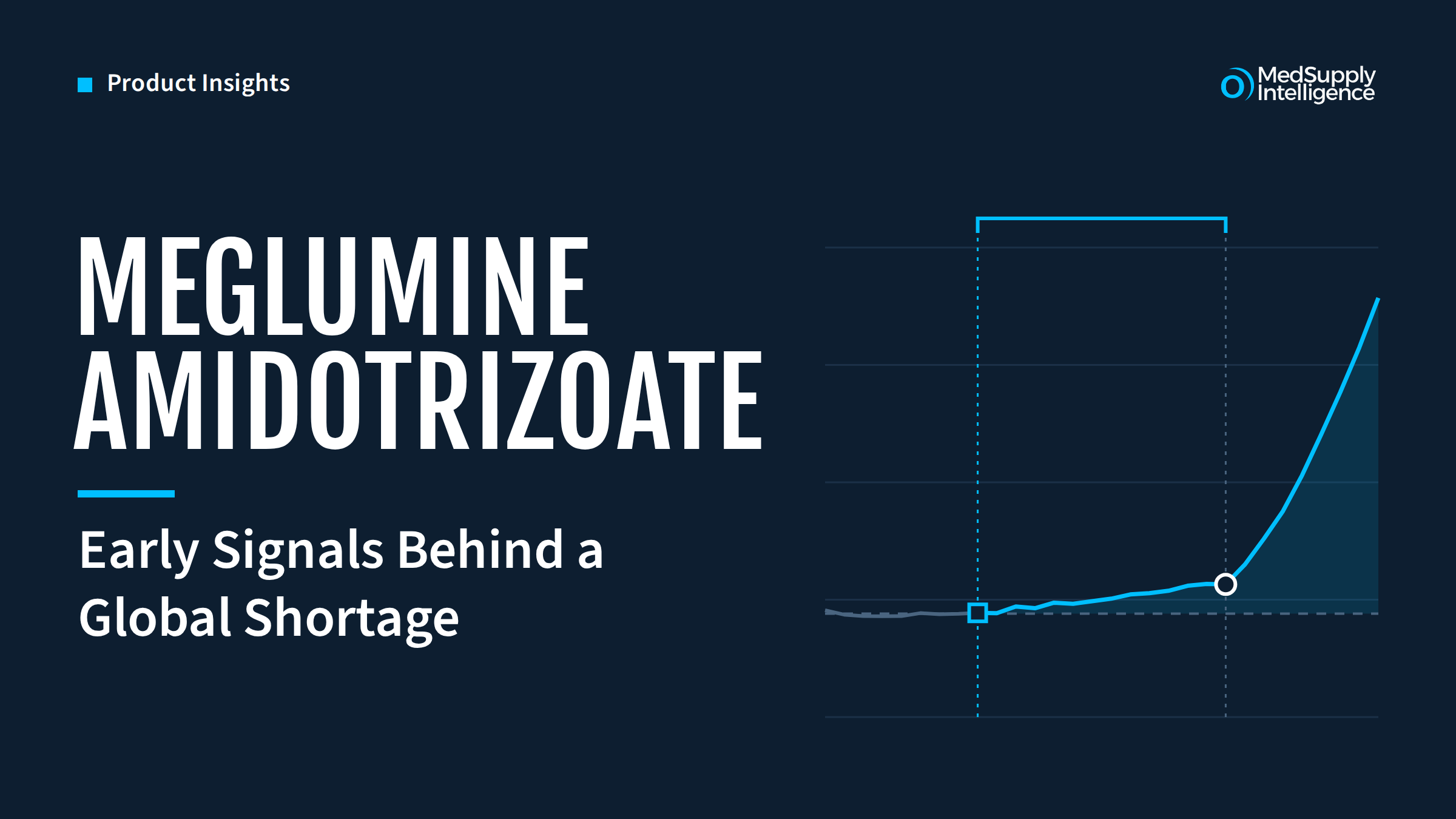
Looking at Gastrografin and Urografin, the earliest signals do not begin with a recall. They begin with a cluster of shortages reported across multiple countries on the same day, 17 February 2026. Australia, Finland and Hungary each report disruption across the same Bayer contrast agent portfolio. At that point, the issue is described in operational terms, typically as a manufacturing problem or without a clearly defined cause.
What is notable is not just that these signals appear outside the UK first, but that they appear simultaneously across jurisdictions. That pattern is rarely coincidental. When the same molecule, from the same supplier, shows disruption in multiple countries at the same time, it usually reflects a single upstream issue beginning to propagate through the system.
At this stage, the expected duration of disruption appears relatively contained. Early Australian data, for example, suggests a return to supply by April 2026, while Finland indicates resolution within weeks. The signal is present, but its severity is not yet fully understood.
Over the following two to three weeks, that picture changes. The same products are updated with extended resolution timelines. Australia moves from April to July, and then to September 2026. European markets begin to report expected resolution dates extending into late 2026. Ireland signals disruption into 2027. At the same time, the underlying cause becomes clearer, shifting from general manufacturing language to a defined quality issue involving nitrosamine contamination.
By early March, two things are happening in parallel. First, the duration of the shortage is being revised upwards across multiple countries. Second, recall activity begins to be formally communicated by regulators. The shortage and the recall are therefore not separate events, but different stages of the same process. The shortage appears first, as batches are withdrawn or supply is constrained. The recall follows, once the root cause has been confirmed and communicated.
The UK sequence sits later in this progression. The first signal appears as local NHS supply alerts on 25 February 2026. The second set of alerts follows in early March. The national shortage notification is not issued until 16 March, at which point the expected resolution is already set as June 2027. By the time the UK formally recognises the issue at a national level, both the cause and the likely duration are already understood elsewhere.
What this illustrates is not simply a lag between countries, but a difference in how the early stages of disruption are interpreted. The initial signals are not framed as a global issue. They appear as isolated shortages, each with its own explanation and timeframe. It is only as those signals accumulate, and as duration extends, that the underlying connection becomes visible.
For those monitoring supply, the implication is straightforward. The most informative signals are not the formal declarations. They are the early, fragmented indications that something is beginning to change. In this case, three countries reporting shortages on the same day, followed by a rapid extension in expected resolution timelines, provided a clear indication that the issue was both structural and likely to persist.
By the time a shortage is formally declared at a national level, the system has already moved on. Availability has tightened, duration has been extended, and the underlying cause is often already known in other markets. The event is no longer emerging. It is established.
Seen in that light, the question is not when a shortage is declared, but when it first becomes detectable.