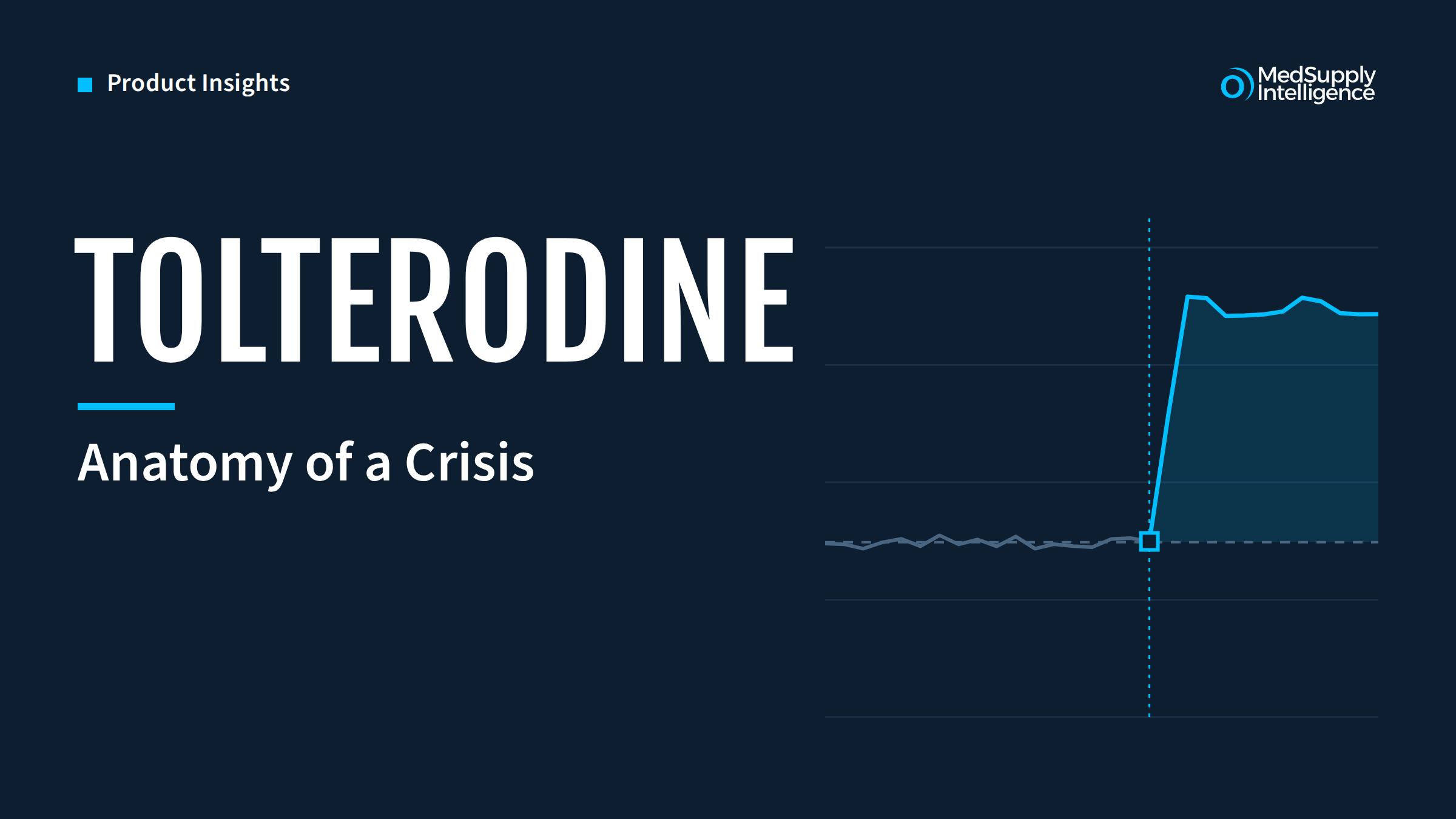
The story of the Tolterodine 4mg modified-release capsule shortage is not about one product or one company. It’s a case study in systemic market failure. For those in pharmaceutical procurement, the past year has been a constant battle, trying to source a product that seemed to vanish from inventories. The official notifications, when they came, confirmed what front-line teams already knew: the market was in crisis.
But what if you could have seen it coming? What if your organisation had the foresight to make strategic decisions before the disruption hit? The reality is, the signals were there. Over a two-year period, MedSupply Intelligence captured 181 distinct supply alerts for this single product line. Tellingly, 176 of those alerts, a staggering 97% occurred within the last 12 months. This data proves the crisis didn’t happen overnight; it was a slow-motion collapse that began a year ago.
Piecing this puzzle together manually is an impossible task. The data is scattered across dozens of countries, buried in regulatory alerts, and hidden in wholesaler updates. This is where intelligence platforms become indispensable. By examining the Tolterodine timeline through the lens of connected data, we can uncover the anatomy of this crisis and demonstrate how comprehensive visibility empowers both manufacturers and procurement teams to navigate market volatility.
A Systemic Challenge Requiring a Systemic View
One of the first critical insights from the Tolterodine data is that this was not an isolated incident. The shortage affected multiple brands and manufacturers simultaneously. When this many players are struggling, it points away from a simple logistical issue and towards a more fundamental problem. The root cause could be a disruption in the production of the active pharmaceutical ingredient (API), a widespread manufacturing capacity shortfall, or a fundamental economic imbalance making the product unviable for multiple suppliers.
For any stakeholder, this context is vital. For a procurement manager, knowing the issue is systemic immediately changes the strategy from “finding an alternative supplier” to “managing a long-term, market-wide risk.”
For manufacturers, this macro view is just as crucial. Are you facing a unique production challenge, or are your struggles part of a wider industry trend? Is a competitor’s disruption an opportunity to gain market share, or is it a warning of an impending raw material shortage that will soon affect your own lines? Without a complete market picture, these strategic questions are impossible to answer, leaving you to make critical decisions in an information vacuum.
The Predictive Power of Global Alerts
The UK market did not begin to feel the full force of the Tolterodine shortage until the spring of 2025. However, the first warning signs appeared much earlier and thousands of miles away.
-
December 2024: The first tremors are felt. A shortage is reported in Ireland. A UK wholesaler notes a specific brand is out of stock. Alerts from Spain and Canada hint at earlier, underlying instability.
-
January – February 2025: The problem escalates across Europe. Alerts flag quality issues, manufacturing delays, and long-term shortages across the continent. Crucially, a major market reports a product discontinuation, permanently removing a significant source of global supply.
-
March 2025: The first significant impact hits the UK. Multiple wholesalers report stock-outs, and a major supplier confirms its brand is unavailable.
By the time the UK’s DHSC issued its first official alert in May 2025, a connected data platform would have already shown five months of escalating international signals. A price concession wasn’t granted until October, a full ten months after the first alerts appeared. Relying on domestic notices means you are always months behind the curve, acting only when the crisis has already peaked.
A Cascade of Interconnected Causes
Supply chain disruptions are rarely caused by a single event. The Tolterodine data reveals a classic domino effect, where one problem triggers another in a cascading failure.
-
The Spark (Manufacturing & Quality): Early alerts specifically cited “Manufacturing” and “Quality” issues. This is the foundational problem, a constraint on the physical production of the drug.
-
The Fire (Increased Demand): As manufacturing tightens the global supply, procurement teams in unaffected regions begin ordering more to secure stock. This creates artificial “Increased Demand,” which was soon reported as a cause for secondary shortages.
-
The Inferno (Total Market Failure): With a constrained supply pool and panicked buying, the system collapses. By late spring and autumn, the alerts simply read “Out of Stock” with an “Unknown” cause. The specific reason no longer matters because the entire supply chain is gridlocked.
Understanding this sequence is impossible if you only see one alert at a time. It requires a system that can categorise and connect these different causes, revealing the narrative of the crisis as it unfolds. This is the unique power of MedSupply Intelligence: transforming a chaotic stream of information into a coherent story with a predictable ending.
MedSupply Intelligence delivers predictive and real-time intelligence, giving you an unparalleled view of the pharmaceutical market
While procurement teams need visibility to buy smarter, manufacturers need it to plan better. Imagine having a real-time dashboard that shows you:
-
Competitor Disruptions: When a rival manufacturer has a production delay, it creates a potential gap in the market. Can your supply chain pivot to meet that new demand?
-
Early API Warnings: Are multiple manufacturers citing “manufacturing issues” for products using the same API? This could be an early warning of a raw material shortage, giving you time to secure your own supply or activate secondary suppliers.
-
Demand Forecasting: Seeing shortages emerge in neighbouring countries allows for more accurate demand forecasting, helping you to optimise production schedules and inventory levels to better serve markets under stress.
This level of intelligence transforms a manufacturer’s position from being a victim of supply chain chaos to becoming a strategic master of it. It’s about leveraging market disruptions as opportunities, not just navigating them as threats.
Seeing the Tipping Point
Within the timeline, two moments stand out as critical failure points where the UK market tipped from intermittent supply into total collapse.
-
May 2025: Six different versions of Tolterodine were all reported out of stock at UK wholesalers. This was the moment the problem became universal.
-
September-October 2025: On 23rd September, a community pharmacy reported being unable to source the product from any supplier. This ground-level intelligence was the final confirmation of market failure, preceding the official price concession by over a week.
No single organisation could spot these tipping points in real-time. It requires a system that monitors and aggregates every alert, from every source, government bodies, manufacturers, wholesalers, and community pharmacies and presents it as a single, unified picture of market health. This is what MedSupply Intelligence delivers.
The Unparalleled Advantage of Connected Intelligence
The Tolterodine shortage was complex, but it was not unpredictable. The challenge was having the right tools to listen to the signals. MedSupply Intelligence is built to solve this exact problem. Our platform automates the monumental task of monitoring, translating, and analysing thousands of data points from across the globe.
We connect the dots so you don’t have to. We show you the early warnings from Europe, the cascading causes of the failure, and the real-time aggregation of UK stock levels. For procurement teams, this provides the foresight to buy smarter. For manufacturers, it provides the strategic intelligence to plan better, mitigate risks, and capitalise on market dynamics.
The question is not whether another Tolterodine-style shortage will happen; it’s whether you will see it coming.
Discover how MedSupply Intelligence provides the visibility you need to navigate the complexities of the pharmaceutical supply chain. Sign up for a demo