Schrödinger’s cat illustrates a situation where you don’t know the outcome until you check — the cat is both “alive and dead” in a theoretical sense because the information is unknown.
You can apply the same idea of uncertainty to medicine supply chains:
1. Uncertainty before verification
Before a pharmacy checks its inventory or before a shipment arrives, the status of a medication can be in a kind of “superposition”:
· It might be in stock
· It might be out of stock
Until verified, both possibilities are simultaneously relevant from a planning perspective.
2. Probabilistic systems
Like quantum events, medicine shortages often come from systems ruled by probability:
· Demand spikes
· Manufacturing delays
· Supply chain disruptions
· Shipment bottlenecks
From a hospital or pharmacist’s viewpoint, future availability is a probability distribution, not a certainty.
3. The act of checking changes the situation
Just as observing the cat collapses its state, checking inventory “collapses” the uncertainty:
· You either do have the medication
· Or you don’t
The uncertainty vanishes only when you inspect the supply.
4. Policy decisions resemble quantum decision trees
Health systems must make choices (ordering, substitutions, rationing) based on incomplete information.
Before the information is known, multiple possible futures exist — akin to quantum states.
Why the analogy matters
Using Schrödinger’s cat helps highlight:
· The importance of real-time data in healthcare supply chains
· How uncertainty drives planning
· Why shortages can feel sudden
· The need for robust monitoring systems to “open the box” earlier
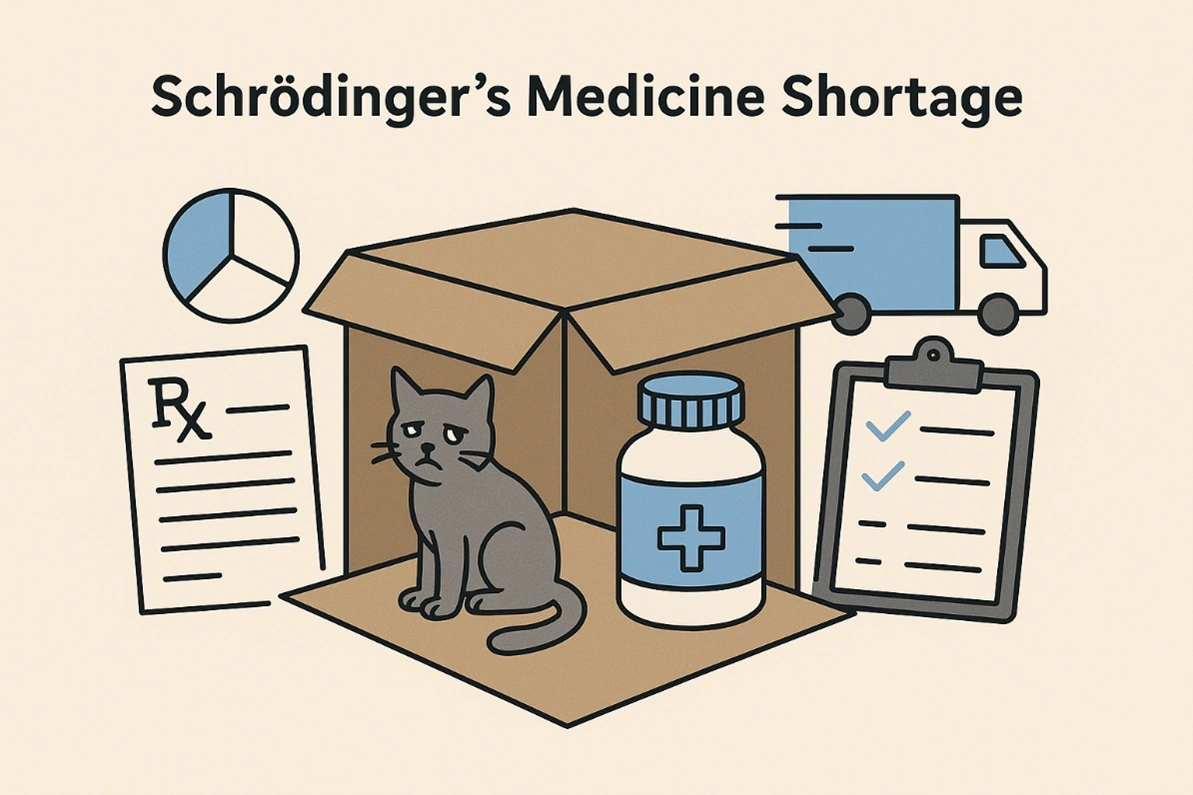
And MedSupply Intelligence allows you to open the box earlier!