**The insights for Amiodarone has been updated in a new blog here. **
Official medicine supply notifications serve a critical purpose: they confirm a crisis. But for procurement leaders, chief pharmacists, and even finance directors, confirmation often arrives too late. By the time a Medicine Supply Notification (MSN) is issued, the market has already shifted, prices may have surged, and the window for strategic action has closed. The scramble to secure stock becomes a reactive, costly exercise in damage control.
This is the difference between compliance and strategy. Compliance waits for the official notice. Strategy acts on the early signals. A recent case with Amiodarone, a crucial antiarrhythmic drug, provides a powerful illustration. While the official UK notice landed in October 2025, the real story began seven months earlier. Global market signals from Denmark to Australia were already painting a clear picture of impending supply pressure and a significant price hike.
For hospital trusts and healthcare systems, the choice is becoming stark: continue reacting to notices and absorbing budget-breaking price increases, or embrace a proactive approach that leverages early intelligence to protect patient care and financial stability. This is not about having a crystal ball; it is about knowing where to look and having the tools to translate faint signals into decisive, preventative action.
A Seven-Month Timeline: Tracking the Amiodarone Shortage
Waiting for an official notice is like watching a storm from your window until the glass breaks. By then, it’s too late to board it up. The Amiodarone supply issue unfolded not as a sudden event in October, but as a slow-burning fire that was visible for months to anyone monitoring the right global data points. This seven-month timeline shows how early signals offered a significant head start.
March: The First Whispers
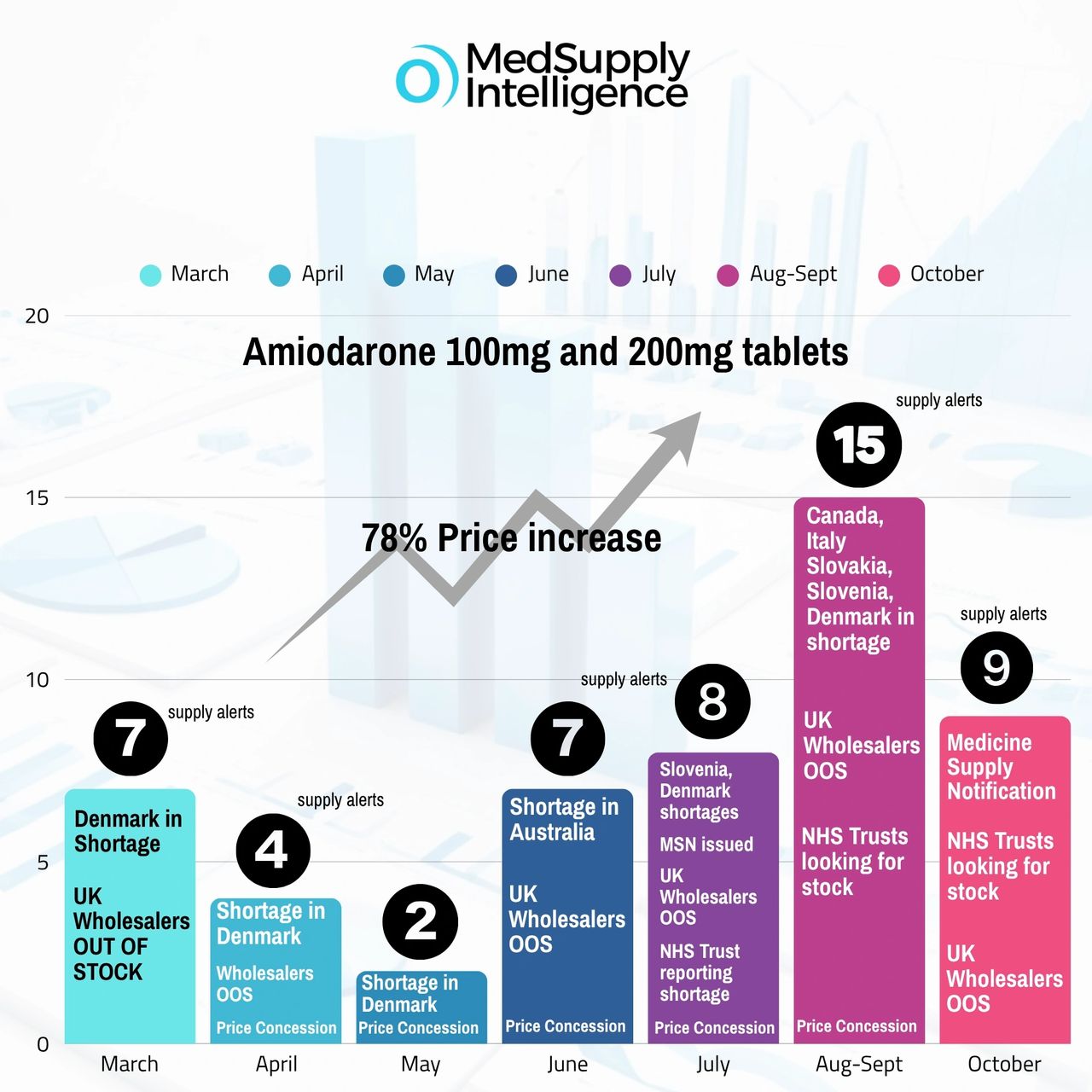
The first signs of trouble emerged not in the UK, but in Denmark. Danish alerts flagged initial supply constraints, a subtle but important indicator of potential continental disruption. Simultaneously, data from UK wholesalers began showing a rise in ‘out of stock’ (OOS) occurrences for Amiodarone. For a single hospital, a sporadic OOS might be a localised issue. But when aggregated, this trend was the first domestic clue that demand was beginning to outstrip routine supply.
April: The Financial Pressure Builds
Just one month later, the UK’s Department of Health and Social Care (DHSC) granted price concessions for Amiodarone. Price concessions are a direct admission that pharmacies cannot obtain a drug at the standard tariff price. This is a clear financial signal that the supply chain is under stress. While not a formal shortage declaration, it is an undeniable leading indicator of scarcity and a precursor to sharper price volatility.
June–September: The Global Chorus Grows Louder
Throughout the summer, the signals intensified and went global. Formal shortage notifications were issued in Australia, Slovenia, and Italy. A problem that began as a whisper in Denmark was now a clear warning being broadcast across multiple international markets. Each notification from another country’s health system served as another piece of evidence, confirming that the Amiodarone supply chain was facing systemic, not isolated, challenges. The risk to UK supply was no longer a possibility; it was an inevitability.
October: The Inevitable Confirmation
On 20th October 2025, the official UK Medicine Supply Notification for Amiodarone was issued. To those who had not been tracking the preceding signals, this was breaking news. For those with access to global intelligence, it was merely the predictable conclusion of a story that had been unfolding for over half a year. The seven-month window of opportunity had closed.
The 78% Consequence: The Budgetary Impact of Reaction
The primary consequence of waiting for the official notice was financial. Between the first signals in March and the MSN in October, the market price for Amiodarone had surged by a staggering 78%.
This price hike was not random. It was the direct result of predictable market dynamics: as supply tightened and demand remained constant, suppliers and wholesalers adjusted their pricing to reflect the scarcity. Those who were forced to enter the market after the MSN was issued had no choice but to pay this premium. They were negotiating from a position of weakness, with their leverage eroded by urgency.
For a hospital’s finance director or chief pharmacist, a 78% price increase on a vital medication is not just a line item. It represents a significant, unbudgeted expenditure that pulls funds away from other critical areas, from other medicines, from clinical services, from staffing. It forces difficult choices and compromises patient care. This is the tangible cost of a reactive procurement strategy.
From Signal to Solution: A Proactive Workflow
A proactive procurement model transforms this dynamic. Instead of being driven by notices, it is guided by data. This workflow can be broken down into three key stages: Detect, Validate, and Act.
1. Detect: Seeing the Smoke Before the Fire
The foundation of this approach is the ability to detect faint signals from a wide range of sources. This goes far beyond monitoring national bulletins. It involves systematically tracking:
-
International Alerts: Shortage notifications and regulatory updates from other countries.
-
Wholesaler Data: Aggregated ‘out of stock’ trends across major suppliers.
-
Price Concessions: Official acknowledgements that standard pricing is no longer viable.
-
Market Chatter: Enquiries from other community retail and NHS trusts indicating supply-seeking behaviour.
In the Amiodarone case, a detection system would have flagged the Danish alerts and UK wholesaler OOS data in March as the primary signal.
2. Validate: Connecting the Dots
A single signal can be noise. Multiple, correlated signals form a pattern. The validation stage involves cross-referencing information to confirm the risk. When the DHSC price concessions appeared in April, they validated the initial supply concerns from March. When Australia, Slovenia, and Italy issued their own shortage notices over the summer, they provided overwhelming validation that the Amiodarone problem was widespread and escalating. This process turns scattered data points into a coherent, credible intelligence picture.
3. Act: Executing with a Head Start
With a validated threat, procurement teams can move to action long before the crisis hits its peak. This is where the seven-month head start becomes a powerful strategic advantage. Actions include:
-
Proactive Sourcing: Identifying and vetting alternative suppliers, including those in international markets not yet affected.
-
Strategic Demand Planning: Methodically reviewing stock based on validated risk, avoiding the panic-buying that inflates prices.
-
Contract Renegotiation: Engaging with incumbent suppliers to lock in pricing and secure supply commitments before the broader market scramble begins.
-
Clinical Collaboration: Working with chief pharmacists and clinical leads to identify appropriate therapeutic alternatives and prepare usage protocols if a shortage becomes unavoidable.
This structured approach moves procurement from a reactive purchasing function to a strategic risk management hub.
Mini Case Vignette: How a Trust Could Have Mitigated the Amiodarone Risk
Imagine a hospital trust equipped with an early-signal intelligence platform. In March, its procurement team is alerted to the Danish supply issues and rising UK wholesaler OOS rates for Amiodarone. They move to the validation stage.
By April, the DHSC price concession confirms their suspicions. The team presents this data to their clinical and finance leads. They decide to act. Their pharmacist begins a review of therapeutic alternatives, while the procurement manager uses the seven-month lead time to their advantage. They contact their secondary suppliers and secure a three-month supply at a price just 5% above the tariff, locking it in before the major market panic.
When the MSN lands in October and prices spike by 78%, this trust is insulated. They have secured their supply, protected their budget from extreme volatility, and ensured continuity of care for their patients. Their neighbours, who waited for the notice, are now competing in a frantic, high-cost market.
Closing the Gaps: Why Shared Visibility is Key
The Amiodarone case also highlights a persistent weakness in healthcare supply chains: collaboration gaps. Often, individual hospital trusts, wholesalers, and national bodies operate in silos. A single trust seeing an OOS from one wholesaler has no way of knowing if it’s an isolated incident or part of a national trend. This lack of shared visibility is what allows a problem to escalate undetected.
Early-signal intelligence platforms help close these gaps by aggregating data from across the ecosystem. When multiple trusts are seeing the same issue, the platform makes that collective experience visible. This shared visibility is an accelerator. It builds confidence in the data, shortens the validation process, and enables a more coordinated response across regions or integrated care systems. When teams can see they are not alone, they can move from “we saw it” to “we solved it” with greater speed and conviction.
Move from Reaction to Prevention
The landscape of medicine supply is changing. Globalised supply chains are more interconnected and vulnerable than ever before. Relying on official notices as your primary trigger for action is no longer a viable strategy; it is a recipe for budget overruns and supply insecurity.
The Amiodarone timeline is not an isolated event. It is a blueprint for the future of drug shortages. The data to get ahead of these crises is available. Early signals from across markets provide the foresight needed to turn reactive procurement into a strategic advantage, protecting your budget, your health system, and your patients from the next inevitable supply shock. It is time to stop waiting for confirmation of a crisis and start acting to prevent one.
See the signals others miss. If you are ready to move from reacting to notices to acting on intelligence, request access to our early-alert platform today.